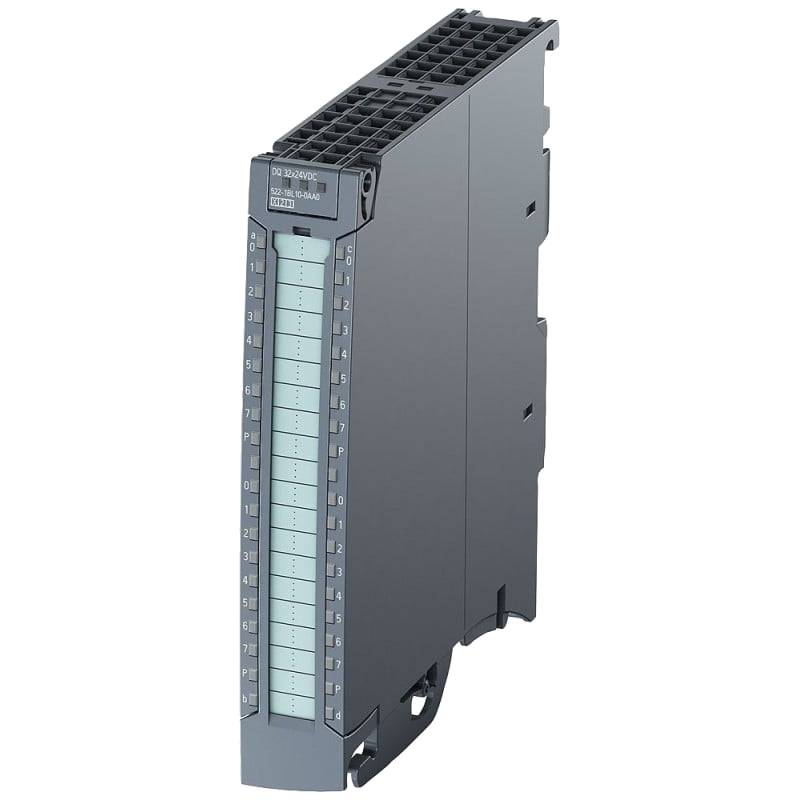
Siemens 6ES7522-1BL10-0AA0 32-point High-performance High-density Output Module


The Siemens 6ES7522-1BL10-0AA0 is a high-performance, high-density digital output module designed for demanding industrial automation applications. This module, part of the SIMATIC S7-1500 family, offers 32 digital outputs, each capable of handling 24V DC at 0.5A. Its key advantages lie in its compact design, robust construction, and seamless integration with Siemens' TIA Portal engineering platform. The 6ES7522-1BL10-0AA0 boasts a high output density, allowing for more control points in a smaller footprint, which is crucial for space-constrained control cabinets. It provides electrical isolation in groups of eight, enhancing system reliability and safety. This module is engineered for straightforward integration, supporting prior versions of STEP 7 and offering compatibility with other SIMATIC components.
Product Specifications
| Feature | Specification |
| :----------------------- | :-------------------------------------------------------------------------- |
| Article Number | 6ES7522-1BL10-0AA0 |
| Product Type Designation | DQ 32x24VDC/0.5A BA |
| Digital Outputs | 32 |
| Output Voltage | 24V DC |
| Output Current | 0.5A per channel |
| Isolation | Electrically isolated in groups of 8 |
| Supply Voltage | 24V DC (Permitted range: 19.2V to 28.8V DC) |
| Reverse Polarity Protection | Yes (internal protection with 7A per group) |
| Output Type | Transistor |
| Short-Circuit Protection | Yes (typ. 1A response threshold) |
| Engineering Software | STEP 7 TIA Portal V13 or later; STEP 7 V5.5 SP3 or later |
| Hardware Version | E01 |
| Firmware Version | V1.0.0 |
| Dimensions (L x W x H) | 20.40 cm x 15.40 cm x 4.00 cm (packaging) |
| Net Weight | 0.360 Kg |
| Country of Origin | Germany |
Core Features & Market Positioning
The Siemens 6ES7522-1BL10-0AA0 stands out in the industrial automation market due to its high channel density and robust performance within the SIMATIC S7-1500 ecosystem. Its primary differentiator is the ability to pack 32 digital outputs into a compact form factor, reducing panel space and associated costs. This high-density design is particularly valuable in applications where space is at a premium. The module's transistor output type offers efficient switching for loads like solenoid valves, DC contactors, and indicator lights. Furthermore, its support for I&M (Information and Monitoring) data (I&M0 to I&M3) allows for enhanced diagnostics and asset management, aligning with the industry's move towards Industry 4.0 and IIoT integration. The module's compatibility with TIA Portal ensures a streamlined engineering experience, allowing for efficient configuration, programming, and diagnostics alongside other Siemens automation components. Its position in the market is that of a reliable, high-capacity output solution for general-purpose automation tasks requiring precise digital control.
Key Application Scenarios
The Siemens 6ES7522-1BL10-0AA0 is ideally suited for a wide array of industrial applications where reliable digital output control is paramount. Common scenarios include:
Machine Building: Controlling actuators, solenoids, indicator lights, and small motor contactors on production machinery. Process Automation: Managing valves, pumps, and signaling devices in manufacturing plants, water treatment facilities, and chemical processing. Material Handling: Operating conveyor belts, sorting mechanisms, and automated guided vehicles (AGVs). Building Automation: Controlling HVAC systems, lighting, and access control systems in large facilities. Packaging Lines: Automating the control of pneumatic actuators, diverters, and warning signals on high-speed packaging equipment.
The module's 32 outputs provide a high level of control density, making it an efficient choice for complex machines or systems requiring numerous discrete output actions.
Practical System Integration Guidance
Integrating the Siemens 6ES7522-1BL10-0AA0 into a SIMATIC S7-1500 system is facilitated by Siemens' TIA Portal software. When configuring the module within TIA Portal, users assign I/O addresses that are mapped to the module's 32 digital outputs. These outputs are organized into groups of eight, with each group sharing a common positive supply (L+) and providing electrical isolation between groups.
For wiring, the module typically connects to the backplane bus of the S7-1500 CPU or an ET 200MP distributed I/O system. The module requires a 24V DC supply within a permitted range of 19.2V to 28.8V. Each output channel (CHx) is designed to source current up to 0.5A. While the module offers short-circuit protection, it's essential to adhere to the specified current limits to prevent damage and ensure operational reliability. Detailed wiring diagrams and terminal assignments are available in the module's technical documentation, which guides the connection of external loads such as solenoid valves or indicator lights to the output terminals. The push-in front connector simplifies field wiring.
Operation and Risk Mitigation
Operating the Siemens 6ES7522-1BL10-0AA0 requires adherence to safety guidelines to prevent potential hazards. Siemens emphasizes that its products should only be operated by qualified personnel who understand the risks involved. The module features built-in short-circuit protection for its digital outputs, typically tripping at around 1A. It also includes reverse polarity protection for the supply voltage, safeguarding against incorrect connections.
Warning notices in the product documentation are graded according to the severity of potential danger (DANGER, WARNING, CAUTION, NOTICE). It is crucial to observe these notices, especially concerning personal safety and preventing property damage. For instance, ensuring proper grounding and adhering to ambient condition limits (e.g., temperature, humidity) are vital for safe and reliable operation. The module is designed for use within specified voltage and current ranges to avoid overloads and potential failures. While the module itself does not typically have extensive troubleshooting codes, system-level diagnostics within TIA Portal can help identify issues related to output states or communication errors.
Scalability & Long-Term Value
The Siemens 6ES7522-1BL10-0AA0 offers significant long-term value through its integration within the scalable SIMATIC S7-1500 platform. This platform allows for easy expansion of I/O capabilities by adding more modules to the same rack or distributing I/O across a network. The module's hardware compatibility with other SIMATIC output modules, such as the DQ 16x24VDC/0.5A BA (6ES7522-1BH10-0AA0), provides flexibility in system design.
Moreover, the module's support for I&M data positions it well for future integration with IIoT platforms and digital twin concepts. This data can be leveraged for predictive maintenance, performance monitoring, and optimized asset management. By utilizing TIA Portal, users benefit from a consistent engineering environment that supports upgrades and modifications to their automation systems over time. The availability of firmware updates also ensures that the module can benefit from ongoing improvements and feature enhancements from Siemens, preserving its relevance and value in evolving industrial landscapes.
Frequently Asked Questions (FAQs)
Q1: What is the primary function of the Siemens 6ES7522-1BL10-0AA0 module?
The Siemens 6ES7522-1BL10-0AA0 is a digital output module. It acts as an interface between the PLC's control signals and external devices. It switches electrical loads ON or OFF based on commands from the CPU.
It provides 32 individual digital outputs, allowing for simultaneous control of numerous actuators or indicators. Each output channel is rated for 24V DC at 0.5A, making it suitable for a variety of industrial loads. This high density of outputs is a key feature for space-constrained applications.
In essence, it translates digital commands from the automation system into physical actions in the plant or machine, enabling precise control over processes and equipment.
Q2: What are the key technical specifications of the 6ES7522-1BL10-0AA0?
This module offers 32 digital outputs, each operating at 24V DC with a maximum current of 0.5A per channel. It provides electrical isolation for these outputs in groups of eight. The module requires a 24V DC supply voltage, with a permissible range from 19.2V to 28.8V DC.
It features transistor outputs, which are efficient for switching DC loads. The module includes short-circuit protection for the outputs and reverse polarity protection for the supply voltage. It is engineered for use with Siemens' TIA Portal (V13 and later) or STEP 7 (V5.5 SP3 and later) for configuration and programming.
The module is part of the SIMATIC S7-1500 family and is designed for high-density applications, fitting standard DIN rails. Its compact dimensions and robust design ensure reliable operation in industrial environments.
Q3: What types of loads can be controlled by the 6ES7522-1BL10-0AA0?
The 6ES7522-1BL10-0AA0 is suitable for controlling various DC loads up to 0.5A per channel. This includes solenoid valves, which are commonly used for pneumatic and hydraulic control.
It can also drive DC contactors, used for switching higher power DC circuits, and indicator lights for signaling status or alarms. The transistor output type ensures efficient switching for these types of inductive and resistive loads.
While designed for 0.5A, it's crucial to consider derating factors for ambient temperature and inductive loads. Always consult the technical documentation for precise load handling capabilities and any specific wiring recommendations.
Q4: How is the 6ES7522-1BL10-0AA0 wired into a system?
Wiring involves connecting the module to the backplane bus of a SIMATIC S7-1500 CPU or an ET 200MP distributed I/O system. The module requires a 24V DC power supply connected to its input terminals.
External loads, such as solenoids or indicators, are wired to the individual output terminals (CH1 to CH32) on the front connector. The outputs are sourced from the 24V DC supply connected to the module. Each group of eight outputs is electrically isolated.
Detailed wiring diagrams and terminal assignments are provided in the module's manual. Using the push-in front connector simplifies the field wiring process, ensuring secure connections.
Q5: What programming software is required to configure the 6ES7522-1BL10-0AA0?
Configuration and programming of the 6ES7522-1BL10-0AA0 are performed using Siemens' TIA Portal software. Specifically, TIA Portal versions V13 or later are recommended for full compatibility and access to all features.
Alternatively, older versions of Siemens' STEP 7 software can also be used. STEP 7 versions V5.5 SP3 or later support the configuration of this module. The choice of software depends on the overall automation system and existing engineering tools.
Utilizing TIA Portal provides a unified environment for hardware configuration, programming, diagnostics, and HMI integration, streamlining the development process for SIMATIC S7-1500 systems.
Q6: Does the 6ES7522-1BL10-0AA0 support safety functions?
The standard 6ES7522-1BL10-0AA0 is a non-fail-safe digital output module. It is designed for general-purpose control tasks and does not inherently support safety-oriented shutdown functions to SIL or PL standards.
For applications requiring safety functions, Siemens offers specific fail-safe I/O modules within the SIMATIC range. These modules are specifically designed and certified to meet stringent safety integrity levels (SIL) and performance levels (PL) as defined by relevant international standards.
If your application requires safety-rated outputs, you must select a dedicated fail-safe digital output module (e.g., from the ET 200SP or ET 200MP families) that meets your specific safety requirements.
Q7: What are the advantages of the high-density design of this module?
The high-density design means more output channels are packed into a single module. This significantly reduces the physical space required in control cabinets.
This reduction in space translates directly to cost savings. Smaller cabinets are less expensive to manufacture and occupy less valuable floor space in a plant. It also simplifies wiring by consolidating many connections into a smaller area.
Moreover, high-density modules contribute to a more organized and efficient panel layout, making maintenance and future modifications easier to manage.
Q8: Can this module be used with older Siemens S7-300 systems?
The 6ES7522-1BL10-0AA0 is part of the SIMATIC S7-1500 family and is designed for integration with S7-1500 CPUs and the ET 200MP distributed I/O system. While STEP 7 V5.5 SP3 can be used for configuration, direct integration into an S7-300 system is not typically supported.
The backplane interfaces and communication protocols differ between the S7-1500/ET 200MP platform and the older S7-300 platform. For S7-300 systems, you would typically use the appropriate output modules designed for that specific PLC generation.
For projects requiring S7-1500 capabilities, it's best to use it with compatible S7-1500 CPUs or ET 200MP I/O systems to ensure seamless operation and full feature utilization.
Q9: What is the meaning of "BA" in the product designation 6ES7522-1BL10-0AA0?
The designation "BA" in Siemens product names often indicates a specific variant or feature set. For digital output modules like the 6ES7522-1BL10-0AA0, "BA" typically signifies a "Basic" module.
Basic modules in the SIMATIC S7-1500 and ET 200MP families are generally characterized by their compact design and straightforward functionality. They offer essential digital input/output capabilities without advanced parameterization or diagnostic features found in "ST" (Standard) or "HF" (High Feature) modules.
This makes "BA" modules ideal for applications where simple, reliable switching is needed and extensive configuration or diagnostics are not required, contributing to easier integration and lower cost.
Q10: How does the 6ES7522-1BL10-0AA0 handle overloads or short circuits?
The Siemens 6ES7522-1BL10-0AA0 is equipped with built-in short-circuit protection for its digital outputs. This protection typically operates by limiting the current or shutting down the affected output channel if a short circuit is detected.
The documentation indicates a typical response threshold for short-circuit protection around 1A. This feature helps prevent damage to the module and connected loads in case of wiring errors or component failures.
While this protection is present, it is always best practice to design systems to avoid overloads and short circuits through proper wiring, component selection, and adherence to current ratings. The module's outputs are rated for 0.5A continuous current, and exceeding this continuously can lead to overheating and premature failure, even with protection mechanisms in place.