











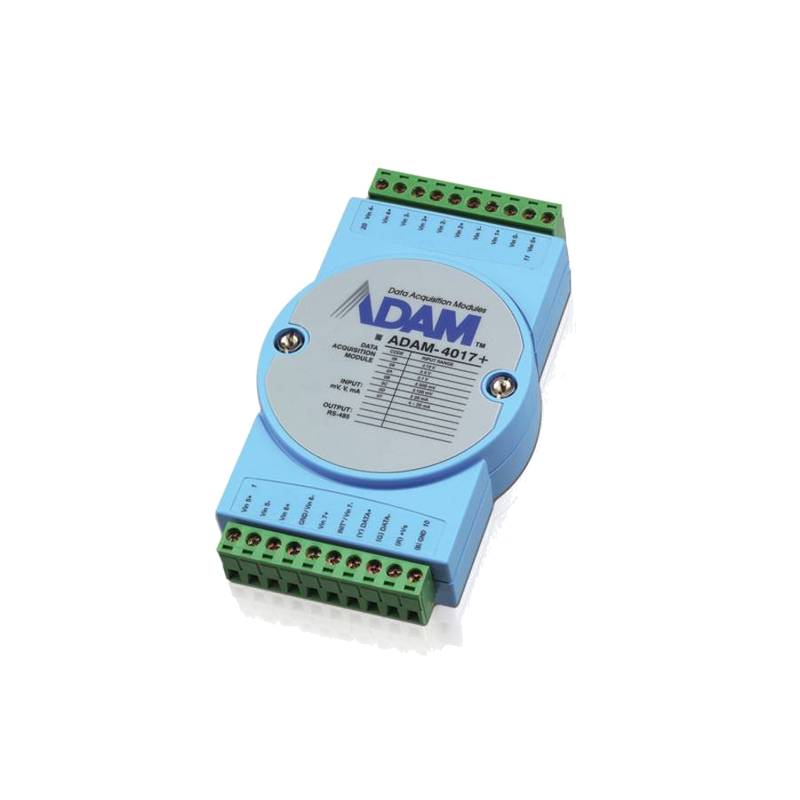
Advantech ADAM-4571-CE Serial Device Networking Server Module


The Advantech ADAM-4571-CE Serial Device Networking Server Module empowers industrial automation by seamlessly bridging serial devices to Ethernet networks. This module offers robust connectivity, enabling remote monitoring and control of legacy equipment. Its compact design and versatile interface support critical industrial applications, delivering reliable performance in demanding environments.
Product Specifications
| Feature | Specification |
| :----------------- | :------------------------------------------------- |
| Serial Port | 1 x RS-232/422/485 (DB9 male connector) |
| Ethernet Port | 1 x 10/100 Mbps Ethernet (RJ45 connector) |
| Protocol Support | TCP/IP, UDP, HTTP, DHCP, ARP, ICMP, BOOTP, Telnet |
| Baud Rate | Up to 115.2 kbps |
| Data Bits | 5, 6, 7, 8 |
| Parity | None, Even, Odd |
| Stop Bits | 1, 2 |
| Flow Control | RTS/CTS, XON/XOFF |
| Power Input | 9-30 VDC |
| Power Consumption | 1.5 W |
| Operating Temp. | -20°C to 70°C |
| Dimensions | 100 mm x 60 mm x 23 mm |
| Mounting | DIN-rail, Wall-mount |
Core Features & Market Positioning
The ADAM-4571-CE distinguishes itself with its inherent flexibility, supporting RS-232, RS-422, and RS-485 communication on a single port, thereby accommodating a wide array of serial devices. Its robust protocol support, including TCP/IP and UDP, ensures seamless integration into existing industrial networks. The module's ability to operate reliably within an extended temperature range of -20°C to 70°C positions it as a dependable solution for harsh industrial settings. Advantech's reputation for industrial-grade hardware further solidifies its market standing as a trusted provider of reliable networking solutions for automation.
Key Application Scenarios
This serial device server is critical for modernizing industrial operations. It facilitates the integration of Programmable Logic Controllers (PLCs) and Human Machine Interfaces (HMIs) into networked systems, enabling centralized data acquisition and control. In manufacturing environments, the ADAM-4571-CE allows for the remote monitoring of sensor data and actuator status from production lines, improving operational efficiency. Furthermore, it is instrumental in building management systems for controlling HVAC equipment and lighting systems remotely via an Ethernet connection. Its application extends to traffic control systems, where it can connect and manage traffic signal controllers and sensors over a network.
Practical System Integration Guidance
Integrating the Advantech ADAM-4571-CE into an industrial network is straightforward. The module supports multiple operating modes, including TCP Server, TCP Client, and UDP, allowing for flexible network configurations. Configuration is typically achieved through a web-based interface or utility software provided by Advantech, enabling users to set IP addresses, serial port parameters, and operating modes without complex programming. For wiring, the DB9 connector facilitates easy connection to standard serial devices, while the RJ45 port connects directly to an Ethernet switch or router. Power is supplied via a 9-30 VDC input, often sourced from existing industrial power supplies.
Operation and Risk Mitigation
Proper operation of the ADAM-4571-CE ensures continuous industrial process control. Users should verify correct serial port configuration (baud rate, data bits, parity, stop bits) to match the connected device. Network settings, including IP address and subnet mask, must align with the plant's network infrastructure to avoid communication conflicts. Potential risks include incorrect wiring, leading to data errors or device damage; exceeding power input specifications, which could cause module failure; and network misconfigurations, resulting in lost connectivity. Regular firmware updates from Advantech can mitigate security vulnerabilities and improve performance. In case of communication failure, checking physical connections, device settings, and network status is paramount.
Scalability & Long-Term Value
The ADAM-4571-CE offers significant long-term value by extending the lifespan of existing serial-based industrial equipment. Its compatibility with standard industrial Ethernet protocols ensures it can be integrated into evolving IIoT and Industry 4.0 architectures. The module's ability to support multiple connections allows for scaling up the number of devices integrated into the network as needs grow. Furthermore, Advantech's commitment to industrial automation provides ongoing support and potential for future product generations that maintain backward compatibility, ensuring a sustainable investment for businesses modernizing their operational technology (OT) infrastructure.
Frequently Asked Questions (FAQs)
Q1: How do I configure the Advantech ADAM-4571-CE for my specific serial device?
The ADAM-4571-CE can be configured using Advantech's Device Manager utility software. This tool allows for easy setup of network parameters such as IP address, subnet mask, and gateway. It also provides access to serial port settings, including baud rate, data bits, parity, and stop bits, which must precisely match the connected device's configuration for successful communication.
You can also use the module's built-in web server for configuration. Access the module's IP address via a web browser to access the intuitive interface. This method is convenient for remote configuration and requires no additional software installation on your PC.
Ensure all serial communication parameters are accurately documented from your serial device's manual and input them carefully during the configuration process to avoid potential data transmission errors.
Q2: What are the primary advantages of using the ADAM-4571-CE over traditional serial-to-USB converters?
The ADAM-4571-CE offers true network connectivity, unlike serial-to-USB converters. This allows devices to be accessed from anywhere on the network, enabling remote monitoring and control capabilities. Its industrial-grade design ensures reliability in harsh environments where standard USB converters might fail.
It supports robust industrial protocols like TCP/IP and UDP, facilitating seamless integration into SCADA systems and Industrial Internet of Things (IIoT) platforms. This network-centric approach eliminates the need for direct PC connections for each serial device.
The module provides multi-device access and can often handle multiple serial connections simultaneously depending on the model and configuration, offering greater flexibility and scalability compared to single-device USB converters.
Q3: Can the ADAM-4571-CE be used for both RS-232 and RS-485 communication simultaneously?
No, the ADAM-4571-CE features a single serial port that can be configured for either RS-232, RS-422, or RS-485 communication. The specific protocol is determined by the wiring at the DB9 connector and the software configuration. You must select the appropriate mode based on your connected device's requirements.
If you need to interface with multiple devices using different serial standards (e.g., one RS-232 and one RS-485), you would require separate ADAM-4571-CE modules for each type of serial interface. Advantech offers other models that might support multiple serial ports if this is a requirement.
Always consult the module's user manual to understand the physical pinout for each serial standard and the corresponding configuration steps needed to enable the desired communication mode.
Q4: What is the typical power consumption of the ADAM-4571-CE, and what power supply is recommended?
The ADAM-4571-CE has a low power consumption, typically around 1.5W. This makes it suitable for use in power-sensitive industrial applications or when powered by batteries. The module supports a wide input voltage range of 9 to 30 VDC.
For industrial environments, it is recommended to use a regulated DC power supply that can provide a stable voltage within the specified range. Ensure the power supply has sufficient current capacity to handle the module and any other connected devices if sharing a power source.
Over-voltage or under-voltage conditions can lead to unstable operation or damage to the module. Always use a power supply that meets the module's electrical specifications and has appropriate safety certifications for industrial use.
Q5: How does the ADAM-4571-CE facilitate remote access to serial devices?
The ADAM-4571-CE converts serial data into Ethernet packets, allowing serial devices to be accessed over a standard IP network. This means you can connect to your serial device from any computer on the same network or even remotely over the internet (with proper network security configurations).
It acts as a gateway, making devices that were previously limited to local serial connections accessible through common network protocols like TCP/IP. This enables centralized monitoring, diagnostics, and control without needing to be physically present at the equipment's location.
This capability is crucial for industries with geographically dispersed assets, reducing maintenance costs and improving response times to operational issues.
Q6: What are the supported Ethernet protocols for the Advantech ADAM-4571-CE?
The ADAM-4571-CE supports a comprehensive suite of essential Ethernet and internet protocols. This includes TCP/IP for reliable, connection-oriented communication and UDP for faster, connectionless data transfer. It also supports HTTP for web-based configuration and management.
Other critical protocols include DHCP for automatic IP address assignment, ARP for mapping IP addresses to MAC addresses, and ICMP for network diagnostics and error reporting. BOOTP is also supported for network booting scenarios.
The inclusion of Telnet allows for command-line access and management, which can be beneficial for advanced troubleshooting and configuration tasks in certain industrial environments.
Q7: Can the ADAM-4571-CE integrate with Modbus TCP/IP or other industrial automation protocols?
While the ADAM-4571-CE itself operates at a lower network layer, converting serial data to IP packets, it serves as a vital link for protocols like Modbus TCP/IP. Many industrial devices use Modbus RTU or ASCII over serial. The ADAM-4571-CE allows these serial Modbus communications to be encapsulated within TCP/IP or UDP packets.
This means that a SCADA system or PLC configured to communicate using Modbus TCP/IP can interact with serial Modbus devices through the ADAM-4571-CE. The module effectively bridges the gap between legacy serial-based protocols and modern Ethernet-based industrial networks.
For full Modbus TCP/IP functionality, the higher-level application logic running on your master device (e.g., PC, PLC) needs to support Modbus TCP/IP. The ADAM-4571-CE simply facilitates the underlying network transport.
Q8: What is the typical physical installation method for the ADAM-4571-CE in an industrial cabinet?
The ADAM-4571-CE is designed for flexible industrial mounting. It commonly features a DIN-rail mounting mechanism, allowing it to be easily clipped onto standard 35mm or 32mm top-hat DIN rails found in most industrial control cabinets. This is the most common and secure method for reliable installation.
Alternatively, the module often includes provisions for direct wall mounting using screws. This option is useful in scenarios where a DIN rail is not available or when a more permanent, fixed installation is desired on a flat surface within the cabinet or enclosure.
Regardless of the mounting method, ensure the module is installed in an area with adequate ventilation to prevent overheating, especially if installed in a crowded cabinet. Secure connections for both power and data are crucial for long-term operational stability.
Q9: What are common troubleshooting steps if the ADAM-4571-CE is not communicating?
First, verify all physical connections: ensure the serial cable is securely connected to the correct pins on both the ADAM-4571-CE and the serial device, and that the Ethernet cable is properly plugged in. Check the status LEDs on the module for activity.
Next, confirm the configuration settings. Double-check the IP address, subnet mask, and gateway on both the module and your network. Critically, ensure the serial port parameters (baud rate, data bits, parity, stop bits, flow control) on the module exactly match those of the connected serial device.
Finally, test network connectivity using tools like `ping` to confirm the module is reachable on the network. If using TCP Server mode, ensure no firewall is blocking the configured port. If using TCP Client mode, verify the server IP and port are correct.
Q10: Does the ADAM-4571-CE support firmware updates, and how can they be applied?
Yes, the Advantech ADAM-4571-CE typically supports firmware updates to enhance functionality, improve performance, or patch security vulnerabilities. Advantech provides firmware files and update utilities on their official support website. Users should download the latest firmware specific to their module model.
The firmware update process usually involves connecting to the module via its Ethernet interface and using a dedicated utility software provided by Advantech, or sometimes through its web interface. This utility will guide the user through selecting the firmware file and initiating the update process.
It is critical to ensure a stable power supply and an uninterrupted network connection throughout the firmware update. Interrupting the process can render the module inoperable, requiring a factory reset or more advanced recovery procedures. Always follow Advantech's official documentation for the update procedure.