











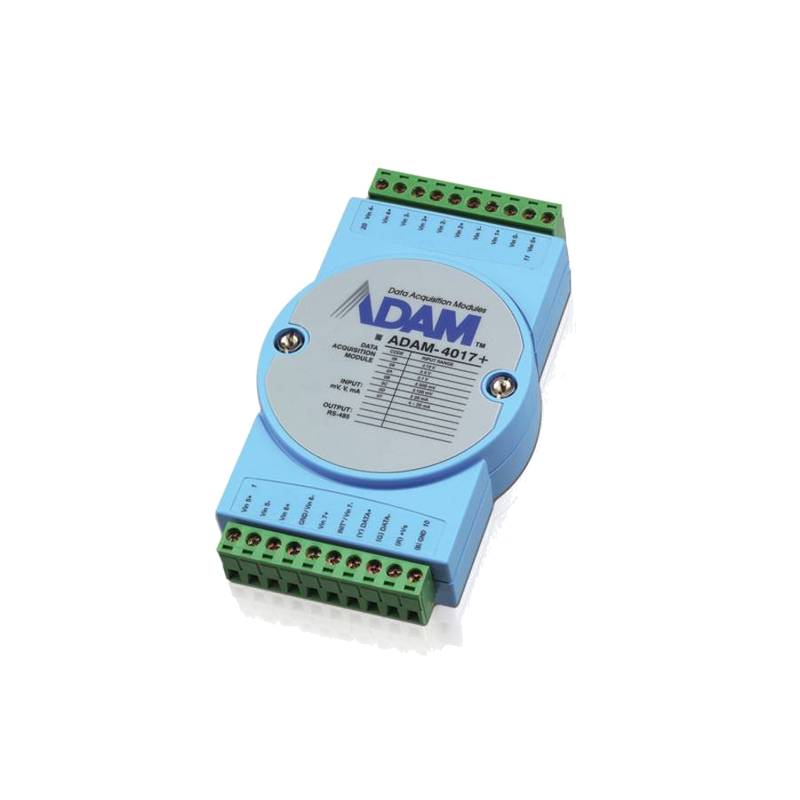
Advantech ADAM-4019+-F High Precision Temperature Measurement Module


The Advantech ADAM-4019+-F stands as a robust solution for high-precision temperature measurement within demanding industrial environments. This module distinguishes itself with its exceptional accuracy, wide operating temperature range, and flexible input signal conditioning, making it a preferred choice for critical process monitoring and control applications. Its core strengths lie in its multi-channel capability, robust industrial design, and seamless integration with automation systems. Key technical specifications include 16 isolated analog input channels, support for various thermocouple types (J, K, T, E, R, S, B, N) and RTD inputs (Pt100, Pt1000), a wide operating temperature range of -40 to +85 °C, and an input accuracy of ±0.1% of span. The module boasts a high sampling rate and advanced noise immunity, ensuring reliable data acquisition even in electrically noisy industrial settings.
Advantech ADAM-4019+-F: Core Features & Market Positioning
The Advantech ADAM-4019+-F carves out its market position through a combination of superior performance and practical industrial design. Its multi-range analog input capability, supporting both thermocouples and RTDs, offers unparalleled flexibility, reducing the need for specialized modules for different sensor types. The module's high accuracy, typically ±0.1% of span, is critical for applications where precise temperature control directly impacts product quality or process efficiency. Furthermore, its isolated design protects against ground loops and voltage transients, enhancing system reliability and safeguarding connected equipment. This robust feature set positions the ADAM-4019+-F as a premium, yet cost-effective, solution for industries requiring dependable, high-fidelity temperature data acquisition.
Key Application Scenarios for the ADAM-4019+-F
The versatility of the Advantech ADAM-4019+-F lends itself to a broad spectrum of critical industrial applications. In the chemical processing industry, it ensures precise temperature control in reactors and distillation columns, crucial for maintaining reaction kinetics and product purity. Within the pharmaceutical sector, its high accuracy is vital for monitoring sterilization processes and maintaining stringent temperature conditions for sensitive drug manufacturing. The food and beverage industry benefits from its reliability in monitoring pasteurization, cooling, and storage temperatures to guarantee product safety and quality. Additionally, its suitability for harsh environments makes it ideal for oil and gas exploration, power generation, and environmental monitoring, where extreme temperatures and corrosive conditions are commonplace.
Practical System Integration Guidance
Integrating the Advantech ADAM-4019+-F into existing automation systems is streamlined due to its standard communication interfaces and robust design. The module typically utilizes RS-485 communication with Modbus RTU protocol, allowing for easy integration with PLCs, SCADA systems, and industrial PCs. For wiring, each of the 16 input channels requires specific connections based on the sensor type: thermocouple inputs necessitate connecting the positive and negative leads, while RTD inputs require connection of the two or three wires from the sensor. Proper grounding of the module and the sensor shield is paramount to minimize electrical noise and ensure signal integrity. Software configuration involves setting the correct communication parameters (baud rate, parity, slave ID) and defining the input type and range for each channel within the host system's software or via Advantech's ADAM Utility software.
Operation and Risk Mitigation
Operating the Advantech ADAM-4019+-F involves ensuring it is installed within its specified environmental limits, particularly concerning temperature and humidity, to maintain performance and longevity. Electrical installation requires careful attention to power supply requirements and correct wiring to prevent damage. Potential risks include incorrect sensor type configuration, which can lead to inaccurate readings, and signal interference from inadequate shielding or grounding. Troubleshooting common issues often involves checking wiring connections, verifying communication settings, and confirming sensor integrity. While specific error codes are less common for this type of module, deviations from expected temperature readings usually point to sensor issues, environmental fluctuations, or configuration errors. Implementing routine checks and adhering to installation guidelines significantly mitigates operational risks.
Scalability & Long-Term Value
The Advantech ADAM-4019+-F offers significant scalability and long-term value within industrial automation infrastructures. Its modular design allows for easy expansion; additional ADAM-4019+-F units or other ADAM modules can be networked via RS-485 to expand monitoring capabilities as needs grow, without requiring a complete system overhaul. Compatibility with the Modbus RTU protocol ensures it integrates seamlessly with a vast array of existing PLCs, DCS, and SCADA systems from various manufacturers, protecting investments in current infrastructure. As industries move towards Industry 4.0 and the Industrial Internet of Things (IIoT), the ADAM-4019+-F serves as a foundational component for smart manufacturing, providing the reliable, high-precision data necessary for advanced analytics, predictive maintenance, and optimized process control.
*
Frequently Asked Questions (FAQs)
What types of temperature sensors does the ADAM-4019+-F support?
The module supports a wide array of thermocouple types, including J, K, T, E, R, S, B, and N, offering broad compatibility. It also accommodates various RTD sensors like Pt100 and Pt1000, providing flexibility for different measurement needs. This diverse sensor support simplifies system design and reduces hardware redundancy.
Can the ADAM-4019+-F be used in extreme environments?
Yes, the ADAM-4019+-F is designed for robust industrial applications with an operating temperature range of -40 to +85 °C. Its durable construction and isolation features help it withstand harsh conditions found in many industrial settings. This makes it suitable for deployment in demanding field applications.
How does the ADAM-4019+-F ensure data accuracy?
The module features high-precision analog-to-digital converters and advanced signal processing to achieve an accuracy of ±0.1% of span. Its channel isolation prevents ground loops and common-mode noise, critical for maintaining signal integrity. These features collectively ensure reliable and precise temperature readings.
What communication protocol does the ADAM-4019+-F use?
It primarily uses the RS-485 serial communication interface with the widely adopted Modbus RTU protocol. This standard protocol ensures easy integration with most industrial automation systems and controllers. Modbus RTU is known for its reliability in industrial networking.
Is the ADAM-4019+-F suitable for high-density temperature monitoring?
With 16 isolated analog input channels, the module is well-suited for applications requiring monitoring of numerous temperature points. This high channel density can reduce wiring complexity and the number of modules needed in a control panel. It offers an efficient solution for comprehensive temperature mapping.
What are the power requirements for the ADAM-4019+-F?
The module typically requires a DC power supply within a specified voltage range, commonly around 12-45 VDC. It's essential to consult the product manual for exact specifications to ensure proper and safe operation. Incorrect voltage can lead to module damage or malfunction.
How is the ADAM-4019+-F typically wired for an RTD sensor?
For a 2-wire RTD, connect the two sensor leads to the designated terminals for that channel. For a 3-wire RTD, connect two leads to the RTD input terminals and the third lead to the designated RTD lead compensation terminal. Proper wiring is crucial for accurate resistance measurement.
What advantages does the isolation feature offer?
The isolation protects the module and connected devices from voltage surges and ground loop interference, which are common in industrial environments. This enhances system reliability and prevents damage to sensitive equipment. Isolation is key for signal integrity in noisy electrical settings.
Can the ADAM-4019+-F be integrated with cloud platforms?
Yes, through an industrial gateway or an edge computer that supports Modbus RTU, data from the ADAM-4019+-F can be aggregated and transmitted to cloud-based IIoT platforms for analysis and remote monitoring. This enables advanced data analytics and remote asset management.
What is the typical lifespan or expected reliability of this module?
Advantech products are engineered for industrial longevity. While specific lifespans vary with operating conditions and maintenance, the robust design and industrial-grade components of the ADAM-4019+-F suggest a long operational life. Following recommended operating procedures maximizes its reliability.