











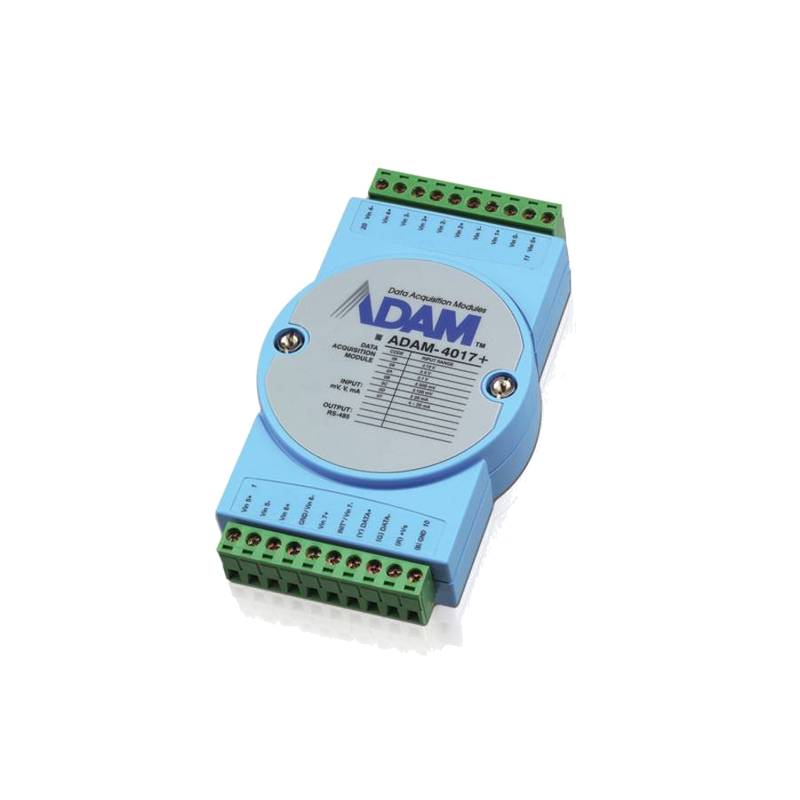
Advantech ADAM-4080-E 2-Channel Frequency Counter Module


The Advantech ADAM-4080-E 2-Channel Frequency Counter Module offers robust and precise measurement capabilities for demanding industrial environments. This module excels in applications requiring high-frequency counting and pulse measurement, boasting a maximum counting speed of 10 kHz and an input range of 0-10 kHz. Its two independent channels, coupled with a versatile voltage input range of 0-5 VDC, make it an ideal choice for monitoring rotational speeds, flow rates, and event occurrences. The ADAM-4080-E is designed for seamless integration into existing systems, featuring a standard RS-485 communication interface and supporting Modbus RTU protocol, ensuring broad compatibility. Its DIN-rail mountable form factor simplifies installation, and its wide operating temperature range of -20°C to 70°C underscores its suitability for harsh industrial conditions.
Advantech ADAM-4080-E: Product Specifications
| Feature | Specification |
| :---------------------- | :-------------------------------------------- |
| Input Channels | 2 |
| Maximum Counting Speed | 10 kHz |
| Input Signal Range | 0-10 kHz |
| Voltage Input Range | 0-5 VDC |
| Communication Interface | RS-485 |
| Protocol | Modbus RTU |
| Power Consumption | 1.2 W @ 24 VDC |
| Operating Temperature | -20°C to 70°C |
| Dimensions | 142 mm x 77 mm x 34 mm |
| Mounting | DIN-rail |
Core Features & Market Positioning
The Advantech ADAM-4080-E distinguishes itself through its dual-channel frequency counting capability, a feature that enhances efficiency by allowing simultaneous monitoring of two independent signal sources. This dual-channel architecture, combined with its precise 10 kHz counting speed and broad input voltage range, positions it as a competitive solution for applications where accurate pulse and frequency measurement is paramount. Unlike simpler single-channel devices, the ADAM-4080-E provides greater data acquisition density, reducing the need for multiple modules and associated wiring. Its robust construction and wide operating temperature tolerance further solidify its market standing for reliable performance in challenging industrial settings, distinguishing it from less resilient alternatives.
Key Application Scenarios
The versatility of the Advantech ADAM-4080-E 2-Channel Frequency Counter Module makes it indispensable across a spectrum of industrial applications. It is frequently deployed in machine monitoring to accurately track motor speeds, fan rotations, and operational cycles, providing critical data for performance analysis and predictive maintenance. In process control, the module excels at measuring flow rates from pulse-generating sensors in fluid dynamics systems, ensuring precise batching and material handling. Furthermore, its application extends to energy management, where it can monitor the frequency of power generation or consumption from various sources. For automation systems, it serves to count events, such as the passage of items on a conveyor belt or the activation of switches, contributing to accurate production tracking and quality control.
Practical System Integration Guidance
Integrating the Advantech ADAM-4080-E into an industrial control system is a straightforward process, primarily leveraging its RS-485 communication interface. For wiring, connect the power terminals (V+ and GND) to a suitable 24 VDC power supply, ensuring correct polarity. The RS-485 communication lines, labeled A and B, should be connected to the corresponding terminals on the master controller or SCADA system. Shielded twisted-pair cabling is recommended for RS-485 to minimize noise interference, especially over longer distances. When configuring the module, the Modbus RTU protocol requires setting the correct communication parameters such as baud rate, data bits, parity, and stop bits on both the ADAM-4080-E and the master device. The default Modbus address of the module can be adjusted via utility software provided by Advantech to avoid conflicts in multi-device networks. For programming, utilize Modbus read/write commands to access the frequency count registers and configure module settings.
Operation and Risk Mitigation
Operating the Advantech ADAM-4080-E 2-Channel Frequency Counter Module requires adherence to basic electrical safety principles. Always ensure the module is powered off before making or breaking any electrical connections. Grounding the module chassis and using shielded cables for RS-485 communication helps mitigate electrical noise and potential interference, crucial for maintaining data integrity. Over-voltage protection on the input channels is not explicitly detailed, so users must ensure that the input signals do not exceed the module's specified voltage limits to prevent damage. While specific fault codes are not listed, common troubleshooting steps involve verifying power supply, checking RS-485 wiring for continuity and correct termination, and confirming Modbus communication settings match between the master and slave devices. Incorrect Modbus addressing is a frequent cause of communication failure.
Scalability & Long-Term Value
The Advantech ADAM-4080-E offers excellent scalability and long-term value through its compatibility with the broader Advantech ADAM data acquisition family. This allows for easy expansion of monitoring capabilities by adding more ADAM modules to an existing RS-485 network, enabling a unified and coherent data acquisition strategy. Its support for the ubiquitous Modbus RTU protocol ensures seamless integration with a wide array of PLCs, HMIs, and SCADA systems from various manufacturers, future-proofing its utility. As industries move towards Industry 4.0 and the Industrial Internet of Things (IIoT), the ADAM-4080-E can serve as a foundational component, feeding critical frequency and pulse data into cloud platforms or edge computing devices for advanced analytics, remote monitoring, and optimized operational decision-making, thereby enhancing its long-term return on investment.
Frequently Asked Questions
1. What is the maximum input frequency for the Advantech ADAM-4080-E?
The Advantech ADAM-4080-E supports a maximum counting speed of 10 kHz. This allows for accurate measurement of events or pulses occurring up to this frequency.
This specification is crucial for applications involving high-speed rotating machinery or rapid event counting. It ensures that the module can capture and process these fast signals without data loss.
The module's input signal range is also specified as 0-10 kHz, aligning with its maximum counting capability for reliable performance.
2. How many channels does the ADAM-4080-E module have for frequency counting?
The Advantech ADAM-4080-E features two independent input channels for frequency counting. This dual-channel design enables simultaneous monitoring of two separate signal sources.
Each channel operates autonomously, allowing for diverse applications like monitoring two different motors or two independent flow meters at once.
This capability enhances system efficiency and reduces the need for multiple single-channel devices, optimizing cost and complexity.
3. What communication protocol does the ADAM-4080-E use for data transfer?
The ADAM-4080-E utilizes the Modbus RTU protocol for communication. This is a widely adopted serial communication protocol in industrial automation.
RS-485 is the physical interface used for Modbus RTU, providing robust multi-drop capabilities over significant distances. This ensures reliable data exchange with controllers and SCADA systems.
Using Modbus RTU allows for straightforward integration with a vast array of existing industrial equipment and software platforms.
4. Can the ADAM-4080-E module operate in extreme temperature environments?
Yes, the ADAM-4080-E is designed to operate within a wide temperature range of -20°C to 70°C. This broad operational window makes it suitable for harsh industrial conditions.
Its robust construction and wide temperature tolerance ensure reliable performance in environments that might experience significant temperature fluctuations. This resilience is key for industrial deployability.
This feature reduces concerns about module failure due to ambient temperature extremes, contributing to system uptime and data consistency.
5. What type of power supply is required for the Advantech ADAM-4080-E?
The Advantech ADAM-4080-E requires a 24 VDC power supply. It has a typical power consumption of 1.2 W at this voltage.
Ensuring a stable and correctly polarized 24 VDC power source is essential for the module's operation and longevity. Users should verify power supply specifications meet or exceed requirements.
The low power consumption of the module makes it an energy-efficient choice for industrial automation systems.
6. What is the input voltage range for the frequency counting channels?
The frequency counting channels on the ADAM-4080-E accept an input voltage range of 0-5 VDC. This specification is important for matching sensor output signals to the module's input.
This voltage range is compatible with many common industrial sensors and digital output signals that generate pulses. Users must ensure their signal source is within this range.
Proper signal conditioning might be necessary if the sensor output deviates significantly from the 0-5 VDC range.
7. How is the ADAM-4080-E module physically installed in an industrial cabinet?
The ADAM-4080-E module features a DIN-rail mounting design. This allows for quick and secure installation onto standard 35mm DIN rails commonly found in control cabinets.
This mounting method simplifies the wiring and organization of components within a control panel, promoting a neat and serviceable layout. It's a standard practice in industrial enclosures.
The module's compact dimensions (142 mm x 77 mm x 34 mm) also contribute to efficient space utilization within the cabinet.
8. Is the ADAM-4080-E compatible with existing SCADA systems?
Yes, due to its support for the Modbus RTU protocol over RS-485, the ADAM-4080-E is highly compatible with most SCADA systems. These systems are designed to communicate using standard industrial protocols.
SCADA software typically includes built-in drivers or configuration options for Modbus RTU devices, allowing for easy integration of the ADAM-4080-E into the supervisory control architecture. Users will need to configure the correct COM port and Modbus settings.
This interoperability ensures that the frequency count data from the module can be collected, displayed, and acted upon within the broader plant monitoring and control infrastructure.
9. What are the typical applications for a 2-channel frequency counter module like the ADAM-4080-E?
Typical applications include monitoring motor speeds, fan RPM, flow meter pulses, and event counting on production lines. It's used for performance tracking and diagnostics.
The dual-channel capability is beneficial for comparing rotational speeds of multiple machines or monitoring input/output flow in a process. This increases diagnostic accuracy.
It is also valuable in control systems requiring precise pulse counting for batch control, totalization, or operational cycle monitoring.
10. Does Advantech provide software for configuring the ADAM-4080-E?
Yes, Advantech typically provides utility software for configuring ADAM modules. This software allows users to set communication parameters, such as the Modbus address, baud rate, and parity.
This configuration tool simplifies the setup process, enabling users to adapt the module's settings to their specific network requirements and application needs without complex programming. Users can download this software from Advantech's official website.
The utility also aids in initial testing and troubleshooting, ensuring the module communicates correctly before full system integration.