











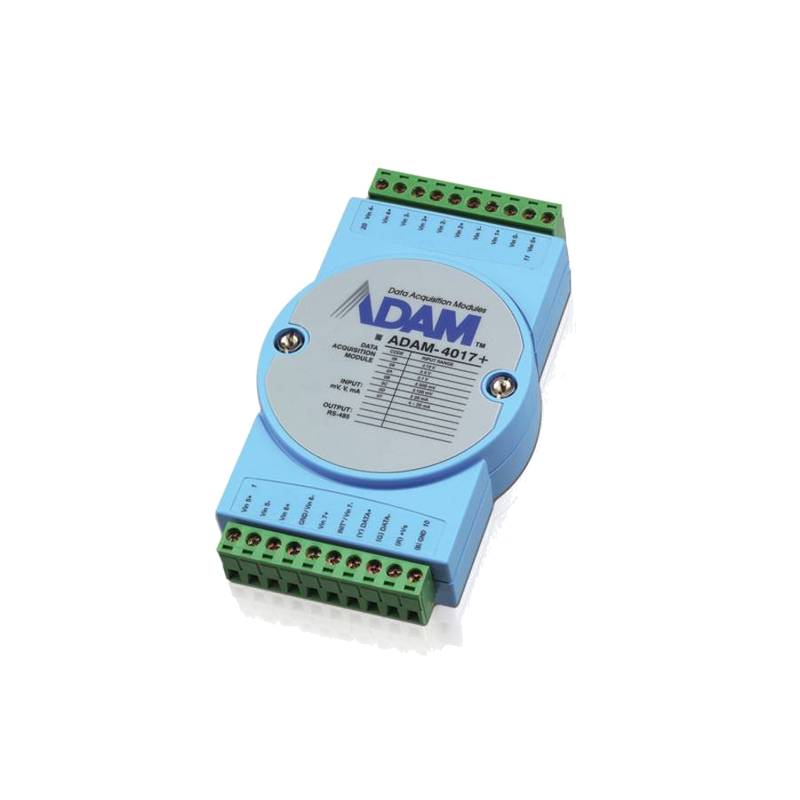
Advantech ADAM-4117-C 8-Channel Analog Input Module


The Advantech ADAM-4117-C 8-Channel Analog Input Module stands as a robust solution for industrial data acquisition, offering precise measurement capabilities in demanding environments. This module excels with its wide operating temperature range, high common-mode rejection ratio (CMRR), and extensive input voltage and current options, making it a versatile component for numerous industrial applications. Its design prioritizes reliability and ease of integration, essential for effective industrial automation and control systems.
Product Specifications
| Feature | Specification |
| :---------------------- | :------------------------------------------- |
| Input Channels | 8 Analog Input |
| Input Signal Types | Voltage, Current |
| Voltage Input Range | ±150 mV, ±500 mV, ±1 V, ±5 V, ±10 V |
| Current Input Range | ±20 mA |
| Resolution | 16-bit |
| Sampling Rate | 10 samples/sec (aggregate) |
| Isolation | 3000 VDC (channel-to-ground) |
| CMRR | 90 dB |
| Input Impedance | Voltage: 1 MΩ, Current: 125 Ω |
| Power Consumption | 1.2 W |
| Operating Temperature | -40 to 85 °C |
| Communication Protocol | Modbus RTU |
| Interface | RS-485 |
| Mounting | DIN-rail |
Core Features & Market Positioning
The ADAM-4117-C distinguishes itself through its exceptional accuracy and stability, crucial for industrial monitoring and control where deviations can be costly. Its 16-bit resolution ensures detailed data capture, while the 3000 VDC isolation protects connected equipment and personnel from voltage transients. The module's wide operating temperature range of -40 to 85 °C positions it as a highly reliable choice for deployment in harsh industrial settings, from remote outdoor installations to high-temperature factory floors. Its compatibility with the Modbus RTU protocol further solidifies its role as an easily integrated component within existing SCADA and PLC systems, offering a cost-effective yet powerful data acquisition solution.
Key Application Scenarios
The Advantech ADAM-4117-C is extensively utilized in process control and automation across various sectors. In manufacturing, it monitors machine performance and environmental conditions like temperature and pressure. For the energy industry, it's deployed in substations and power plants for real-time electrical parameter monitoring. Environmental monitoring applications benefit from its ability to accurately measure parameters such as water levels, flow rates, and air quality sensors. Furthermore, its robust design makes it suitable for building automation systems, managing HVAC and lighting control through precise analog input readings.
Practical System Integration Guidance
Integrating the ADAM-4117-C into an industrial system is streamlined by its DIN-rail mounting and standard RS-485 communication interface. Wiring involves connecting the input signals to the designated terminals, ensuring correct polarity for voltage inputs and proper loop configuration for current inputs. Power is supplied via a 12-24 VDC source. Configuration and data retrieval are managed through the Modbus RTU protocol, typically requiring a master device such as an industrial PC, PLC, or dedicated data logger with an RS-485 interface. Software tools or PLC programming blocks are used to establish Modbus communication, define register addresses for each channel, and set parameters like input ranges and sampling rates.
Operation and Risk Mitigation
Operating the ADAM-4117-C involves configuring its input channels via Modbus commands to match the specific sensors being used, whether they are voltage or current output devices. It's critical to ensure that the input signal levels do not exceed the module's specified ranges to prevent damage. The module's inherent 3000 VDC isolation between channels and ground significantly mitigates risks associated with ground loops and electrical noise, enhancing system stability and data integrity. For troubleshooting, common issues often relate to incorrect wiring, improper Modbus communication settings (baud rate, parity, slave ID), or sensor malfunctions. Verifying these elements systematically will resolve most operational problems.
Scalability & Long-Term Value
The ADAM-4117-C offers considerable scalability, allowing users to expand their data acquisition capabilities by daisy-chaining multiple ADAM-4000 series modules on the same RS-485 bus, limited only by the communication protocol's addressing capacity. Its adherence to the Modbus RTU standard ensures broad compatibility with a vast array of industrial control hardware and software platforms, safeguarding investment in existing infrastructure. As industries move towards Industrial IoT (IIoT) and digital transformation, the ADAM-4117-C can serve as a foundational element, feeding analog data into IIoT gateways or cloud platforms for advanced analytics, predictive maintenance, and remote monitoring, thus providing long-term value and future-proofing data acquisition strategies.
---
Frequently Asked Questions (FAQs)
What are the primary advantages of the Advantech ADAM-4117-C?
The ADAM-4117-C offers high-precision 16-bit analog input conversion for eight channels. It boasts a wide operating temperature range, making it suitable for harsh industrial environments. The module also features robust 3000 VDC isolation, protecting against electrical disturbances and ensuring system reliability.
Its design emphasizes ease of integration with standard industrial protocols like Modbus RTU. This facilitates seamless connection to PLCs, SCADA systems, and data loggers. The module's versatility in accepting both voltage and current inputs further enhances its applicability across diverse sensor types.
Key benefits include enhanced data accuracy, increased operational uptime due to its rugged construction, and simplified system design with its common communication interface. These factors contribute to a lower total cost of ownership for industrial automation projects.
How do I connect sensors to the ADAM-4117-C for analog input?
Connecting sensors involves utilizing the module's screw terminals. For voltage inputs, ensure the sensor's positive output connects to the designated input terminal and the negative to the common terminal. For current inputs, the sensor's signal wire is wired in series with the module's current input terminal and the common.
Always refer to the specific sensor's datasheet to confirm its output type (voltage or current) and the corresponding range. This ensures correct wiring and prevents potential damage to the module or sensor. Double-check all connections before applying power to the system.
The ADAM-4117-C supports various voltage ranges like ±150mV to ±10V and a ±20mA current range, so proper terminal assignment based on the sensor's output is crucial for accurate readings.
What communication protocol does the ADAM-4117-C use, and how is it configured?
The module exclusively uses the Modbus RTU protocol over an RS-485 serial interface for communication. Configuration involves setting the correct Modbus parameters: baud rate, data bits, parity, and stop bits, typically to match the master device's settings.
Each ADAM-4117-C must be assigned a unique Modbus slave ID to enable communication when multiple modules are on the same bus. This ID is usually set via DIP switches or through software configuration, depending on the specific model variant.
Data access and module configuration are performed by sending Modbus read/write commands to specific register addresses. These registers control input channel configuration and retrieve measurement data.
Can the ADAM-4117-C be used in extreme temperature environments?
Yes, the ADAM-4117-C is specifically designed for operation in extreme temperatures, boasting an impressive operating range of -40°C to +85°C. This wide thermal tolerance makes it exceptionally suitable for deployment in demanding industrial settings.
Locations such as outdoor control cabinets, unattended remote sites, or manufacturing floors with high ambient temperatures are ideal scenarios for this module. Its robust construction ensures reliable performance even under significant thermal stress.
This broad temperature capability minimizes the need for environmental controls around the module, simplifying installation and reducing associated costs. It guarantees consistent data acquisition regardless of external climatic conditions.
What is the resolution and accuracy of the ADAM-4117-C?
The ADAM-4117-C features a high 16-bit resolution for its analog-to-digital converter (ADC). This high resolution allows for very fine distinctions in measured analog signals, leading to more precise data capture.
This precision is critical for applications requiring detailed monitoring of process variables. For example, accurately tracking slight changes in temperature, pressure, or flow rates is essential for optimal control and efficiency.
While specific accuracy figures can vary slightly by channel and operating conditions, the 16-bit resolution provides a strong foundation for reliable and detailed industrial data acquisition tasks.
How does the isolation feature of the ADAM-4117-C benefit my system?
The 3000 VDC isolation between the input channels and ground is a critical safety and reliability feature. It effectively prevents ground loops, which are a common source of noise and inaccurate readings in industrial environments.
This high level of isolation protects the module and other connected devices from potentially damaging voltage surges or transients that may occur on the signal lines. It enhances overall system robustness and extends equipment lifespan.
By separating the analog input circuitry from the main control system ground, the isolation ensures that noise from one channel or external sources does not corrupt the data from other channels, leading to cleaner and more dependable measurements.
What types of analog input signals can the ADAM-4117-C accept?
The ADAM-4117-C is highly versatile and supports both voltage and current analog input signals. This flexibility allows it to interface with a wide array of industrial sensors and transmitters commonly used in automation.
Specifically, it can accept various voltage ranges, including ±150 mV, ±500 mV, ±1 V, ±5 V, and ±10 V. For current inputs, it is configured to accept a standard ±20 mA signal.
This broad compatibility means users can integrate existing sensors without needing signal conditioning hardware, simplifying wiring and reducing overall system complexity.
How can I integrate the ADAM-4117-C with existing PLC systems?
Integrating the ADAM-4117-C with PLC systems is straightforward due to its standard Modbus RTU communication over RS-485. Most PLCs are equipped with serial communication ports or can be interfaced with them.
You will need to configure the PLC's communication module for Modbus RTU, matching the baud rate, parity, and slave ID of the ADAM-4117-C. Then, use the PLC's programming software to create Modbus read/write instructions to exchange data with the module.
Specific function codes are used to read input values from the analog channels or to configure module settings. Referencing the ADAM-4117-C manual and the PLC's communication library will provide detailed guidance for this integration.
What are common troubleshooting steps for the ADAM-4117-C?
Begin by verifying all physical connections, ensuring sensors are correctly wired to the input terminals and that the RS-485 communication lines (A and B) are properly terminated. Check that the module is receiving the correct DC power supply voltage.
Next, confirm the Modbus communication settings on both the ADAM-4117-C (slave ID, baud rate, parity) and the master device (PLC, HMI) are identical. Ensure the correct Modbus function codes and register addresses are being used in the master's communication requests.
If issues persist, try reconfiguring the specific input channel settings via Modbus commands to rule out incorrect configuration parameters. Test the sensor independently to ensure it is functioning correctly and outputting within its specified range.
How does the ADAM-4117-C contribute to Industrial IoT (IIoT) deployments?
The ADAM-4117-C serves as a crucial edge device for IIoT by collecting raw analog data from various industrial sensors. Its Modbus RTU interface allows it to be easily connected to IIoT gateways or edge computers.
These gateways then can aggregate data from multiple ADAM modules and other devices, transforming it into protocols suitable for cloud-based IIoT platforms. This enables remote monitoring, data analysis, and the implementation of predictive maintenance strategies.
By providing reliable, high-resolution analog input at the source, the ADAM-4117-C ensures that accurate data is available for IIoT applications, driving efficiency and intelligent decision-making in industrial operations.