











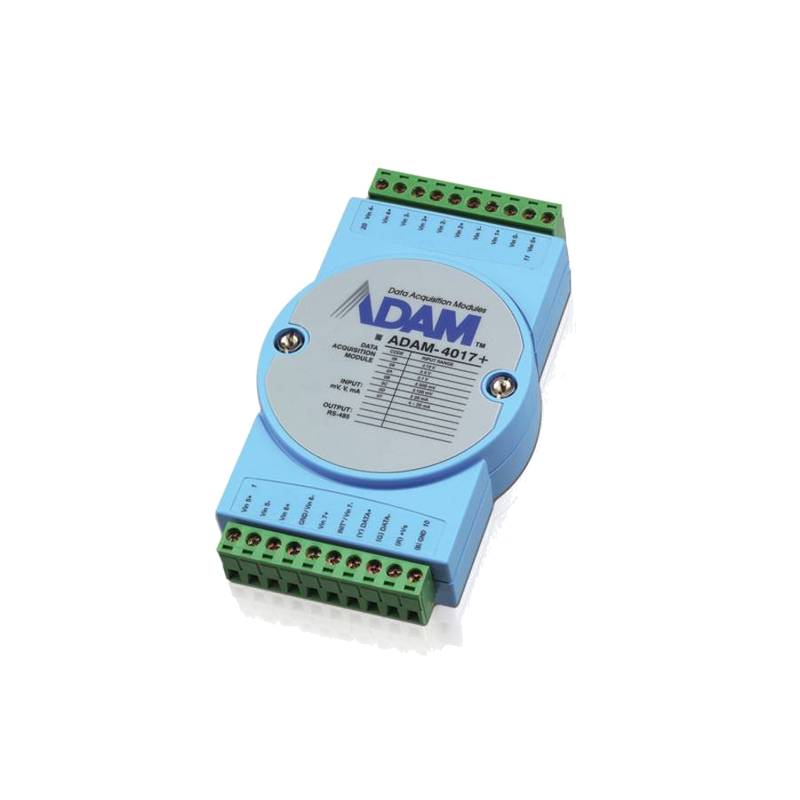
Advantech ADAM-4055-C 8-Channel Digital Input Module


The Advantech ADAM-4055-C 8-Channel Digital Input Module is a robust and versatile module designed for industrial automation, offering reliable data acquisition and control. This module excels in environments demanding high precision and durability, featuring 8 optically isolated digital input channels that effectively shield against voltage surges and ground loops, ensuring signal integrity. Its wide operating temperature range of -25°C to +70°C makes it suitable for extreme industrial conditions, while its DIN-rail mountable design simplifies installation in control cabinets. The ADAM-4055-C supports 3000 VDC isolation, crucial for protecting connected equipment and personnel. Its compact form factor and low power consumption further enhance its appeal for space-constrained and energy-conscious applications.
Product Specifications
| Feature | Specification |
| :----------------------- | :----------------------------------------------------- |
| Digital Input Channels | 8 |
| Isolation Voltage | 3000 VDC |
| Input Format | Dry contact, Wet contact (selectable) |
| Input Voltage Range | 0-13 VDC (for ON state), 0-3 VDC (for OFF state) |
| Max. Input Frequency | 1 kHz |
| Power Consumption | 1.4 W @ 12 VDC |
| Operating Temperature | -25°C to +70°C |
| Dimensions (W x L x H) | 70 mm x 112 mm x 32 mm |
| Mounting | DIN-rail |
| Communication Protocol | Modbus RTU (RS-485) |
Core Features & Market Positioning
The Advantech ADAM-4055-C stands out in the industrial digital input module market due to its superior optical isolation, offering an exceptional level of protection against electrical noise and transients, which is a critical differentiator for mission-critical applications. This module is engineered for reliability in harsh industrial settings, a testament to Advantech's long-standing reputation for building rugged automation hardware. Its compatibility with the widely adopted Modbus RTU protocol over RS-485 ensures seamless integration into existing SCADA and PLC systems, making it a cost-effective and practical choice for a broad spectrum of industrial clients seeking dependable data acquisition without proprietary vendor lock-in. The dual selectable input format (dry/wet contact) adds significant flexibility, reducing the need for external signal conditioning and simplifying system design.
Key Application Scenarios
The ADAM-4055-C is ideally suited for monitoring the status of various industrial equipment, such as detecting the open or closed state of doors, gates, and machine guards, providing essential safety interlocks and operational feedback. It is frequently deployed in building automation systems for tasks like monitoring occupancy sensors, detecting the activation of emergency stop buttons, or confirming the operational status of pumps and fans. In manufacturing environments, it proves invaluable for counting discrete events, such as cycles completed by machinery, or for confirming the presence or absence of components on a production line. Its robust design also makes it a reliable choice for environmental monitoring, such as detecting water leaks or confirming the status of ventilation systems in remote or harsh locations.
Practical System Integration Guidance
Integrating the Advantech ADAM-4055-C is straightforward, primarily revolving around its RS-485 communication and power connections. For wiring, the digital inputs can be configured for either dry contact (requiring a direct connection to the switch or sensor) or wet contact (utilizing an external voltage source, typically 5-24 VDC, applied through the module). Ensure the RS-485 A and B lines are correctly terminated and connected to the master controller's corresponding terminals, respecting polarity. When configuring the module using Advantech's utility software, setting the correct Modbus address, baud rate, and parity is crucial for successful communication. For instance, a common setup involves daisy-chaining multiple ADAM modules on a single RS-485 bus, each assigned a unique Modbus address.
Operation and Risk Mitigation
Proper operation of the ADAM-4055-C relies on adherence to its specified voltage and current limits for the digital inputs to prevent damage. The optical isolation is a key risk mitigation feature, protecting sensitive control systems from ground loops and voltage spikes that are common in industrial environments. Ensure that the power supply used for the module is stable and within the specified voltage range (typically 12-30 VDC). Troubleshooting often involves verifying communication parameters (address, baud rate, parity) and checking physical wiring connections. A common issue is incorrect wiring of dry vs. wet contacts; always confirm the input type configuration in the software matches the physical wiring. No specific fault codes are typically generated by the module itself; rather, communication errors or unexpected input states will be reported by the master controller.
Scalability & Long-Term Value
The ADAM-4055-C offers excellent scalability, allowing users to expand their digital input capacity by simply adding more modules to the RS-485 bus, up to the limit supported by the master communication device. Its adherence to the Modbus RTU standard ensures broad compatibility with a wide range of PLCs, HMIs, and SCADA systems from various manufacturers, safeguarding investment by avoiding proprietary hardware dependencies. This makes it a future-proof solution, easily integrated into evolving industrial control architectures. Furthermore, as industrial facilities move towards Industry 4.0 and IIoT, the ADAM-4055-C can serve as a fundamental data acquisition component, feeding discrete state information into cloud platforms or edge computing devices for advanced analytics and predictive maintenance strategies.
Frequently Asked Questions
What is the maximum number of ADAM-4055-C modules that can be connected on an RS-485 network?
The maximum number of ADAM-4055-C modules on a single RS-485 network depends on the master device's polling capability and the overall bus load. Typically, a standard RS-485 bus can support up to 32 nodes without repeaters. However, Advantech's ADAM-4000 series is designed for robust multi-drop communication. Consider network traffic and response time requirements when planning the number of modules.
How do I configure the input type (dry contact vs. wet contact) for the ADAM-4055-C?
Input type configuration is managed through Advantech's ADAM Utility software or by sending specific Modbus commands. Within the software, you can select the desired mode for each of the 8 digital input channels. For wet contact, an external voltage source needs to be applied to the input terminals. Ensure the voltage is within the module's specified range for correct operation.
What are the typical power supply requirements for the Advantech ADAM-4055-C?
The Advantech ADAM-4055-C operates on a DC power supply, typically ranging from 12V to 30V DC. The module itself consumes a low amount of power, around 1.4W at 12V DC. It's crucial to use a stable and regulated power supply to ensure reliable operation and to prevent potential damage to the module or connected devices. Always refer to the official datasheet for precise power specifications.
Can the ADAM-4055-C be used with PLC systems that do not support Modbus RTU?
While the ADAM-4055-C primarily uses the Modbus RTU protocol over RS-485, integration with PLCs using different communication protocols is possible through protocol conversion gateways. These gateways can translate Modbus RTU to other industrial protocols like Profibus, EtherNet/IP, or CANopen. This allows the ADAM-4055-C to be incorporated into a wider range of automation systems.
What is the significance of the 3000 VDC isolation on the ADAM-4055-C?
The 3000 VDC isolation is a critical safety and reliability feature. It effectively separates the digital input channels from the internal circuitry of the module and the communication bus. This prevents ground loops, protects the module and connected equipment from voltage surges, and enhances system stability in electrically noisy industrial environments.
How does the optical isolation in the ADAM-4055-C protect the system?
Optical isolation uses light to transmit signals between two electrically separated circuits. In the ADAM-4055-C, this means a light-emitting diode (LED) on the input side converts the electrical signal to light, which is then detected by a phototransistor on the output side. This physical separation eliminates direct electrical pathways, thereby blocking high voltages and noise from reaching the control system.
What kind of sensors can be connected to the digital inputs of the ADAM-4055-C?
You can connect various types of digital sensors and switches, including push buttons, limit switches, proximity sensors, and reed switches. For dry contact inputs, you need a switch that opens or closes a circuit. For wet contact inputs, you will connect to sensors that provide a voltage signal when activated, within the specified input voltage range.
Is the ADAM-4055-C suitable for outdoor or extreme temperature applications?
Yes, the ADAM-4055-C is designed for industrial environments and features a wide operating temperature range of -25°C to +70°C. This broad temperature tolerance makes it suitable for deployment in many outdoor or harsh conditions where temperature fluctuations are common. Always ensure proper ventilation and protection from direct environmental elements like rain or excessive dust.
What troubleshooting steps should I take if the ADAM-4055-C is not communicating?
Begin by verifying the RS-485 wiring, ensuring correct polarity (A to A, B to B) and termination if necessary. Check that the module's Modbus address, baud rate, and parity settings match those of the master controller. Ensure the module is receiving adequate power within the specified voltage range. Finally, confirm that the input type (dry/wet contact) is correctly configured and wired.
How does the ADAM-4055-C contribute to an IIoT-enabled system?
The ADAM-4055-C acts as an edge device, collecting real-time digital status data from the plant floor. This data can then be transmitted via Modbus RTU to a gateway or PC, which forwards it to cloud platforms or IIoT dashboards. This enables remote monitoring, data logging, and advanced analytics for improved operational efficiency and predictive maintenance.