











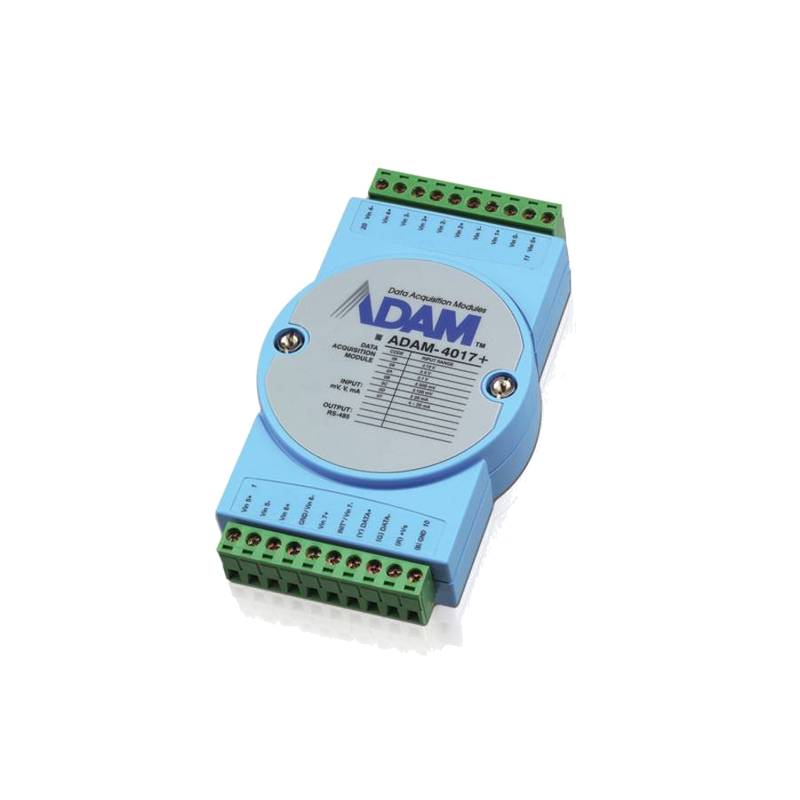
Advantech ADAM-4021-F Analog Output Module


The Advantech ADAM-4021-F is a robust, single-channel analog output module designed for industrial automation applications. It offers essential features like Modbus and ASCII protocol support, a watchdog timer for system reliability, and 3000VDC isolation protection, ensuring data integrity and equipment safety. This module efficiently converts digital input signals received via an RS-485 interface into analog voltage or current output signals, with a microprocessor-controlled D/A converter providing precise control. A key advantage is the true readback capability of the analog output signal via an independent ADC, allowing for precise monitoring and control. The ADAM-4021-F operates within a temperature range of -10°C to 70°C and requires a power input of 10-30VDC. Its compact design and DIN-rail mounting capability facilitate straightforward integration into existing industrial systems.
Product Specifications
| Feature | Specification |
| :---------------------- | :------------------------------------------------ |
| Manufacturer | Advantech |
| Model | ADAM-4021-F |
| Type of Module | Analog Output |
| Number of Outputs | 1 Channel |
| Protocols Supported | ASCII, Modbus RTU |
| Isolation Protection | 3000VDC |
| Input Power | 10-30 VDC |
| Operating Temperature | -10°C to 70°C |
| Communication Interface | RS-485 |
| Dimensions | 70 x 112 x 26 mm |
| Mounting | DIN Rail, Panel Mount |
| Watchdog Timer | Yes |
Core Features & Market Positioning
The Advantech ADAM-4021-F stands out in the competitive industrial automation market due to its combination of reliability, precise control, and robust protection features. Its primary differentiator lies in the true readback capability of the analog output, a critical function for applications demanding high accuracy and verification of control signals. The 3000VDC isolation protection is another significant advantage, safeguarding sensitive equipment from voltage surges and ground loops, which is paramount in harsh industrial environments. The module's support for both ASCII and Modbus protocols enhances its compatibility with a wide array of existing control systems and SCADA software, positioning it as a versatile solution for diverse industrial needs. Furthermore, the integrated watchdog timer enhances system stability by automatically recovering the system in case of communication failures, minimizing downtime.
Key Application Scenarios
The Advantech ADAM-4021-F is ideally suited for a range of industrial applications where precise analog signal generation and control are essential. It is commonly employed in:
Process Control: Automating valves, pumps, and actuators in chemical plants, water treatment facilities, and manufacturing lines to maintain optimal process parameters like flow rate, pressure, and temperature. Building Automation: Controlling HVAC systems, lighting intensity, and other environmental controls in commercial and industrial buildings to enhance energy efficiency and occupant comfort. Remote Monitoring and Control: Facilitating data acquisition and control in geographically dispersed or hard-to-reach locations, such as smart agriculture (greenhouses, farms), environmental monitoring stations, and utility substations. Machine Control: Providing precise analog outputs for variable speed drives, motor controllers, and other machinery requiring fine-tuned operational adjustments. Testing and Measurement: Generating stable and accurate analog signals for calibration and testing of sensors and instrumentation.
Practical System Integration Guidance
Integrating the Advantech ADAM-4021-F into an industrial control system is facilitated by its standard RS-485 communication interface and common industrial protocols. The module receives digital data, typically in engineering units, hexadecimal, or percentage of full-scale range (FSR), which is then converted into analog signals.
Wiring: The module connects to a host computer or PLC via the RS-485 interface. Proper wiring of the Data+ and Data- lines is crucial for reliable communication. The power input is typically a DC voltage within the 10-30VDC range.
Configuration: Configuration of the ADAM-4021-F, including setting communication parameters like baud rate and module ID, is often performed using Advantech's utility software (e.g., ADAM.EXE). This software allows users to define the output signal range and slew rates. For Modbus communication, the module adheres to the Modbus RTU protocol, requiring appropriate configuration of the master device's Modbus settings to match the module's parameters.
Operation and Risk Mitigation
The Advantech ADAM-4021-F is designed for reliable operation in demanding industrial environments. Key operational considerations and risk mitigation strategies include:
Power Supply: Ensure a stable and regulated DC power supply within the specified 10-30VDC range to prevent operational issues or damage. Transient suppression on power lines is recommended. Communication: Maintain the integrity of the RS-485 communication lines. Ensure correct termination of the bus if multiple modules are used. Incorrect baud rate or ID settings are common communication failure points. Environmental Considerations: While the module offers a wide operating temperature range (-10°C to 70°C), it is advisable to install it within an industrial enclosure (e.g., ADAM-4950-ENC) to protect it from environmental hazards like dust, moisture, and electrical static discharge (ESD), especially to comply with CE specifications. Troubleshooting: Communication issues are often resolved by verifying wiring, confirming correct baud rates and slave IDs in both the host system and the module, and checking for I/O address or IRQ conflicts. The watchdog timer provides a layer of fault tolerance for system recovery.
Scalability & Long-Term Value
The ADAM-4021-F offers inherent scalability and long-term value as part of Advantech's broader ADAM-4000 series. This modular design allows for easy expansion by adding more modules to a single RS-485 serial port, supporting up to 256 multidrop modules. Compatibility with the widely adopted Modbus protocol ensures that the ADAM-4021-F can be integrated into existing SCADA systems and PLC networks, and can be incorporated into future upgrades or expansions without requiring a complete system overhaul. Advantech's continued development of IIoT and digital solutions means that modules like the ADAM-4021-F can serve as foundational elements for more advanced intelligent systems, contributing to the overall digitalization of industrial processes. The two-year warranty also underscores Advantech's commitment to product durability and long-term customer support.
Frequently Asked Questions
What are the primary communication protocols supported by the Advantech ADAM-4021-F?
The Advantech ADAM-4021-F supports both ASCII and Modbus RTU communication protocols. This dual protocol support enhances its compatibility with a wide range of industrial automation systems and SCADA software.
Modbus RTU is a widely adopted serial communication protocol known for its efficiency and robustness in industrial environments. ASCII offers a more human-readable format, which can be useful for simpler applications or debugging purposes.
By supporting these versatile protocols, the ADAM-4021-F allows for flexible integration into diverse networking setups, whether connecting to legacy systems or modern distributed control architectures.
What is the isolation protection level of the Advantech ADAM-4021-F, and why is it important?
The Advantech ADAM-4021-F features 3000VDC isolation protection. This high level of isolation is critical in industrial settings to protect sensitive control equipment from damage caused by voltage transients, surges, and ground loops.
Electrical isolation prevents different parts of a system from sharing a common ground, thereby mitigating potential damage from large voltage differences. This is particularly important when connecting devices over long distances or in environments with significant electrical noise.
By incorporating 3000VDC isolation, the ADAM-4021-F ensures enhanced reliability and longevity of the connected machinery and control systems, reducing the risk of costly failures and downtime.
How does the watchdog timer in the ADAM-4021-F contribute to system reliability?
The watchdog timer in the Advantech ADAM-4021-F is a hardware-based safety feature designed to improve system reliability. It functions by monitoring the module's operational status.
If the module experiences a software glitch or communication interruption that causes it to become unresponsive, the watchdog timer will detect this anomaly. Upon detecting a failure, it automatically resets the module or the connected system.
This automatic recovery mechanism helps to prevent prolonged system downtime and ensures that operations can resume quickly, which is crucial for maintaining continuous industrial processes.
What are the typical power requirements for the Advantech ADAM-4021-F?
The Advantech ADAM-4021-F typically requires a power input ranging from +10VDC to +30VDC. This specification defines the acceptable voltage range for stable operation.
Adhering to these power requirements is essential for preventing damage to the module and ensuring consistent performance. It's recommended to use a regulated power supply that can maintain a stable output within this range.
Users should consult the product's datasheet for the most precise power consumption figures and recommendations, especially when designing a system with multiple modules to ensure the power supply capacity is adequate.
Can the Advantech ADAM-4021-F be integrated into existing Modbus networks?
Yes, the Advantech ADAM-4021-F is fully compatible with Modbus RTU networks. Modbus is a widely used industrial communication protocol, making integration straightforward.
To integrate it, you will need to configure the master device (e.g., PLC, SCADA system) with the correct Modbus parameters such as baud rate, parity, and slave ID that match the ADAM-4021-F's settings. The module itself can be configured for these parameters using Advantech's utility software.
This compatibility allows the ADAM-4021-F to seamlessly exchange data with other Modbus-enabled devices, enabling it to be a valuable component in both new and existing industrial automation systems.
What is the operating temperature range for the Advantech ADAM-4021-F?
The Advantech ADAM-4021-F is designed to operate within a temperature range of -10°C to +70°C. This specification indicates its suitability for a variety of industrial environments.
This wide operating temperature range ensures reliable performance even in moderately challenging conditions, such as factory floors or outdoor enclosures. However, extreme temperatures outside this range could affect performance or longevity.
For applications operating at the temperature extremes or in environments with significant temperature fluctuations, it is advisable to consider appropriate environmental controls or protective enclosures for the module.
How is the analog output signal quality ensured with the ADAM-4021-F?
The Advantech ADAM-4021-F ensures high analog output signal quality through its microprocessor-controlled Digital-to-Analog (D/A) converter. This allows for precise conversion of digital commands into analog signals.
A key feature is the true readback capability provided by an independent Analog-to-Digital Converter (ADC). This ADC continuously monitors the actual analog output signal, allowing for verification and correction if necessary.
Users can also specify slew rates and start-up currents via configuration software, offering fine-tuned control over the output signal's behavior and ensuring it meets specific application requirements.
What is the mounting method for the Advantech ADAM-4021-F?
The Advantech ADAM-4021-F supports multiple mounting options for flexible system integration. It is designed for standard DIN rail mounting, which is common in industrial control cabinets.
Additionally, the module can be panel mounted, offering further versatility depending on the enclosure or control panel design. This adaptability simplifies installation in various industrial setups.
The compact dimensions of the module (70x112x26mm) also contribute to its ease of installation, allowing it to fit into space-constrained environments.
What are the potential troubleshooting steps for communication issues with the ADAM-4021-F?
Troubleshooting communication issues with the ADAM-4021-F typically involves checking several key areas. First, verify that the RS-485 Data+ and Data- lines are correctly wired between the host and the module.
Next, confirm that the baud rate and slave ID settings are identical on both the ADAM-4021-F and the communication master device (e.g., PLC, PC software). Incorrect baud rates are a frequent cause of communication failure.
Additionally, ensure there are no conflicts with I/O addresses or IRQs if the module is connected through a PC-based system. Using Advantech's utility software can help diagnose and set these parameters.
What warranty is provided for the Advantech ADAM-4021-F?
Advantech typically provides a two-year warranty for the original purchaser of the ADAM-4021-F. This warranty covers defects in materials and workmanship from the date of purchase.
However, the warranty does not extend to products that have been altered, misused, subjected to accident, or improperly installed. It's important to follow installation and operation guidelines to maintain warranty coverage.
For warranty service, customers usually need to contact their dealer, provide proof of purchase, and obtain a Return Merchandise Authorization (RMA) number before shipping the defective product for repair or replacement.