











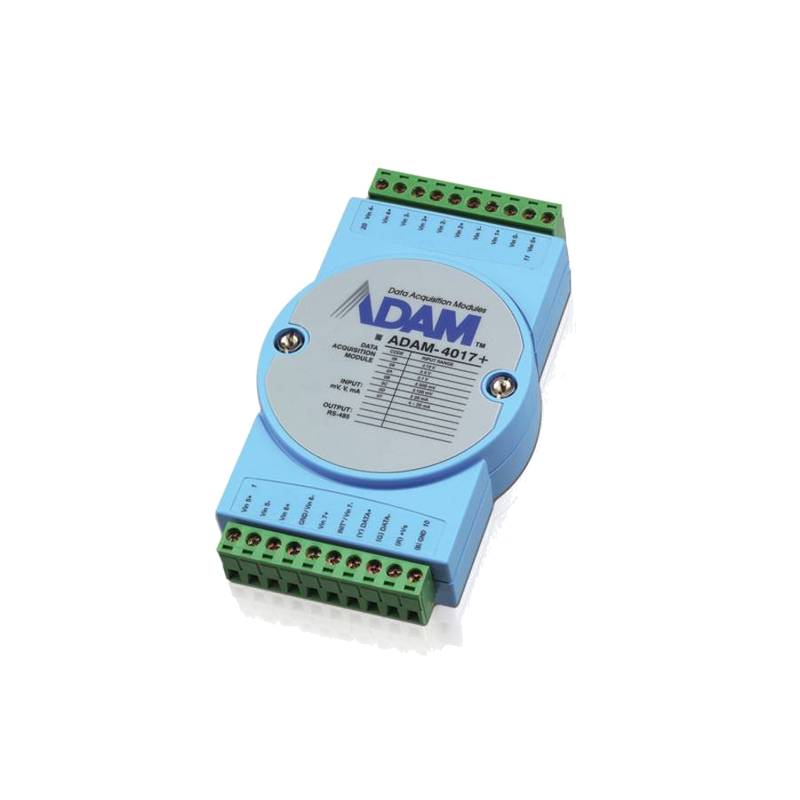
Advantech ADAM-4118-B High Precision Analog Input Acquisition Module


The Advantech ADAM-4118-B High Precision Analog Input Acquisition Module stands as a robust solution for demanding industrial data acquisition tasks. This module excels in delivering precise analog signal measurement with a wide input range and excellent noise immunity, making it ideal for critical monitoring and control applications. Its key advantages include high accuracy, a compact form factor, and reliable performance in harsh environments. Core technical parameters such as its 16-bit resolution, comprehensive input ranges (-10 to 10 VDC, 4-20 mA, etc.), and support for Modbus RTU communication protocols underscore its versatility.
Product Specifications
| Feature | Specification |
| :----------------------- | :------------------------------------------ |
| Analog Input Channels | 8 |
| Resolution | 16-bit |
| Input Ranges | Voltage: ±10 VDC, ±5 VDC, ±1 VDC; Current: 4-20 mA, 0-20 mA |
| Accuracy | ±0.05% of Full Scale |
| Isolation | 3000 VDC |
| Communication Interface | RS-485 (Modbus RTU) |
| Power Consumption | 1.2 W |
| Operating Temperature | -10°C to 70°C |
| Dimensions | 120 x 70 x 33 mm |
Core Features & Market Positioning
The ADAM-4118-B distinguishes itself through its superior 16-bit resolution, enabling the capture of minute variations in analog signals, a critical factor in high-precision industrial processes. Its robust 3000 VDC isolation capability provides essential protection against ground loops and transient voltage spikes, significantly enhancing system reliability and safeguarding connected equipment. Positioned as a cost-effective yet high-performance data acquisition module, it competes effectively against more complex and expensive systems where precise analog input handling is paramount. The module's enduring popularity in sectors demanding stringent measurement accuracy highlights its strong market presence.
Key Application Scenarios
The Advantech ADAM-4118-B is indispensable in a multitude of industrial automation and monitoring applications. It is frequently deployed in process control systems for tasks such as precise temperature, pressure, and flow rate monitoring in chemical plants and refineries. Its high-accuracy current and voltage input capabilities make it suitable for sophisticated control loops in manufacturing environments, ensuring optimal product quality and efficiency. Furthermore, its rugged design and isolation features lend themselves to deployment in challenging field applications, including environmental monitoring stations and remote asset management systems.
Practical System Integration Guidance
Integrating the ADAM-4118-B into an industrial control system is streamlined due to its standard RS-485 communication interface, which utilizes the widely adopted Modbus RTU protocol. This facilitates seamless integration with various Programmable Logic Controllers (PLCs), Human-Machine Interfaces (HMIs), and SCADA systems from different manufacturers. Wiring involves connecting the power supply to terminals labeled V+ and GND, and the RS-485 communication lines to the A and B terminals. For programming, users typically configure the module's communication parameters (baud rate, parity, slave ID) and then implement Modbus read/write functions to access channel data and module settings within their control software.
Operation and Risk Mitigation
Safe operation of the Advantech ADAM-4118-B requires adherence to specified power input ranges and proper wiring to avoid damage. Users must ensure that the analog input signals do not exceed the module's defined voltage or current limits, which could lead to inaccurate readings or component failure. In case of communication loss, common troubleshooting steps include verifying RS-485 wiring polarity, checking the master device's communication settings, and ensuring the module's slave ID is unique and correctly configured. Environmental considerations, such as operating within the specified temperature range (-10°C to 70°C), are crucial for maintaining performance and longevity.
Scalability & Long-Term Value
The ADAM-4118-B offers excellent scalability, allowing users to expand their data acquisition capabilities by simply adding more modules to the RS-485 network. This distributed I/O architecture enables cost-effective system growth without requiring extensive rewiring or controller upgrades. Its compatibility with Advantech's broader range of industrial automation products and its adherence to standard communication protocols ensure long-term value and integration potential with evolving IIoT and digital transformation initiatives. This makes it a future-proof investment for industries seeking to enhance their data intelligence and operational efficiency.
FAQs
What is the primary function of the Advantech ADAM-4118-B?
The ADAM-4118-B is an analog input module. It converts real-world analog signals into digital data for industrial systems. It measures signals like voltage and current with high precision.
This module is crucial for monitoring and control. It enables PLCs and SCADA systems to understand process variables. Applications include temperature, pressure, and flow sensing.
Its core purpose is accurate data acquisition. This ensures reliable automation and informs operational decisions. It bridges the gap between the physical industrial environment and digital control.
What are the key technical specifications for the ADAM-4118-B?
It features 8 analog input channels with 16-bit resolution. This offers precise signal measurement capabilities.
The module supports various input ranges, including voltage (±10 VDC) and current (4-20 mA). It also boasts 3000 VDC isolation.
It operates via RS-485 with Modbus RTU protocol. Power consumption is low at 1.2 W, and it functions from -10°C to 70°C.
How do I connect the ADAM-4118-B in a system?
Connect power to the V+ and GND terminals. Ensure the voltage is within the module's specifications.
For communication, use the RS-485 A and B terminals. Connect these to your master device's communication bus.
Proper grounding and shielding of RS-485 lines are recommended for reliable communication in noisy industrial settings. Follow wiring diagrams precisely.
What communication protocol does the ADAM-4118-B use?
The module utilizes the Modbus RTU communication protocol. This is a widely accepted standard in industrial automation.
Modbus RTU is a serial communication protocol. It allows efficient data exchange between devices over RS-485.
Users can integrate the ADAM-4118-B with any master device supporting Modbus RTU. This ensures broad compatibility.
What input ranges are supported by the ADAM-4118-B?
It supports various voltage input ranges. These include ±10 VDC, ±5 VDC, and ±1 VDC for flexible signal measurement.
The module also accommodates current input signals. Standard ranges like 4-20 mA and 0-20 mA are supported.
Users must select the appropriate input range setting in the software. This ensures accurate conversion of the analog signal to digital data.
Can the ADAM-4118-B be used in harsh industrial environments?
Yes, the ADAM-4118-B is designed for industrial use. It operates within a wide temperature range of -10°C to 70°C.
The module features 3000 VDC isolation. This protects against voltage surges and ground loops, crucial in harsh settings.
Its robust construction ensures reliable performance even in environments with significant electrical noise or vibration.
What is the accuracy of the ADAM-4118-B?
The ADAM-4118-B offers high precision with 16-bit resolution. This allows for very fine measurement granularity.
Its accuracy is rated at ±0.05% of the full scale. This ensures that the measured values are highly reliable.
This level of accuracy is vital for critical control loops and precise data logging applications.
How does the isolation feature benefit system integration?
The 3000 VDC isolation prevents ground loops. This is common when connecting devices from different power sources.
It protects the module and connected devices from transient voltage spikes. This enhances system reliability and longevity.
Isolation simplifies grounding schemes. It allows for more flexible system design in complex industrial networks.
What are common troubleshooting steps for the ADAM-4118-B?
Verify power supply connections and voltage levels. Ensure the module is receiving adequate and stable power.
Check RS-485 wiring for correct polarity (A/B) and ensure a solid connection. Confirm communication parameters match the master device.
Verify the module's slave ID is unique and correctly set within the network. Consult the manual for specific error codes if applicable.
How can the ADAM-4118-B support IIoT integration?
Its Modbus RTU interface easily connects to IIoT gateways. These gateways bridge serial data to IP networks for cloud access.
The module's precise data acquisition capabilities feed valuable real-time information. This data fuels IIoT analytics and predictive maintenance.
By enabling remote monitoring and control of analog signals, it's a foundational component for smart factory and Industry 4.0 initiatives.