











ABB PSTX210-600-70 210A Advanced Soft Starter


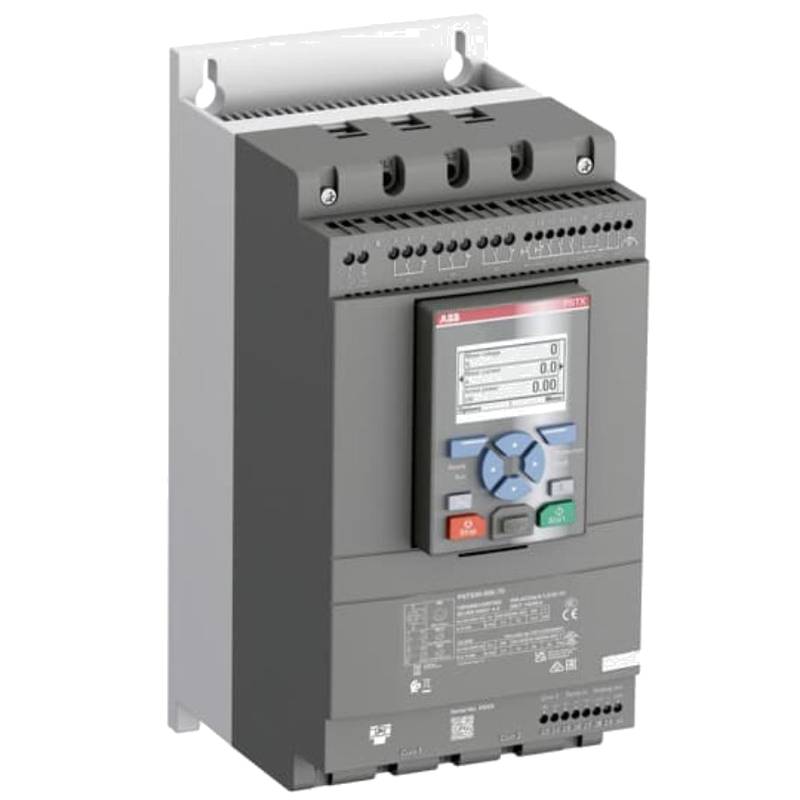
The ABB PSTX210-600-70 210A Advanced Soft Starter offers sophisticated motor control solutions, boasting a rated current of 210A and designed for 600V systems. Its key advantages include reduced mechanical stress on equipment, optimized energy consumption, and enhanced operational reliability. Core features encompass advanced motor protection, integrated bypass functionality, and precise torque control, positioning it as a superior choice for demanding industrial applications.
Product Specifications
| Parameter | Value |
| :------------------------ | :----------------------------- |
| ABB Model | PSTX210-600-70 |
| Rated Operational Current | 210 A |
| System Voltage | 600 V |
| Control Method | Advanced Soft Start |
| Mounting Type | DIN Rail / Panel Mount |
| Protection Features | Overload, Short Circuit, Phase Loss |
| Communication Options | Modbus, Profibus, DeviceNet |
| Bypass | Integrated |
Core Features & Market Positioning
The ABB PSTX210-600-70 stands out with its advanced electronic soft-start technology, providing smooth acceleration and deceleration profiles that significantly extend the lifespan of connected machinery. Unlike traditional starters, it offers precise torque control, crucial for applications requiring delicate handling of loads, such as conveyors or pumps. Its integrated bypass ensures full-load current operation without additional external components, simplifying installation and reducing footprint. This robust feature set positions the PSTX series as a premium solution for industries prioritizing uptime, energy efficiency, and equipment longevity, directly competing with more complex variable frequency drives (VFDs) where full speed control is not a primary requirement.
Key Application Scenarios
This advanced soft starter is ideal for a wide range of industrial applications where smooth motor start-up and reduced electrical inrush current are paramount. Common scenarios include the operation of centrifugal pumps in water treatment plants, fan systems in HVAC, and conveyor belts in manufacturing and material handling. It is particularly beneficial in environments with sensitive electrical grids or where frequent starts and stops are common, mitigating voltage dips and mechanical shock. The 210A rating and 600V compatibility make it suitable for medium-voltage motor applications across industries like mining, oil and gas, and heavy manufacturing.
Practical System Integration Guidance
Integrating the ABB PSTX210-600-70 into existing systems is streamlined due to its comprehensive features. Wiring involves connecting the main power supply to the input terminals and the motor to the output terminals, with clear terminal markings facilitating correct connections. The integrated bypass contacts simplify wiring by eliminating the need for external bypass contactors. For advanced control and monitoring, the PSTX series supports various fieldbus communication protocols, allowing seamless integration with SCADA systems and PLCs. Commissioning typically involves setting motor parameters such as rated current, nominal voltage, and desired start/stop ramps via the intuitive HMI or through software tools like ABB's E-Configurator, ensuring optimal performance and protection tailored to the specific motor and load.
Operation and Risk Mitigation
Operating the ABB PSTX210-600-70 is designed for simplicity and safety, featuring an intuitive human-machine interface (HMI) for local control and parameter adjustment. The device incorporates extensive motor protection functions, including overload, phase loss, short circuit, and over-temperature protection, to prevent damage and ensure operational safety. Key fault codes are displayed on the HMI, enabling quick diagnosis and troubleshooting. For instance, a "OL" code indicates an overload condition, prompting a review of the motor load or starting parameters. Proper installation, adherence to wiring diagrams, and correct parameter setting are critical to mitigate risks such as premature component failure or electrical hazards.
Scalability & Long-Term Value
The ABB PSTX210-600-70 offers significant long-term value through its compatibility with ABB's broader automation ecosystem. Its modular design and support for multiple communication protocols allow for easy integration into existing or future smart factory setups, including Industrial Internet of Things (IIoT) platforms. This enables advanced data analytics for predictive maintenance and performance optimization. While the PSTX is a soft starter, ABB also provides a comprehensive range of Variable Frequency Drives (VFDs) that can be integrated into the same system for applications requiring full speed control, offering a scalable solution for evolving industrial needs.
*
Frequently Asked Questions
1. What is the primary function of the ABB PSTX210-600-70 soft starter?
It smoothly starts and stops electric motors, reducing electrical and mechanical stress. This enhances equipment lifespan and operational reliability.
This starter manages motor acceleration and deceleration to prevent sudden current surges. It protects the motor from electrical faults like overloads and phase loss.
The PSTX series offers advanced control for precise torque and speed regulation in specific applications. It's designed for efficient energy usage.
2. How does the ABB PSTX210-600-70 protect the motor?
It incorporates comprehensive built-in motor protection features. These include overload, short circuit, and phase loss detection.
The soft starter monitors motor temperature and current draw to prevent overheating and damage. It can also detect ground faults for added safety.
By managing the start-up current, it significantly reduces stress on motor windings and connected mechanical components. This extends the overall life of the motor.
3. What are the key benefits of using an ABB PSTX210-600-70 over a direct-on-line (DOL) starter?
It significantly reduces the high inrush current associated with DOL starting. This prevents voltage dips on the power supply network.
The PSTX provides smooth acceleration and deceleration, minimizing mechanical shock on pumps, fans, and conveyors. This reduces wear and tear.
It offers advanced features like integrated bypass, motor protection, and communication capabilities, which are absent in basic DOL starters. This leads to better control and monitoring.
4. What is the rated current and voltage for the ABB PSTX210-600-70?
This model is rated for a continuous operational current of 210 Amperes. It is designed for systems operating at up to 600 Volts.
The specific rating ensures compatibility with motors requiring substantial power delivery. It is suitable for demanding industrial motor applications.
Always ensure the motor's full load current and the system voltage are within these specifications for safe and efficient operation. Consult the manual for exact limits.
5. Can the ABB PSTX210-600-70 be integrated with PLC systems?
Yes, the PSTX series supports multiple communication protocols like Modbus, Profibus, and DeviceNet. This allows for seamless integration with PLCs and SCADA systems.
Integration enables remote monitoring, control, and diagnostics of the motor and starter. It facilitates automated processes and data logging.
Engineers can leverage this connectivity for advanced automation and IIoT applications, enhancing operational efficiency and predictive maintenance.
6. What applications are best suited for the ABB PSTX210-600-70?
It is ideal for pumps, fans, conveyors, and compressors in water treatment, HVAC, and manufacturing. Applications requiring smooth starts and reduced mechanical stress benefit most.
Industries such as mining, oil and gas, and general manufacturing use it for medium-voltage motor control. It's effective where power quality is a concern.
Any application where reducing starting current, minimizing wear on machinery, and improving energy efficiency are critical is a good fit.
7. Does the ABB PSTX210-600-70 have an integrated bypass?
Yes, the ABB PSTX210-600-70 features an integrated bypass function. This bypass is active during normal full-speed operation.
The integrated bypass eliminates the need for an external bypass contactor, simplifying wiring and reducing panel space. It ensures full-load current capacity.
When the motor reaches full speed, the bypass closes to allow full line voltage to the motor, optimizing energy efficiency and reducing heat generation within the soft starter.
8. What are some common troubleshooting issues for soft starters like the PSTX210-600-70?
Overload faults (OL) can occur if the motor is undersized, the load is too heavy, or the start ramp is too short. Phase loss is another common issue that requires checking incoming power.
Motor overheating can stem from incorrect parameter settings or continuous operation at rated current without sufficient cooling. Communication errors may indicate wiring problems or incorrect network configuration.
Troubleshooting often involves checking motor parameters, supply voltage, load conditions, and communication settings. The HMI display and fault codes provide crucial diagnostic information.
9. How do I set up the ABB PSTX210-600-70 for a new motor?
First, ensure correct wiring according to the installation manual. Then, use the HMI or configuration software to input motor nameplate data like rated current and voltage.
Adjust the start and stop ramp times to match the application's requirements, ensuring smooth acceleration and deceleration without excessive mechanical stress. Configure protection settings based on motor and load characteristics.
Test the setup by initiating a start cycle and monitoring motor performance and starter status. Fine-tune parameters as needed to achieve optimal operation and protection.
10. What is the difference between a soft starter and a Variable Frequency Drive (VFD)?
A soft starter provides controlled acceleration and deceleration, reducing starting current and mechanical stress. It operates motors at full speed once started.
A VFD offers full control over motor speed, torque, and direction, in addition to soft starting capabilities. It can significantly improve energy efficiency by matching motor speed to load demand.
While soft starters are simpler and more cost-effective for applications requiring only controlled starts, VFDs are chosen when variable speed operation is essential for process control or energy savings.