











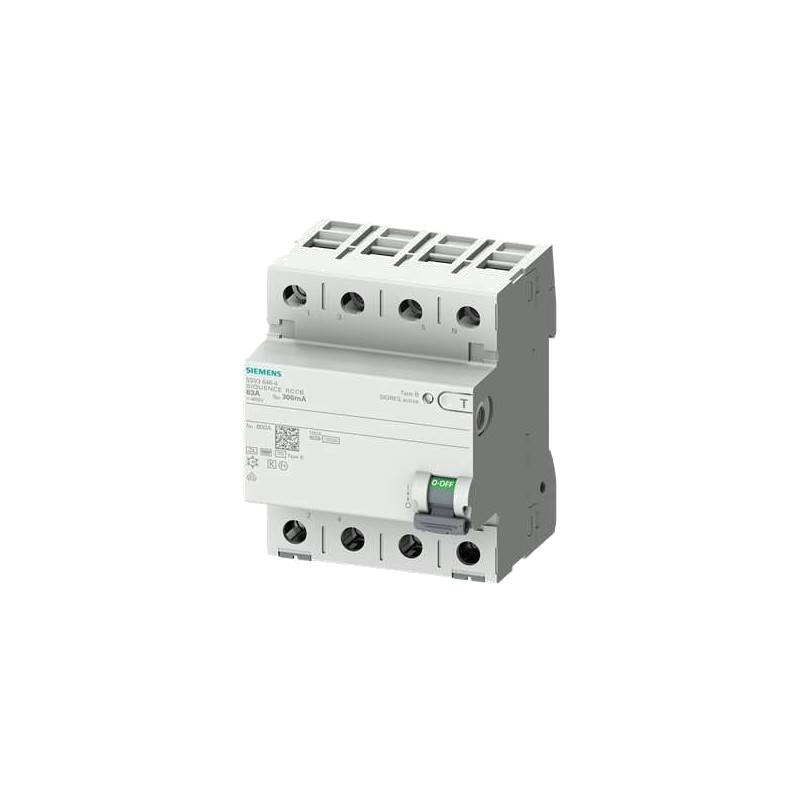
Siemens 5SV3442-6 Leakage protection switch 4P 25A 100mA


The Siemens 5SV3442-6 is a robust 4-pole, 25A, 100mA residual current circuit breaker (RCCB) designed for reliable protection against electrical hazards in demanding industrial environments. This device offers superior safety through rapid detection of earth faults and leakage currents, preventing potential fires and safeguarding personnel from electric shock. Its core advantages lie in its high breaking capacity, dependable tripping characteristics, and durable construction, making it a cornerstone for electrical safety installations. Key technical parameters include a rated voltage of 400V AC, a frequency of 50/60 Hz, and a breaking capacity (Icn) of 6kA.
Siemens 5SV3442-6: Product Specifications
| Feature | Specification |
| :---------------------- | :------------------------------------------------- |
| Product Type | Residual Current Circuit Breaker (RCCB) |
| Pole Configuration | 4-pole (3-phase) |
| Rated Current (In) | 25A |
| Rated Residual Current | 100mA |
| Rated Voltage (Un) | 400V AC |
| Frequency | 50/60 Hz |
| Breaking Capacity (Icn) | 6kA |
| Tripping Type | Type AC |
| Mounting | DIN rail (35mm) |
| Protection Class | IP20 (enclosure), IP40 (with cover) |
| Operating Temperature | -25°C to +45°C |
| Standards | IEC/EN 61008-1, IEC/EN 61008-2-1 |
Core Features & Market Positioning
The Siemens 5SV3442-6 distinguishes itself in the market through its unwavering reliability and advanced protection capabilities. As an AC-type RCCB, it effectively detects sinusoidal AC residual currents, a common fault characteristic in many industrial applications. Its robust construction ensures consistent performance even under harsh environmental conditions, a critical factor for equipment longevity and operational uptime. The 4-pole design is particularly advantageous for three-phase systems, providing comprehensive protection across all phases and the neutral conductor. This positions the 5SV3442-6 as a preferred choice for engineers and facility managers prioritizing safety, compliance, and operational continuity in complex electrical networks.
Key Application Scenarios
This Siemens leakage protection switch is ideally suited for safeguarding electrical installations in a variety of industrial sectors. It is frequently deployed in manufacturing plants to protect machinery and personnel from earth faults, particularly in areas with high humidity or conductive dust. In commercial buildings, it provides essential protection for power distribution panels serving critical equipment like HVAC systems, server rooms, and lighting circuits. Its application extends to infrastructure projects, ensuring the safe operation of power supplies for telecommunication networks and public utility systems. The 100mA residual current sensitivity makes it suitable for main incoming protection or in circuits where a higher level of fault detection is required to prevent significant damage or cascading failures.
Practical System Integration Guidance
Integrating the Siemens 5SV3442-6 into existing or new electrical systems is a straightforward process, adhering to standard industrial electrical practices. The unit is designed for DIN rail mounting, allowing for quick and secure installation within standard electrical enclosures. Wiring is typically performed using appropriate cable lugs, ensuring secure connections to the main incoming power supply on the top terminals and outgoing circuits on the bottom terminals. For 4-pole applications, it is crucial to connect all four conductors, including the neutral, to maintain full system protection. When installing in a 3-phase system, careful attention must be paid to phase sequencing to ensure correct operation and to prevent nuisance tripping. Always ensure that the upstream circuit breaker or fuse rating does not exceed the breaking capacity of the 5SV3442-6 to guarantee its protective function.
Operation and Risk Mitigation
The primary function of the Siemens 5SV3442-6 is to provide rapid disconnection of power when a dangerous residual current is detected, thereby mitigating the risks of electric shock and fire. In the event of an insulation failure or accidental contact with a live part, a current will flow to earth. If this leakage current exceeds the 100mA threshold, the internal sensing mechanism triggers a trip, opening the circuit almost instantaneously. Risk mitigation involves regular testing of the RCCB's functionality using its integrated test button. This test should be performed periodically, as recommended by local electrical codes and manufacturer guidelines, to confirm the tripping mechanism is operational. Should the device fail to trip during a test, it indicates a potential fault within the switch, necessitating prompt replacement to maintain safety standards.
Scalability & Long-Term Value
The Siemens 5SV3442-6 offers significant long-term value through its robust design and compatibility with Siemens' broader industrial electrical product ecosystem. Its modular design allows for straightforward replacement or expansion within distribution boards. For systems requiring enhanced monitoring or integration into intelligent building management systems or industrial control platforms, the 5SV3442-6 serves as a reliable foundational protection device. While this specific model is an AC-type, Siemens offers a range of other residual current devices, including Type A, B, and F, allowing for future upgrades or adaptation to systems with different fault current characteristics, such as those involving DC components. This ensures that electrical protection strategies can evolve alongside technological advancements and changing operational requirements.
Frequently Asked Questions (FAQs)
What is the primary function of the Siemens 5SV3442-6?
The Siemens 5SV3442-6 is a residual current circuit breaker (RCCB) designed to protect electrical circuits from earth faults. It detects imbalances in current flow, indicating leakage, and rapidly disconnects the power. This prevents electric shock hazards and reduces the risk of electrical fires.
This device ensures personnel safety by quickly interrupting dangerous current paths to ground. It is crucial for compliance with modern electrical safety regulations in industrial and commercial settings. Its core purpose is enhanced protection beyond standard overcurrent devices.
The 4-pole configuration is specifically designed for three-phase systems, offering comprehensive protection across all live conductors and the neutral. This makes it ideal for industrial machinery and larger power distribution applications where balanced loads are common.
How do I test the Siemens 5SV3442-6 to ensure it's working?
Regularly pressing the integrated test button on the front of the 5SV3442-6 is the primary method to verify its functionality. This simulates a fault condition and should cause the breaker to trip. A successful trip confirms the internal mechanism is operational.
If the breaker does not trip when the test button is pressed, it indicates a malfunction. In such cases, the device must be replaced immediately to maintain electrical safety. Always ensure the main power is on before conducting the test.
The test button is typically labeled "T" or features a test icon. It is recommended to perform this test at least monthly, or as specified by local electrical codes and safety standards. Record test dates for maintenance logs.
Can the Siemens 5SV3442-6 be used in residential applications?
While technically capable, the 100mA sensitivity of the Siemens 5SV3442-6 makes it more suited for industrial or commercial main protection. Residential applications typically use 30mA RCCBs for personal protection against electric shock.
This 4-pole, 25A, 100mA breaker is primarily engineered for three-phase industrial power systems. Its high current and sensitivity ratings align with the needs of heavy machinery and complex electrical grids.
For residential use, where single-phase circuits are standard, a 2-pole RCCB with a lower residual current rating (e.g., 30mA) is generally more appropriate for safeguarding against direct contact. Always consult local electrical codes.
What is the difference between Type AC and other RCCB types like Type A?
Type AC RCCBs, like the 5SV3442-6, are designed to detect sinusoidal AC residual currents. They are suitable for most standard AC circuits in industrial environments where fault currents are typically sinusoidal.
Type A RCCBs can detect both sinusoidal AC residual currents and pulsating DC residual currents. This makes them more versatile for applications where electronic devices that can generate pulsating DC fault currents are present.
Choosing the correct type is vital. For systems with modern electronic equipment (e.g., variable speed drives, power supplies), a Type A or higher is often recommended to ensure effective protection against various fault current waveforms.
What are the consequences of a faulty Siemens 5SV3442-6 tripping frequently?
Frequent tripping of the 5SV3442-6 without an apparent fault may indicate an underlying issue with the protected circuit or connected equipment. This could be due to insulation degradation or an accumulating leakage current.
Investigate the electrical system connected to the breaker to identify the source of the nuisance tripping. Check for damaged wiring, faulty appliances, or excessive capacitive leakage, especially in humid environments.
Persistent nuisance tripping necessitates a thorough professional inspection. It is crucial to resolve the root cause to ensure reliable power supply and to confirm the RCCB is functioning correctly as a safety device.
What does the 4P in the Siemens 5SV3442-6 designation signify?
The "4P" in the product name signifies that the Siemens 5SV3442-6 is a 4-pole circuit breaker. This means it has four physical poles that can interrupt the flow of current, designed for use in three-phase electrical systems.
In a 4-pole configuration, the breaker switches all three live conductors (L1, L2, L3) and the neutral conductor (N) simultaneously. This provides comprehensive protection for three-phase loads and ensures complete isolation when tripped.
This type of breaker is essential for balanced three-phase power distribution, ensuring safety and proper operation of equipment powered by L-N, L-L, or L-L-L configurations within the three-phase network.
What is the breaking capacity (Icn) of the Siemens 5SV3442-6?
The breaking capacity (Icn) of the Siemens 5SV3442-6 is 6kA (kiloamperes). This rating indicates the maximum fault current the device can safely interrupt without sustaining damage.
This 6kA rating is sufficient for many standard industrial and commercial distribution applications where the potential short-circuit current is below this level. It ensures the breaker will operate correctly during a fault without failing open.
It is critical for installation designers to ensure that the prospective fault current at the point of installation does not exceed the breaker's Icn rating. If it does, a higher breaking capacity device or upstream protection is required for safety.
What are the typical installation requirements for the Siemens 5SV3442-6?
The Siemens 5SV3442-6 is designed for standard 35mm DIN rail mounting within electrical enclosures. Ensure the enclosure provides adequate ventilation and protection against environmental factors like dust and moisture.
Wiring connections should be made using appropriately sized cable lugs, ensuring a tight and secure connection to both the line (input) and load (output) terminals. Follow correct phase and neutral conductor connections as per wiring diagrams and local regulations.
Before energizing, double-check all connections and confirm that the upstream protective device (e.g., main circuit breaker) is correctly rated and compatible with the 5SV3442-6's specifications to prevent damage or safety hazards.
Can the Siemens 5SV3442-6 detect DC leakage currents?
No, the Siemens 5SV3442-6 is a Type AC residual current circuit breaker. This means it is specifically designed to detect and react to sinusoidal AC residual currents only.
It will not reliably detect or trip for pulsating DC residual currents or smooth DC residual currents. These types of currents can be generated by modern electronic equipment like power supplies, inverters, and LED drivers.
For circuits with potential DC leakage components, a Type A, Type F, or Type B RCCB would be necessary to ensure adequate protection against all types of residual currents. Always select the RCCB type that matches the potential fault characteristics of the load.
What is the meaning of 100mA residual current rating?
The 100mA residual current rating on the Siemens 5SV3442-6 signifies the threshold leakage current that will trigger the device to trip and disconnect the circuit. It means that if a current exceeding 100 milliamperes flows to earth, the breaker will activate.
This sensitivity level is generally considered suitable for main incomer protection in industrial facilities or for protecting groups of circuits where the primary concern is fire prevention and significant equipment damage, rather than direct personal protection against electric shock.
For direct personal protection against electric shock in residential or office environments, a lower sensitivity rating, typically 30mA, is usually specified by electrical codes, as this level is considered safer for human contact.