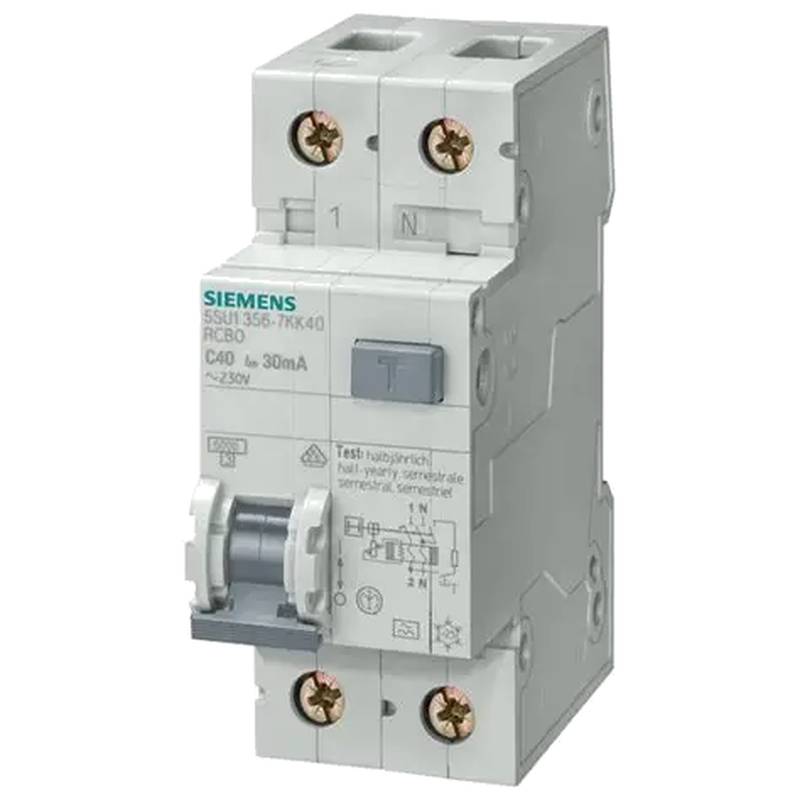












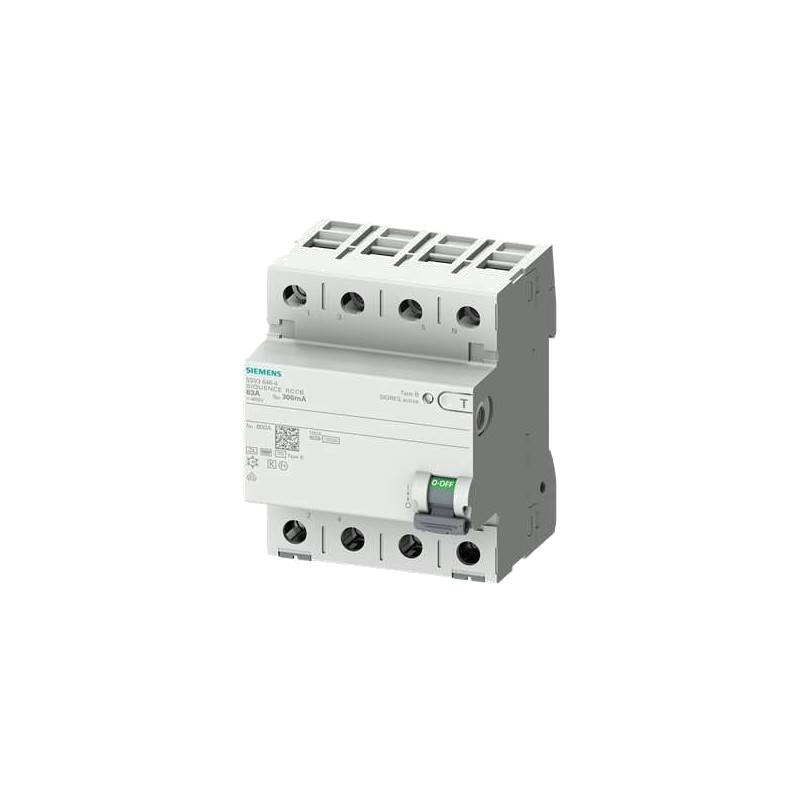
Siemens 5SV3846-8 Miniature Circuit Breaker 4P 63A 1000mA


The Siemens 5SV846-8 Miniature Circuit Breaker (MCB) is a robust 4-pole, 63A device with a 1000mA residual current sensitivity, engineered for superior protection in demanding electrical installations. Its primary advantage lies in its dual functionality, offering both overcurrent and earth-fault protection within a single unit, thereby streamlining panel design and reducing component count. The 5SV846-8 is distinguished by its high breaking capacity, ensuring safety during fault conditions, and its reliable tripping mechanism, safeguarding personnel and equipment from electrical hazards. Key technical parameters include its 4-pole configuration, 63A rated current, and a residual operating current of 1000mA, with a rated voltage of 400V AC. This MCB is designed for AC applications, ensuring efficient and secure power distribution.
Product Specifications
| Feature | Specification |
| :----------------------- | :--------------------------------------------- |
| Product Type | Miniature Circuit Breaker (MCB) |
| Pole Configuration | 4-Pole |
| Rated Current (In) | 63 A |
| Residual Operating Current | 1000 mA |
| Rated Voltage (Ue) | 400 V AC |
| Tripping Characteristic | Type B, C, or D (dependent on specific variant) |
| Breaking Capacity (Icn) | 6 kA or 10 kA (dependent on specific variant) |
| Frequency | 50/60 Hz |
| Terminal Type | Screw Terminals |
| Mounting Type | DIN Rail (35 mm) |
| Protection Class | IP20 (enclosure), IP40 (front face) |
Core Features & Market Positioning
The Siemens 5SV846-8 MCB stands out in the industrial protection landscape due to its integrated residual current protection, a feature often requiring a separate device. This consolidation simplifies wiring, reduces enclosure space, and lowers overall installation costs, positioning it as a highly efficient solution for complex electrical systems. Its robust construction and adherence to stringent international standards (IEC/EN 60947-2) underscore Siemens' commitment to reliability and safety. The MCB's high breaking capacity ensures it can safely interrupt fault currents, a critical factor in preventing catastrophic equipment damage and ensuring operational continuity. This makes it a preferred choice for applications where dependable protection is paramount.
Key Application Scenarios
This Siemens MCB is ideally suited for distribution boards in commercial buildings, industrial facilities, and demanding residential applications where comprehensive protection against overcurrents and earth faults is essential. Its 1000mA residual current sensitivity makes it particularly effective for safeguarding equipment in environments with higher potential leakage currents, such as motor control centers or areas with extensive machinery. It is commonly deployed in main incomer panels and sub-distribution boards to provide a primary layer of protection for entire circuits or sections of an electrical installation. The 4-pole design ensures simultaneous disconnection of all phases and the neutral conductor, crucial for safety in three-phase systems.
Practical System Integration Guidance
Integrating the Siemens 5SV846-8 MCB into existing or new electrical panels is straightforward, primarily involving mounting on a standard 35mm DIN rail. Wiring requires connecting the incoming power supply to the designated terminals, typically at the top, and the outgoing load circuits to the bottom terminals. For the residual current function, ensure all live conductors (L1, L2, L3, and N) pass through the MCB's internal sensing coil. Proper torque must be applied to the screw terminals to ensure secure connections and prevent overheating. In three-phase systems, correct phase rotation is important, though the MCB itself will function regardless of rotation, ensuring circuit protection.
Operation and Risk Mitigation
The Siemens 5SV846-8 MCB operates by continuously monitoring the current flowing through its circuits. In the event of an overcurrent (due to overload or short circuit), a thermal or magnetic tripping mechanism activates, rapidly opening the contacts and interrupting the power supply. Simultaneously, the residual current function detects imbalances between the live and neutral conductors, indicative of an earth fault. If this imbalance exceeds the 1000mA threshold, the MCB trips, preventing electric shock and mitigating fire risks associated with earth faults. Regular testing of the residual current function using a dedicated test button or an external tester is recommended to ensure its continued operational integrity.
Scalability & Long-Term Value
The Siemens 5SV846-8 MCB offers excellent long-term value through its compatibility with the broader Siemens SENTRON system portfolio. This allows for seamless integration with other Siemens protection devices, switchgear, and control components, facilitating system expansion and upgrades. Its modular design enables easy replacement or addition of circuit breakers within a panel without disrupting adjacent circuits significantly. While not directly an IIoT device, its reliable performance and integration capabilities contribute to the overall stability and efficiency of modern industrial networks, laying a foundation for future smart grid or Industry 4.0 implementations by ensuring robust and dependable basic electrical protection.
FAQs
Q1: What is the primary function of the Siemens 5SV846-8 MCB?
The Siemens 5SV846-8 MCB provides dual protection against overcurrents and earth faults. It ensures electrical safety by preventing damage to equipment and reducing shock hazards. This integrated approach simplifies electrical installations.
It offers both overload and short-circuit protection through its overcurrent sensing mechanisms. The device also detects residual currents, tripping when a fault to earth occurs. This combination is vital for comprehensive circuit safeguarding.
Its main role is to protect electrical circuits and connected loads from abnormal current conditions. By interrupting power during faults, it prevents fires, equipment damage, and protects personnel.
Q2: What does "4P 63A 1000mA" signify for this circuit breaker?
"4P" indicates that the circuit breaker has four poles, meaning it can switch all live conductors and the neutral in a three-phase system. "63A" is the rated current, specifying the maximum continuous current the breaker can handle without tripping.
The "1000mA" signifies the residual operating current sensitivity. This means the breaker will trip if it detects an earth leakage current of 1000 milliamperes or more. This level is typically for industrial applications where higher leakage may be expected or for equipment protection.
In summary, it's a four-pole, 63-amp breaker designed to trip on significant earth leakage faults above 1000mA, offering robust protection in AC electrical systems.
Q3: Where is the Siemens 5SV846-8 MCB typically installed?
This MCB is commonly found in main distribution boards and sub-distribution panels within industrial facilities. It's also used in commercial buildings and complex residential electrical systems.
Its application extends to protecting circuits with higher fault current potential or where enhanced earth leakage detection is required. This includes areas with extensive machinery or sensitive equipment.
The 4-pole configuration makes it ideal for three-phase power distribution systems, ensuring all conductors are protected and disconnected simultaneously during fault conditions.
Q4: What is the breaking capacity of the Siemens 5SV846-8?
The breaking capacity, often denoted as Icn, indicates the maximum fault current the MCB can safely interrupt without sustaining damage. For the Siemens 5SV846-8, this capacity is typically 6 kA or 10 kA, depending on the specific variant.
A higher breaking capacity is crucial for installations where high short-circuit currents are anticipated. This ensures the breaker will reliably shut down the circuit during a severe fault, preventing dangerous arcing and potential system failure.
Referencing the exact product variant is important to confirm its specific breaking capacity. This parameter is critical for ensuring the MCB is appropriately rated for the electrical network it serves.
Q5: How does the residual current protection (1000mA) function?
The 1000mA residual current function detects an imbalance between the current flowing into a circuit and the current returning from it. This imbalance typically indicates current leaking to earth.
When the leakage current exceeds 1000mA, the breaker's internal sensing mechanism triggers a rapid disconnection of power. This prevents electrocution and fire hazards caused by insulation failures or accidental contact with live parts.
This sensitivity level is generally higher than that used for personal protection (e.g., 30mA) and is more suited for protecting equipment or specific industrial scenarios.
Q6: Is the Siemens 5SV846-8 suitable for DC circuits?
No, the Siemens 5SV846-8 Miniature Circuit Breaker is designed and rated for AC (Alternating Current) applications only. Its tripping mechanisms and construction are optimized for AC system characteristics.
Using this breaker in a DC (Direct Current) circuit can lead to unreliable operation and potentially hazardous situations. DC circuits have different fault characteristics than AC circuits, requiring specialized DC breakers.
Always ensure that the circuit breaker's specifications match the type of current in the system you are protecting. For DC circuits, a dedicated DC miniature circuit breaker must be used.
Q7: What are the main advantages of using a 4-pole MCB like the 5SV846-8?
A 4-pole MCB ensures simultaneous switching of all live conductors (L1, L2, L3) and the neutral conductor. This is critical for safety in three-phase systems, ensuring complete isolation during fault conditions.
It provides enhanced protection in systems where the neutral conductor carries significant current or is part of the protective earthing system. This prevents neutral overloads and ensures proper operation of residual current devices.
The 4-pole configuration simplifies wiring and can reduce the number of components needed compared to using separate single or double-pole breakers for multi-phase loads.
Q8: How do I test the residual current function of the 5SV846-8?
Most Siemens MCBs with residual current functions include a built-in test button, often labeled "T" or "Test." Pressing this button simulates a residual current fault.
When the test button is pressed, it should cause the circuit breaker to trip, indicating that the residual current protection mechanism is functioning correctly. This test should be performed periodically, typically monthly.
If the breaker does not trip when the test button is pressed, it indicates a malfunction, and the unit likely needs to be replaced to ensure continued safety.
Q9: Can the Siemens 5SV846-8 be used in residential or only industrial settings?
While primarily designed for industrial and commercial applications due to its robust features and 1000mA sensitivity, it can be used in residential settings, particularly for main incomer protection or for specific circuits requiring higher levels of protection.
The 1000mA residual current tripping level is generally for equipment protection or specific industrial safety requirements, not typically for direct personal protection in homes, where 30mA devices are standard.
However, its overcurrent protection features are universally applicable. Its use in residential contexts would depend on specific local electrical codes and the overall system design requirements.
Q10: What is the compatibility of the Siemens 5SV846-8 with other Siemens components?
The Siemens 5SV846-8 is part of the Siemens SENTRON protection device series, ensuring excellent compatibility with other SENTRON components. This includes busbars, terminal blocks, and other circuit breakers within the same system.
This compatibility facilitates modular panel building and allows for easy expansion or reconfiguration of electrical distribution systems. It integrates seamlessly into Siemens' broader electrical engineering solutions.
For advanced integration, such as with industrial control systems or IIoT platforms, while the MCB itself is a fundamental protection device, its reliable operation supports the overall system's connectivity and data acquisition capabilities.