












ABB S202-B16 Double Pole MCB 16A Residential Use


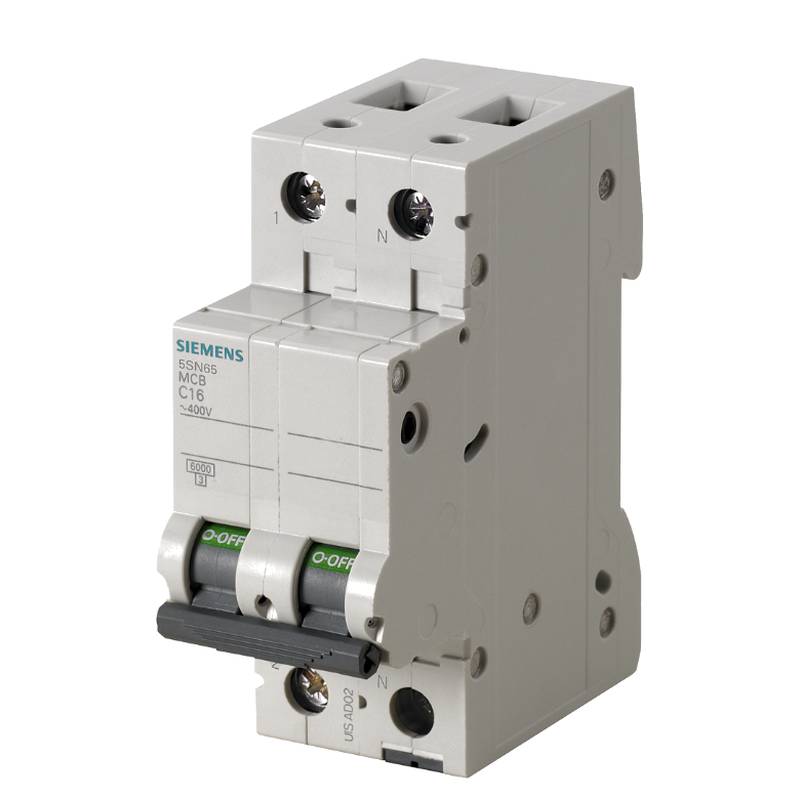
The ABB S202-B16 double pole Miniature Circuit Breaker (MCB) is a crucial component for ensuring electrical safety and reliable power distribution in residential applications. This device provides robust protection against overcurrents, specifically overloads and short circuits, safeguarding both electrical installations and connected appliances. Its design adheres to stringent international standards, making it a dependable choice for modern homes.
Product Specifications
| Specification | Value |
| :---------------------------- | :------------------------------------------------------- |
| Product Type | Miniature Circuit Breaker (MCB) |
| Manufacturer | ABB |
| Series | System pro M compact S200 |
| Model | S202-B16 |
| Number of Poles | 2 |
| Rated Current (In) | 16 A |
| Tripping Characteristic | Type B |
| Rated AC Voltage (Ue) | 400 V |
| Rated Impulse Voltage (Uimp) | 4 kV |
| Breaking Capacity (Icn) | 6 kA @ 400V AC |
| Frequency (f) | 50/60 Hz |
| Energy Limiting Class | 3 |
| Mounting | DIN Rail (TH35-15/TH35-7.5) |
| Connection Capacity (Rigid) | 0.75 – 35 mm² |
| Connection Capacity (Flexible)| 0.75 – 25 mm² |
| Operating Temperature | -25 °C to +55 °C |
| Degree of Protection (Enclosure)| IP20 |
| Mechanical Endurance | 20,000 cycles |
| Electrical Endurance | 20,000 AC cycles |
| Dimensions (H x W x D) | 88 mm x 35 mm x 69 mm |
Core Features & Market Positioning
The ABB S202-B16 MCB stands out in the residential market due to its robust construction and adherence to multiple international standards, including IEC/EN 60898-1 and IEC/EN 60947-2. This compliance ensures its suitability for a wide range of residential electrical installations. Its current-limiting design provides fast disconnection during fault conditions, significantly reducing the risk of thermal damage to wiring and connected equipment. The "Type B" tripping characteristic is specifically designed for sensitive equipment and domestic appliances, initiating disconnection at 3 to 5 times its rated current. This precise response minimizes nuisance tripping while effectively protecting against hazardous fault currents. Furthermore, the S200 series, to which the S202-B16 belongs, is known for its compact size and ease of installation, making it a preferred choice for panel builders and electricians prioritizing efficiency and space-saving solutions. The patented connection terminal, featuring a pressure plate, ensures secure and safe wire connections, simplifying the installation process.
Key Application Scenarios
The primary application for the ABB S202-B16 MCB is in residential electrical distribution boards. It is ideal for protecting individual circuits that feed sensitive loads such as lighting, general-purpose outlets, and small appliances. Its Type B characteristic makes it particularly suitable for circuits where rapid response to low-level overcurrents is critical, preventing damage to electronics and other delicate equipment. This MCB can be used for branch circuit protection in new installations or as a direct replacement in existing fuse boxes or distribution panels, ensuring compliance with current safety regulations. Its dual-pole design allows for the simultaneous isolation of both live and neutral conductors, offering enhanced safety during maintenance or in specific circuit configurations. Beyond purely residential use, the S200 series, including the S202-B16, is also approved for commercial and light industrial applications where similar protection requirements exist.
Practical System Integration Guidance
Integrating the ABB S202-B16 into an electrical system is straightforward, primarily involving DIN rail mounting and proper wiring. The device clips securely onto a standard 35mm DIN rail, a common mounting method in modern electrical panels. For wiring, the S202-B16 accommodates rigid conductors from 0.75 to 35 mm² and flexible conductors from 0.75 to 25 mm². The upper connection opening for cables, positioned above the phase rail connection, aids in visibility during wiring. A pressure plate mechanism within the terminal ensures a robust and vibration-resistant connection. It is crucial to ensure that incoming power is connected to the line terminals and outgoing power to the load terminals. The device is designed for AC use only. For enhanced safety, a bottom-fitting auxiliary contact can be mounted on S200 series MCBs to save space, allowing for remote indication or signaling.
Operation and Risk Mitigation
The ABB S202-B16 operates using a dual-mechanism system: a delayed thermal tripping mechanism for overload protection and an electromechanical tripping mechanism for short-circuit protection. When an overload occurs, the bimetallic strip heats up and bends, triggering the trip mechanism. In the event of a short circuit, the electromagnetic coil is energized, causing an instantaneous trip. Operation is managed via a toggle lever, with clear "ON" and "OFF" positions. If the MCB trips, the lever moves to a central or tripped position. To reset, the lever must first be moved to the full "OFF" position before being switched back to "ON". The degree of protection for the enclosure is IP20, meaning it is protected against solid objects larger than 12.5 mm, but not against water ingress. Therefore, it must be installed within a suitable enclosure or panel board to maintain its IP rating and prevent accidental contact. Risk mitigation is inherent in its design; the "current limiting" feature means it interrupts fault currents before they reach their peak, thereby minimizing damage and fire hazards. Compliance with UL1077 standards further attests to its safety for supplemental circuit protection.
Scalability & Long-Term Value
The ABB S202-B16 MCB offers significant long-term value through its compatibility with the broader ABB System pro M compact range and its robust design. The S200 series MCBs can be expanded with various accessories, such as auxiliary and signal contacts, remote control mechanisms, shunt trips, and under-voltage releases, allowing for integration into more sophisticated control and monitoring systems. This modularity ensures that a residential electrical system can be upgraded or adapted to meet evolving needs without requiring a complete replacement of the fundamental protection devices. The mechanical and electrical endurance ratings of 20,000 cycles ensure a long operational life under normal conditions, reducing the total cost of ownership over the lifespan of the installation. Furthermore, its compliance with a wide array of global standards means it remains a relevant and reliable component even as regulations evolve.
Frequently Asked Questions (FAQs)
Q1: What is the primary function of the ABB S202-B16 MCB?
The ABB S202-B16 MCB serves as an essential safety device that protects electrical circuits from overcurrents. It automatically interrupts the flow of electricity when it detects an overload or a short circuit. This prevents overheating of wires and potential damage to connected appliances and electrical installations.
This dual-protection mechanism is critical for maintaining the integrity of the electrical system and preventing fire hazards. The MCB's quick response ensures that fault conditions are managed effectively, safeguarding both property and personal safety.
Its role extends to ensuring compliance with electrical safety standards, making it a fundamental component in any modern residential electrical panel.
Q2: What does "Type B" tripping characteristic mean for the S202-B16?
A Type B tripping characteristic indicates that the S202-B16 will trip (disconnect power) when the current reaches 3 to 5 times its rated current (16A). This characteristic is ideal for protecting circuits with low inrush currents, such as lighting, socket outlets, and sensitive electronic devices.
This sensitivity ensures that even relatively small, sustained overcurrents are quickly detected and interrupted. It provides a balance between protection against damaging faults and avoiding nuisance tripping from normal operating conditions.
Therefore, Type B MCBs are a common choice for general-purpose circuits in residential settings where the connected loads typically do not have significant starting surges.
Q3: Can the ABB S202-B16 be used in both AC and DC circuits?
The ABB S202-B16 Miniature Circuit Breaker is designed and rated primarily for AC (Alternating Current) circuits, specifically up to 400V AC. While some ABB S200 series MCBs have DC variants (like the S200M DC), the S202-B16 model itself is intended for AC applications.
Using this AC-rated MCB in a DC circuit can lead to unpredictable performance and failure to trip correctly, posing a significant safety risk. DC circuits have different arc-quenching requirements compared to AC circuits.
Always verify the product specifications and intended application before installation. For DC applications, specific DC-rated circuit breakers from ABB or other manufacturers should be selected.
Q4: What is the breaking capacity of the S202-B16 MCB?
The ABB S202-B16 has a rated short-circuit breaking capacity (Icn) of 6 kA at 400V AC. This specification indicates the maximum fault current the MCB can safely interrupt without sustaining damage. A higher breaking capacity ensures greater protection in systems where higher fault currents are possible.
This 6 kA rating is generally sufficient for most residential installations. It signifies that the breaker can effectively and safely disconnect circuits even when subjected to significant short-circuit currents.
Ensuring the breaking capacity of the MCB meets or exceeds the prospective fault current at the point of installation is a fundamental safety requirement in electrical design.
Q5: How is the ABB S202-B16 installed in an electrical panel?
Installation is typically done by clipping the MCB onto a standard 35mm DIN rail within an electrical distribution board or panel. The device features terminals designed for connecting rigid or flexible conductors, with specific cross-sectional area requirements.
Ensure all power is disconnected before installation. Securely attach the MCB to the DIN rail and then connect the incoming line and neutral conductors to the appropriate terminals. The outgoing load wires connect to the load-side terminals.
The compact dimensions (88mm x 35mm x 69mm) allow for efficient use of space within the panel. Its finger-safe (IP20) terminals require proper installation within an enclosure for full protection.
Q6: What is the difference between a Type B, Type C, and Type D MCB?
The tripping characteristics (B, C, D, K, Z) define the current level at which an MCB will trip instantaneously due to a short circuit. Type B trips at 3-5 times rated current (for sensitive loads), Type C trips at 5-10 times (for general loads with moderate inrush), and Type D trips at 10-20 times (for loads with high inrush, like motors).
The S202-B16, being a Type B, is best suited for residential applications with sensitive equipment. Type C is more common for general commercial and industrial circuits, while Type D is used for specific industrial applications like motor starting.
Choosing the correct tripping characteristic is crucial for effective protection without unnecessary tripping. Each type offers a specific level of sensitivity to overcurrents based on the expected inrush characteristics of the protected equipment.
Q7: Can an auxiliary contact be added to the ABB S202-B16?
Yes, the ABB S200 series, including the S202-B16, supports the mounting of bottom-fitting auxiliary contacts. These contacts do not affect the MCB's primary protective function but provide additional signaling capabilities.
Auxiliary contacts can be used for remote indication of the MCB's status (ON, OFF, or tripped) or to integrate with control systems. This is particularly useful in smart home systems or for remote monitoring applications.
The ability to add accessories like auxiliary contacts enhances the modularity and functionality of the S200 series, allowing for system expansion and integration with other electrical or automation components.
Q8: What are the voltage ratings for the S202-B16?
The ABB S202-B16 has a rated AC operational voltage (Ue) of 400V and a rated insulation voltage (Ui) of 440V, conforming to IEC/EN 60664-1 standards. It also has a rated DC operational voltage limit of 125V DC per pole.
While it can handle 125V DC per pole, it is crucial to note that this MCB is primarily designed for AC circuits. Its performance and safety in DC circuits are limited, and specific DC-rated MCBs should be used for higher DC voltages or applications.
Always ensure the operational voltage of your system does not exceed the rated voltage of the MCB to guarantee safe and reliable operation.
Q9: What safety standards does the ABB S202-B16 comply with?
The ABB S202-B16 complies with several key international safety and performance standards, including IEC/EN 60898-1, IEC/EN 60947-2, and UL1077. These certifications ensure the MCB meets rigorous requirements for protection, performance, and interoperability.
Compliance with these standards guarantees that the device offers reliable overload and short-circuit protection. UL1077 listing, in particular, signifies its suitability as a supplemental protector in various electrical systems.
These approvals make the S202-B16 a globally accepted and trusted component for residential, commercial, and industrial electrical installations.
Q10: How does the S202-B16 protect against short circuits?
The S202-B16 protects against short circuits through its electromechanical tripping mechanism. When a very high current flows due to a short circuit, a solenoid within the MCB is energized, causing a rapid mechanical trip that disconnects the circuit almost instantaneously.
This instantaneous response is critical because short-circuit currents can rise very rapidly and reach magnitudes far exceeding those of overloads. The MCB's design ensures it can interrupt these high fault currents before they can cause significant damage to wiring or equipment.
The breaking capacity (6 kA) indicates the maximum short-circuit current it can safely interrupt, providing essential protection against severe electrical faults.