











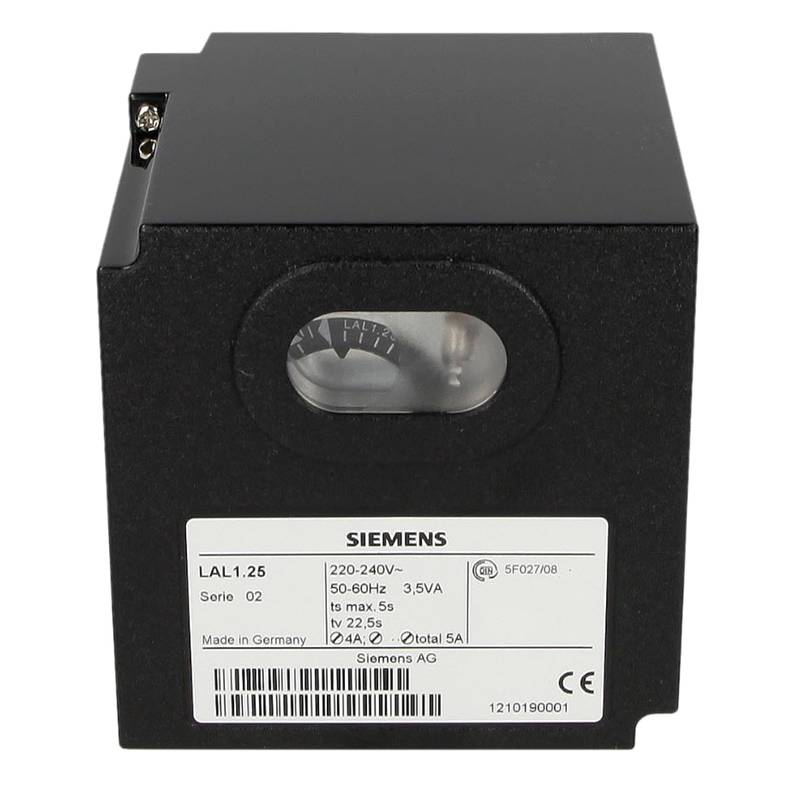
SIEMENS LFL1.322 Multi-Stage Burner Control LFL1.322


The SIEMENS LFL1.322 multi-stage burner control is a critical component for reliable and efficient operation of industrial combustion systems. This advanced control unit offers significant advantages in terms of safety, performance, and operational flexibility. Its core strengths lie in its multi-stage functionality, ensuring optimal fuel-air ratios across varying load demands, and its robust design for demanding industrial environments. Key technical parameters include its wide operating voltage range, typically supporting 100-240 VAC, and its comprehensive safety interlocking capabilities. The LFL1.322 is engineered for precise control of fuel firing systems, providing a stable and safe flame throughout the combustion process.
Product Specifications
| Feature | Specification |
| :------------------ | :------------------------------------------- |
| Product Type | Multi-Stage Burner Control |
| Manufacturer | Siemens |
| Model Number | LFL1.322 |
| Power Supply | 100-240 VAC, 50/60 Hz |
| Number of Stages | Typically 2-stage |
| Flame Monitoring | Ionization probe or UV sensor compatible |
| Safety Time (purge)| Programmable |
| Max. Ambient Temp. | -20°C to +60°C |
| Enclosure | IP40 or IP54 (depending on variant/housing) |
| Communication | Potential for integration via external modules |
Core Features & Market Positioning
The SIEMENS LFL1.322 stands out in the industrial burner control market due to its inherent reliability and sophisticated multi-stage operation, which directly translates to enhanced energy efficiency and reduced emissions. Unlike simpler single-stage controllers, the LFL1.322 intelligently manages fuel and air flow, adapting to fluctuating load requirements. This capability is particularly valued in applications where precise temperature control and consistent performance are paramount. Its robust construction and adherence to stringent safety standards position it as a preferred choice for engineers and facility managers prioritizing operational integrity and long-term cost savings over initial purchase price. The Siemens reputation for quality and extensive support further solidifies its market leadership.
Key Application Scenarios
The versatility of the SIEMENS LFL1.322 burner control makes it suitable for a wide array of industrial heating applications. It is extensively employed in controlling industrial boilers, process heaters, and thermal oxidizers across sectors such as chemical processing, food and beverage manufacturing, and power generation. Its multi-stage capabilities are crucial for applications requiring precise temperature regulation, such as in drying ovens or specialized industrial furnaces. Users frequently seek solutions for reliable and safe combustion in high-demand environments, making the LFL1.322 an ideal fit for maintaining operational continuity and meeting stringent environmental regulations.
Practical System Integration Guidance
Integrating the SIEMENS LFL1.322 burner control into existing or new systems demands careful attention to wiring and setup. The unit typically connects to fuel valves, air dampers, ignition transformers, and flame detection devices (ionisation probe or UV sensor). A common setup involves utilizing the LFL1.322's terminal blocks for direct wiring, ensuring correct polarity and secure connections. Pre-purge and post-purge cycles are configurable to ensure safe startup and shutdown. For advanced integration, compatibility with Siemens control platforms or SCADA systems can be achieved through optional communication modules, allowing for remote monitoring and control.
Operation and Risk Mitigation
Safe operation of the SIEMENS LFL1.322 is paramount, with built-in safety interlocks designed to prevent hazardous conditions. During startup, the control performs a pre-purge sequence to clear the combustion chamber of any residual gases. Flame detection is continuously monitored; if the flame is lost, the unit will immediately shut off fuel supply and initiate a post-purge. Critical error codes, often indicated by flashing LEDs on the unit or transmitted via a communication interface, signal specific fault conditions such as flame failure, pilot failure, or internal malfunctions. Understanding these codes and adhering to recommended maintenance schedules are key to mitigating operational risks and ensuring prolonged service life.
Scalability & Long-Term Value
The SIEMENS LFL1.322 burner control offers substantial long-term value through its compatibility with Siemens' broader automation portfolio, facilitating seamless integration into evolving industrial control architectures. While the LFL1.322 itself is a dedicated burner control, its ability to interface with Programmable Logic Controllers (PLCs) and Human-Machine Interfaces (HMIs) from Siemens or other manufacturers allows for system expansion and modernization. This compatibility ensures that investments in burner control remain relevant even as plant-wide automation strategies advance, supporting the integration of IIoT capabilities for predictive maintenance and enhanced operational intelligence.
Frequently Asked Questions
What is the primary function of the SIEMENS LFL1.322?
The SIEMENS LFL1.322 is a multi-stage burner control. It manages the ignition and operation of industrial burners, ensuring safe and efficient combustion.
It precisely controls fuel and air supply to maintain optimal flame conditions. The unit includes safety interlocks to prevent hazardous situations.
Its multi-stage capability allows for adjustments based on load demand, improving efficiency.
How does the LFL1.322 handle flame failure detection?
The LFL1.322 utilizes a flame sensor, typically an ionization probe or a UV sensor, for continuous flame monitoring. If flame is lost during operation, it immediately de-energizes the fuel valves.
The controller then initiates a safety shutdown sequence, which includes a post-purge of the combustion chamber to clear any unburned fuel. This prevents dangerous accumulation of combustible gases.
This rapid and automatic response to flame failure is a critical safety feature, minimizing risks associated with uncontrolled combustion.
What are the typical voltage requirements for the LFL1.322?
The SIEMENS LFL1.322 generally operates on a standard industrial voltage supply. It is designed to accept a wide input range, commonly from 100 to 240 VAC.
This broad voltage compatibility simplifies installation in various electrical systems and regions without requiring complex voltage conversion. Always verify the specific model's datasheet for exact specifications.
Ensure the power source is stable and meets the unit's requirements to prevent operational issues or damage.