











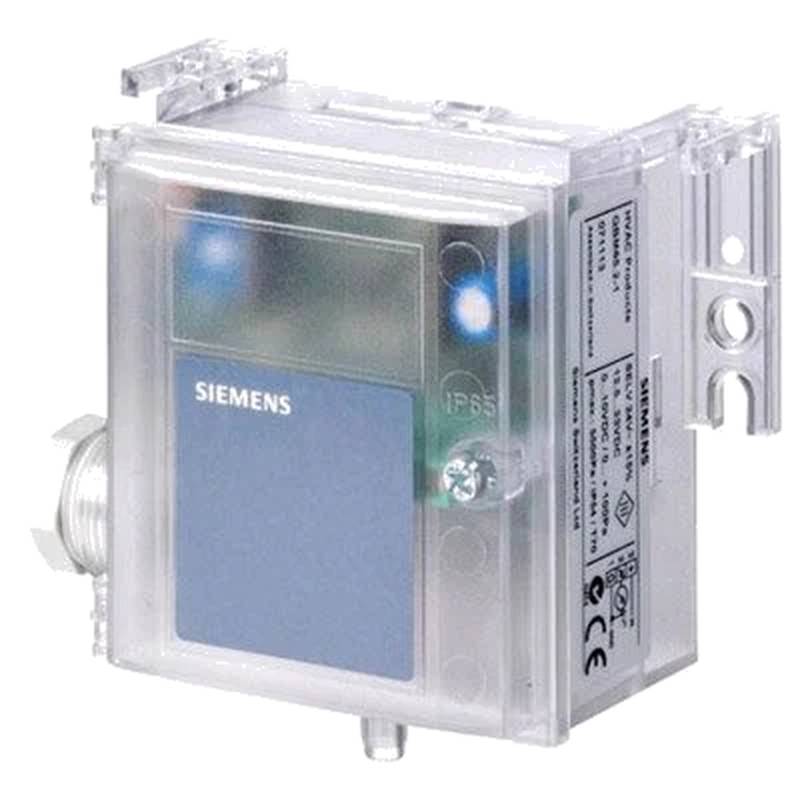
SIEMENS QBM3020-25 Differential Pressure Sensor 2500 Pa


The SIEMENS QBM3020-25 Differential Pressure Sensor stands as a robust solution for accurate differential pressure measurement in HVAC and building automation systems, boasting a 2500 Pa measuring range. This sensor offers exceptional reliability and precision, crucial for maintaining optimal environmental control and energy efficiency. Its core advantages include a user-friendly calibration process, high accuracy of ±1.5 Pa, and a versatile power supply range of 24 VAC/VDC. The QBM3020-25 is engineered for seamless integration, featuring standard signal outputs like 0…10 V and 4…20 mA, and a durable IP54 protection rating for demanding industrial environments. With a response time of less than 10 seconds, it ensures timely data for system adjustments.
Product Specifications
| Parameter | Value |
| :-------------------- | :--------------------------------------- |
| Measuring Range | 0…2500 Pa |
| Accuracy | ±1.5 Pa (at 1000 Pa) |
| Output Signal | 0…10 V or 4…20 mA (switchable) |
| Power Supply | 24 VAC/VDC |
| Operating Temperature | -20…+50 °C |
| Storage Temperature | -30…+70 °C |
| Protection Rating | IP54 |
| Response Time | < 10 s |
| Connection | G1/4" internal thread, pressure ports |
| Dimensions | 86 x 72 x 31 mm |
Core Features & Market Positioning
The SIEMENS QBM3020-25 differentiates itself through its inherent Siemens quality and advanced sensor technology, positioning it as a premium choice for applications demanding high accuracy and long-term stability. Its advanced MEMS technology ensures precise and reliable readings, even in fluctuating environmental conditions. Market analysis indicates a strong demand for differential pressure sensors that offer straightforward integration and robust performance, areas where the QBM3020-25 excels. Its competitive edge lies in its combination of a broad measuring range, excellent accuracy, and comprehensive environmental resistance, making it a preferred component for sophisticated building management systems seeking to optimize airflow and energy consumption.
Key Application Scenarios
This differential pressure sensor is ideally suited for a variety of critical applications within industrial and commercial settings. It is extensively used for monitoring air and gas pressure in ventilation systems, controlling fan speeds, and ensuring precise duct pressure regulation in HVAC applications. Its accuracy makes it suitable for positive and negative pressure monitoring in cleanrooms and laboratories, maintaining required air change rates and containment. Furthermore, the QBM3020-25 is frequently deployed in filter monitoring to detect clogging, thereby optimizing maintenance schedules and system performance. Its versatility extends to controlling variable air volume (VAV) systems, ensuring consistent airflow to different zones within a building.
Practical System Integration Guidance
Integrating the SIEMENS QBM3020-25 into existing systems is designed for efficiency. The sensor requires a 24 VAC or 24 VDC power supply, with polarity to be observed for DC connections. Signal output selection between 0-10 V and 4-20 mA is typically managed via internal jumpers or DIP switches, detailed in the product manual. For installation, the sensor should be mounted in a location that minimizes vibration and exposure to extreme temperatures, ensuring accurate readings. Pressure connections are facilitated via G1/4" internal threads, and appropriate tubing or fittings must be used to establish a secure and leak-free connection to the points of pressure measurement. Proper grounding is essential for optimal signal integrity and electrical safety.
Operation and Risk Mitigation
Safe and effective operation of the SIEMENS QBM3020-25 relies on adhering to its specified operating parameters. Avoid exposing the sensor to pressures exceeding its rated range, as this can lead to permanent damage and inaccurate measurements. Ensure that the fluid being measured is compatible with the sensor's wetted parts. In case of erratic readings or no output, check power supply voltage and polarity, verify all connections are secure, and confirm the correct signal output is selected. For troubleshooting, consult the official SIEMENS documentation, which often provides detailed error code interpretations and guided resolution steps for common issues. Maintaining a clean environment around the sensor and its connections can prevent contamination that might affect performance.
Scalability & Long-Term Value
The SIEMENS QBM3020-25 offers significant long-term value through its compatibility with a wide range of automation platforms and its robust design. Its standard output signals ensure interoperability with most Building Management Systems (BMS) and Programmable Logic Controllers (PLCs). The sensor is designed for durability, minimizing the need for frequent replacements and reducing total cost of ownership. For integration into modern Industrial Internet of Things (IIoT) ecosystems, the QBM3020-25 can be coupled with data acquisition modules that enable remote monitoring, analysis, and predictive maintenance strategies, thereby enhancing the overall intelligence and efficiency of building operations.
FAQs
Q1: What is the primary function of the SIEMENS QBM3020-25 sensor?
This sensor measures the difference between two pressures. It is crucial for monitoring airflow in HVAC systems. It ensures precise pressure control in various industrial applications.
Q2: What is the accuracy of the SIEMENS QBM3020-25?
The sensor provides a high accuracy of ±1.5 Pa. This is specified at a measuring point of 1000 Pa. This precision is vital for sensitive control loops.
Q3: What are the output signal options for this differential pressure sensor?
It offers a selectable output of 0-10 V or 4-20 mA. This allows for flexible integration with control systems. The choice depends on the specific BMS or PLC requirements.
Q4: What power supply is required for the QBM3020-25?
The sensor operates on a 24 VAC or 24 VDC power supply. It is important to ensure correct polarity for DC connections. Verify the voltage before powering up the device.
Q5: What is the maximum pressure range this sensor can measure?
The SIEMENS QBM3020-25 has a measuring range of up to 2500 Pa. It is designed for differential pressure applications within this limit. Exceeding this can cause damage to the sensor.
Q6: How does the IP54 rating benefit the sensor's application?
The IP54 rating means it is protected against dust ingress. It also offers protection against splashing water from any direction. This makes it suitable for challenging environments.
Q7: Can the QBM3020-25 be used in cleanroom applications?
Yes, its accuracy makes it suitable for cleanroom pressure monitoring. It helps maintain required air pressure differentials. This is key for containment and air quality control.
Q8: What is the response time of this SIEMENS pressure sensor?
The sensor has a response time of less than 10 seconds. This ensures rapid detection of pressure changes. It allows for quick system adjustments.
Q9: How is the QBM3020-25 physically installed and connected?
It features G1/4" internal thread for pressure connections. Standard tubing and fittings are used. Proper mounting and secure connections are vital for performance.
Q10: What are the operating temperature limits for the QBM3020-25?
The sensor can operate between -20 °C and +50 °C. It also has a storage temperature range of -30 °C to +70 °C. This ensures reliability in varied conditions.