











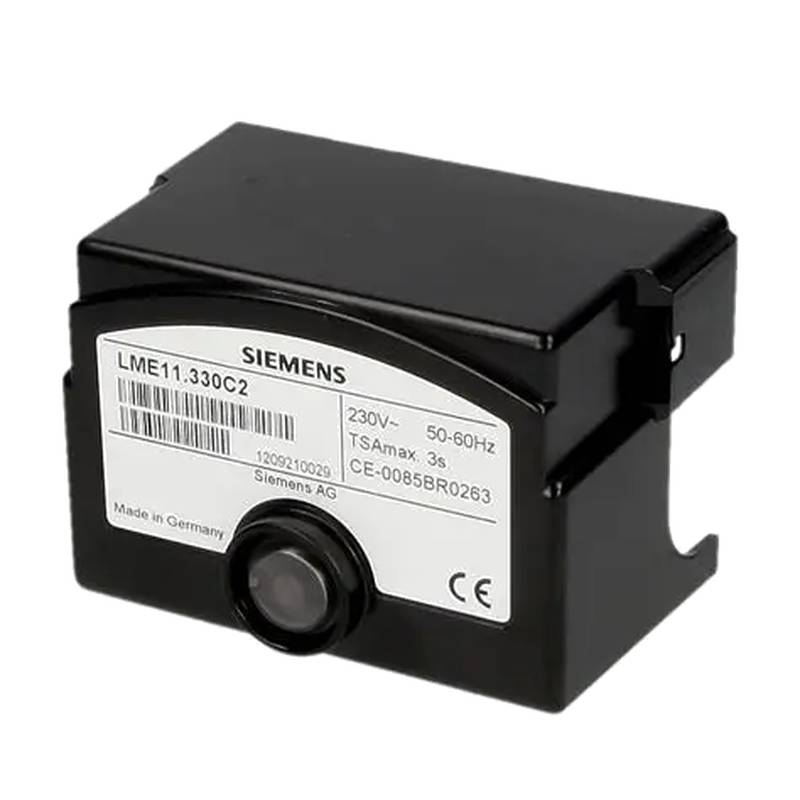
SIEMENS LME22.331C2 Program Controller LME22 Modulating


The SIEMENS LME22.331C2 Program Controller LME22 Modulating is a sophisticated control unit designed for precise management of combustion processes, particularly in industrial heating applications. This advanced controller offers enhanced operational efficiency, robust safety features, and seamless integration capabilities. Key advantages include its modulating control for optimized fuel-air ratio, comprehensive diagnostic capabilities, and reliable performance in demanding environments. Technical parameters highlight its suitability for various burner types and control strategies, ensuring precise temperature regulation and fuel economy.
Product Specifications
| Feature | Specification |
| :------------------------- | :------------------------------------------- |
| Product Type | Program Controller |
| Model | LME22.331C2 |
| Control Type | Modulating |
| Voltage | 230 V |
| Flame Monitoring | Ionization probe and UV sensor |
| Burner Capacity | Single-stage or two-stage operation |
| Safety Time | Adjustable |
| Ambient Temperature Range | -20 to +60 °C |
| Protection Rating | IP40 |
| Dimensions (W x H x D) | 140 x 102 x 124 mm |
| Weight | Approx. 600 g |
Core Features & Market Positioning
The SIEMENS LME22.331C2 distinguishes itself through its advanced modulating control, which allows for dynamic adjustment of fuel and air supply to precisely match the heating demand. This capability ensures optimal combustion efficiency, reducing fuel consumption and emissions, a critical differentiator in today's environmentally conscious industrial landscape. Its robust design and Siemens' reputation for reliability position it as a premium solution for critical heating processes where uptime and safety are paramount. The controller integrates sophisticated self-diagnostic functions, providing real-time feedback on system status and enabling proactive maintenance, thereby minimizing unexpected downtime.
Key Application Scenarios
This program controller is ideally suited for a wide range of industrial combustion applications, including but not limited to, large industrial boilers, process heaters, and thermal oxidizers. Its modulating capability makes it particularly valuable in scenarios requiring precise temperature control, such as in chemical processing, food and beverage production, and manufacturing plants with sensitive heating requirements. The LME22.331C2 is designed for use with gas and oil burners, offering flexibility for various fuel types and combustion systems. Its robust construction also ensures reliable operation in challenging environments commonly found in heavy industry.
Practical System Integration Guidance
Integrating the SIEMENS LME22.331C2 involves careful wiring of actuators, ignition transformers, flame detectors, and sensors according to the manufacturer's diagrams. The controller supports flexible programming for single-stage, two-stage, or modulating burner control sequences, allowing engineers to tailor combustion profiles to specific operational needs. Commissioning typically involves setting parameters such as pre-purge times, post-purge times, safety times, and flame signal strength, often utilizing the integrated digital display and interface. Proper grounding and electrical isolation are essential for safe and reliable operation.
Operation and Risk Mitigation
Operating the SIEMENS LME22.331C2 requires trained personnel familiar with combustion control systems. The controller incorporates multiple safety interlocks and monitoring functions to mitigate operational risks. These include flame failure detection, over-temperature protection, and burner lockout procedures in case of persistent faults. Common error codes, often indicated on the controller's display, signal issues such as flame loss, ignition failure, or limit switch activation. Understanding these codes and their corresponding corrective actions is crucial for safe and efficient operation and troubleshooting.
Scalability & Long-Term Value
The SIEMENS LME22.331C2 offers significant long-term value through its robust design and compatibility with Siemens' broader industrial automation ecosystem. While not explicitly an IIoT device in itself, its integration into larger SCADA or DCS systems allows for remote monitoring, data logging, and advanced analytics, supporting digital transformation initiatives. Its modular design and comprehensive feature set ensure it can adapt to evolving operational demands and regulatory requirements, providing a reliable and future-proof solution for critical combustion control.
FAQs
What is the primary function of the SIEMENS LME22.331C2?
The SIEMENS LME22.331C2 is a modulating program controller for industrial burners. It precisely manages fuel and air supply for optimal combustion and temperature control.
Its core purpose is to ensure safe and efficient operation of heating processes. It achieves this by dynamically adjusting burner output based on system demand.
This controller is vital for applications requiring stable temperatures, reduced fuel consumption, and minimized emissions. It forms the brain of many industrial combustion systems.
How does the modulating control feature benefit industrial heating?
Modulating control allows the burner to continuously adjust its output. This prevents wasteful on/off cycling common in simpler controls.
By precisely matching heat output to demand, it ensures consistent temperatures and significant energy savings. This leads to lower operating costs and improved process quality.
This dynamic adjustment also optimizes the air-to-fuel ratio across the entire operating range, resulting in cleaner combustion and reduced pollutant emissions.
What types of flame detection does the LME22.331C2 support?
The LME22.331C2 typically supports both ionization probes and UV flame sensors. This offers flexibility for different burner designs and fuel types.
Using multiple detection methods enhances safety and reliability, providing redundant flame monitoring. This is critical for preventing hazardous situations.
The controller analyzes signals from these sensors to confirm a stable flame and shut down the burner if the flame is lost, ensuring operational safety.
Can the SIEMENS LME22.331C2 be integrated with Building Management Systems (BMS)?
Yes, the LME22.331C2 can be integrated into larger control systems, including BMS. This is usually achieved via communication interfaces or auxiliary relays.
Integration allows for centralized monitoring and control of heating assets. It enables performance tracking and diagnostics from a single platform.
This connectivity supports advanced energy management strategies and predictive maintenance, maximizing the value of the installed equipment.
What are common troubleshooting steps for LME22.331C2 burner lockout?
First, check the display for specific error codes indicating the cause of lockout. Common issues include flame failure or ignition problems.
Next, inspect the flame detector (ionization or UV) for contamination or damage. Ensure gas and air supplies are adequate and pressures are correct.
Finally, review the safety time settings and burner sequence logic to confirm proper configuration. Consult the manual for detailed fault-finding procedures.
What is the typical voltage requirement for the SIEMENS LME22.331C2?
The SIEMENS LME22.331C2 program controller typically operates on a 230 VAC power supply. This is standard for many industrial control applications.
Ensuring the correct voltage is supplied is crucial for the controller's proper function and longevity. Incorrect voltage can lead to malfunction or damage.
Always verify the power supply specifications against the product's requirements before installation or during troubleshooting.
How is the air-to-fuel ratio controlled in a modulating system?
In a modulating system, the controller adjusts both the fuel valve position and the combustion air damper simultaneously. This maintains an optimal ratio.
The controller receives feedback from sensors or is programmed with curves to determine the ideal air-to-fuel mix for each firing rate. This ensures efficient combustion.
This precise control minimizes wasted fuel and reduces harmful emissions by ensuring complete combustion across the entire operating range.
What safety features are inherent to the LME22.331C2?
The controller includes automatic flame monitoring and flame failure shutdown. This is a primary safety function to prevent unburned fuel release.
It also incorporates safety time limits for ignition and operation, and checks for limit switch engagement. These prevent hazardous conditions during startup and running.
Furthermore, self-diagnostic capabilities constantly monitor system health, initiating a safe shutdown if critical faults are detected.
What is the purpose of the safety time in combustion control?
The safety time defines the maximum duration allowed for specific events during burner operation. This includes the ignition period and flame establishment time.
If the flame is not detected within the set safety time during ignition, the controller will lock out the burner to prevent gas accumulation. This is a critical safety measure.
Similarly, safety times are also programmed for overall burner operation to ensure rapid shutdown in case of flame loss, safeguarding the system.
Does the LME22.331C2 require specialized programming software?
While the controller has an onboard interface for basic parameter adjustments, advanced programming may involve specific software tools. However, many common configurations are achievable directly.
Siemens often provides proprietary software for in-depth configuration, diagnostics, and firmware updates. This ensures optimal performance and system integration.
It's essential to consult the product documentation to determine the specific software requirements for your intended application and level of customization.