











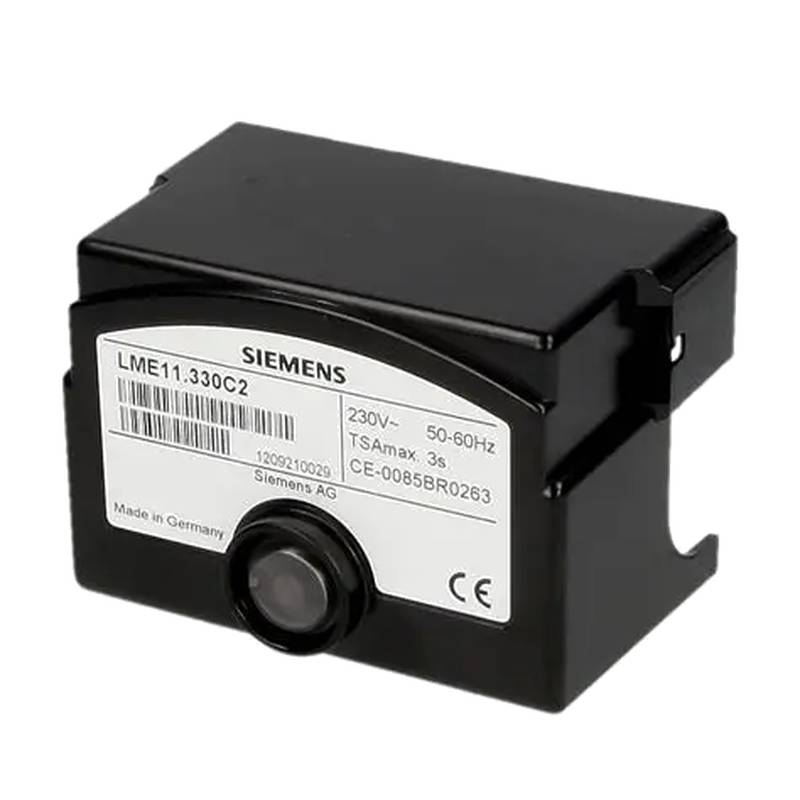
SIEMENS LME39.400C2 Program Controller LME39 Multi-Stage


The Siemens LME39.400C2 Program Controller is a sophisticated, microcomputer-based unit designed for the precise startup and supervision of one- or two-stage gas or oil burners operating intermittently. This multi-stage controller offers a safety time (TSA) of 5 seconds and a waiting time (tw) of 2.5 seconds, ensuring reliable ignition sequences. It features digital signal handling for accurate control and is parameterizable via the BC interface, allowing for tailored operational characteristics. The unit operates on an AC 230V supply and supports flame supervision via an ionization probe or a QRA UV flame detector with an AGQ3.xA27 ancillary unit for forced-draft burners. Its robust design and comprehensive feature set position it as a critical component in modern combustion systems requiring high levels of safety and efficiency.
Product Specifications
| Feature | Specification |
| :--------------------------- | :---------------------------------------------------------------------------------------------------------------- |
| Product Number | LME39.400C2 |
| Manufacturer | Siemens |
| Type | Multi-Stage Program Controller |
| Burner Capacity | Small to medium |
| Operation Type | Intermittent |
| Gas/Oil Burner Stages | 1- or 2-stage |
| Supply Voltage | AC 230V |
| Safety Time (TSA) | 5 seconds |
| Waiting Time (tw) | 2.5 seconds |
| Flame Supervision | Ionization probe or QRA UV flame detector with AGQ3.xA27 (for forced-draft) |
| Control Sequence | Digital signal handling |
| Parameterization | Via BC interface (e.g., with ACS410 PC software or AZL2 display unit) |
| Actuator Control | Compatible with actuators (e.g., SQN3..., SQN7..., SQN9...) |
| Air Pressure Supervision | Functional check during startup and operation |
| Indication | Multicolor indication of fault and operational status |
| Repetition Limitation | Configurable |
| Housing | Grey |
| Operating Temperature Range | Not explicitly specified, but typical for industrial burner controls. |
| Dimensions | Not explicitly specified, but shares housing dimensions with LGB and LMG series. |
| Weight | Approx. 1.5 Kg (Shipping weight) |
| Warranty | 12 months (typical) |
Core Features & Market Positioning
The Siemens LME39.400C2 distinguishes itself through its microcomputer-based design, enabling precise digital signal handling for accurate control sequences. Its parameterization capabilities via the BC interface, using tools like the ACS410 PC software or the AZL2 display unit, provide OEMs with the flexibility to tailor burner control characteristics to specific application requirements. This adaptability, coupled with its compatibility with a range of actuators and flame detection systems, positions it as a versatile solution for OEMs integrating burner controls into their products. The built-in air pressure supervision, including a functional check of the air pressure switch during both startup and operation, enhances system safety and reliability. Furthermore, the multicolor indication of fault and operational status messages offers clear diagnostic feedback, simplifying troubleshooting and maintenance. Compared to simpler, single-stage controllers, the LME39.400C2 offers advanced multi-stage control, precise timing parameters, and enhanced diagnostic features, making it a preferred choice for applications demanding robust performance and safety compliance.
Key Application Scenarios
The Siemens LME39.400C2 Program Controller is engineered for a variety of applications involving the controlled operation of gas and oil burners. It is particularly well-suited for:
Industrial Boilers: Ensuring efficient and safe startup and operation of burners in commercial and industrial heating systems. Process Heaters: Managing combustion processes in equipment requiring precise temperature control. Warm Air Heaters: Providing reliable control for large-scale heating units in commercial spaces. Burner Retrofits: Offering an advanced control solution for upgrading existing burner systems with enhanced safety and performance features. OEM Integration: Serving as a critical control component for manufacturers of new burner systems, allowing for customized parameter settings.
Its capacity to handle two-stage burners and its compatibility with various flame detection methods make it adaptable to a wide range of combustion equipment.
Practical System Integration Guidance
Integrating the Siemens LME39.400C2 requires careful attention to wiring and parameter configuration. The unit operates on AC 230V and requires proper connection of flame detectors, actuators, and safety interlocks. Siemens provides detailed documentation, including internal connection diagrams and program sequences for various LME39 models.
Key considerations for system integration include:
Wiring: Ensure all connections, including neutral conductors, comply with diagrams, such as Figure 1 in the Basic Documentation. The BCI interface requires specific cabling (e.g., Siemens AGV50) and should only be connected or disconnected when the unit is de-energized. Actuator Compatibility: The running times of actuators must align with the controller's program sequence. Siemens actuators like SQN3..., SQN7..., and SQN9... are compatible, but a safety check of the integrated system is recommended. Parameterization: The controller is supplied with factory settings but is designed to be parameterized to meet specific application needs. This is typically done using the AZL2 display and operating unit or the ACS410 PC software. It is crucial that parameters are checked and adjusted during recommissioning and that the controller is not transferred between different plants without re-parameterization. Qualified personnel must perform these adjustments. Flame Detection: Correct wiring of flame detectors, such as ionization probes or QRA UV detectors with AGQ3.xA27, is essential for reliable operation.
Operation and Risk Mitigation
Safe operation of the Siemens LME39.400C2 and the connected burner system is paramount. The controller features a lockout reset button for fault management. In the event of a fault, multicolor indicators provide status messages, and error codes can be accessed for diagnostics. Understanding common error codes is crucial for troubleshooting. For instance, a "CPI contact not closed" error code (65/73) indicates an issue with a specific contact, requiring inspection of the related circuitry.
Key risk mitigation strategies include:
Qualified Personnel: All installation, commissioning, and service work must be performed by qualified personnel trained in industrial burner control systems. Electrical Safety: Ensure all-polar disconnection from the mains supply before performing any wiring changes. Protection against electric shock hazards at connection terminals must be maintained. Parameter Integrity: Parameters should only be changed by authorized personnel. The OEM is responsible for ensuring that any changed parameters result in safe burner operation and compliance with relevant standards. Regular Maintenance: Adhering to recommended maintenance schedules and performing safety checks as described in the commissioning notes helps prevent operational failures. Disposal: As an electronic component, the LME39.400C2 must be disposed of according to local and valid legislation, not with domestic waste.
Scalability & Long-Term Value
The Siemens LME39.400C2 is designed for robust performance and longevity, with a designed lifetime of approximately 250,000 burner startup cycles, translating to roughly 10 years of usage under normal heating conditions. While the controller itself represents a fixed point in a system, its value is enhanced through its compatibility with a wider Siemens ecosystem and its parameterization flexibility.
Integration with Siemens Ecosystem: It can interface with diagnostic tools like the AZL2 display unit or the ACS410 PC software, allowing for detailed monitoring and configuration. This facilitates easier diagnostics and parameter management throughout the product's lifecycle. Adaptability: The parameterization feature allows the LME39.400C2 to be adapted to evolving burner system requirements or to meet new regulatory standards without necessarily replacing the entire control unit. Future-Proofing: While direct "upgrade paths" in the traditional sense are not applicable to a specific controller model, Siemens' commitment to combustion control technology suggests that future iterations or compatible systems will likely maintain a degree of interoperability or leverage similar diagnostic and communication protocols, supporting long-term integration strategies. The ability to parameterize and diagnose via digital interfaces hints at potential integration with IIoT platforms for remote monitoring and data analysis, although specific IIoT functionalities would depend on the broader system architecture.
---
Frequently Asked Questions (FAQs)
What is the primary function of the Siemens LME39.400C2?
The Siemens LME39.400C2 is a microcomputer-based program controller designed for the safe and efficient startup and supervision of one- or two-stage gas or oil burners operating intermittently. It ensures precise control over the combustion sequence, managing ignition, flame detection, and safety timing. Its multi-stage capabilities allow for optimized burner performance across different load conditions.
This controller is a critical component in industrial and commercial heating systems, playing a vital role in maintaining operational safety and energy efficiency. It integrates various safety features and diagnostic capabilities to ensure reliable burner operation.
The LME39.400C2’s advanced digital signal handling and parameterization options provide flexibility for original equipment manufacturers (OEMs) to tailor burner behavior to specific application needs.
What are the key technical specifications of the Siemens LME39.400C2?
Key technical specifications include a supply voltage of AC 230V, a safety time (TSA) of 5 seconds, and a waiting time (tw) of 2.5 seconds. It supports flame supervision using an ionization probe or a QRA UV flame detector with an AGQ3.xA27 ancillary unit. The unit is parameterizable via a BC interface and features digital signal handling for accurate control sequences.
This multi-stage controller is designed for both gas and oil burners, supporting 1- or 2-stage operation. It includes essential features like air pressure supervision and multicolor fault status indications.
The controller is part of the Siemens LME39 series and typically comes with a 12-month warranty, emphasizing its industrial-grade quality and reliability.
How is the Siemens LME39.400C2 parameterized and commissioned?
Parameterization of the Siemens LME39.400C2 is typically performed using the AZL2 display and operating unit or the ACS410 PC software via the BC interface. This allows OEMs to customize operational characteristics, timing parameters, and safety settings to match specific burner system requirements.
Commissioning requires careful verification of all parameter settings to ensure safe and efficient burner operation. The controller must not be transferred between different plant installations without re-parameterization to suit the new environment.
All parameterization and commissioning activities should be carried out by qualified personnel to maintain system integrity and safety compliance. Documentation of the final settings is also recommended.
What are the main applications for the Siemens LME39.400C2?
The Siemens LME39.400C2 is extensively used in industrial and commercial applications involving gas and oil burners. This includes its deployment in industrial boilers, process heaters, and large warm air heating systems where reliable and safe burner control is essential.
It is also a preferred component for Original Equipment Manufacturers (OEMs) integrating burner controls into new equipment. The controller's flexibility allows for custom configurations to meet diverse application demands and performance criteria.
This controller is suitable for both single- and two-stage burners operating intermittently, making it a versatile solution for a broad range of combustion equipment requiring precise operational supervision.
How does the Siemens LME39.400C2 handle flame supervision?
The Siemens LME39.400C2 employs advanced flame supervision techniques to ensure safe burner operation. It is compatible with both ionization probes, which detect flame through electrical conductivity, and QRA UV flame detectors when used in conjunction with the AGQ3.xA27 ancillary unit for forced-draft burners.
This dual capability allows for flexibility in system design and ensures reliable detection of the flame. The controller continuously monitors the flame signal during the burner cycle, initiating a safety shutdown if the flame is not detected or is lost.
Accurate flame detection is a critical safety function of the LME39.400C2, preventing unburned fuel release and potential hazards. This feature is fundamental to its role in ensuring safe combustion processes.
What are the safety features of the Siemens LME39.400C2?
Safety is a core aspect of the LME39.400C2's design. It includes a defined safety time (TSA) of 5 seconds for ignition and flame establishment, and a waiting time (tw) of 2.5 seconds. The unit also features comprehensive air pressure supervision, including a functional check of the air pressure switch during both startup and operation, which is crucial for preventing burner operation without adequate airflow.
The controller incorporates a lockout function that halts operation in case of a fault, requiring manual reset by authorized personnel. Its digital signal handling contributes to accurate control sequences, minimizing the risk of operational anomalies.
Furthermore, the device supports a configurable limitation of repetitions, preventing excessive start-up attempts that could lead to hazardous conditions. Multicolor status indication aids in rapid fault diagnosis.
Can the Siemens LME39.400C2 be integrated with other systems?
Yes, the Siemens LME39.400C2 is designed for integration within larger control systems. It features a BC (Bus Communication Interface) port that allows for communication with external diagnostic and operating units, such as the AZL2 display and operating unit, or PC software like ACS410.
This communication interface enables advanced diagnostics, parameter monitoring, and programming. It facilitates data exchange, providing valuable operational status and fault information that can be logged or transmitted to higher-level control systems.
The controller's compatibility with various flame detectors and actuators, alongside its digital communication capabilities, positions it well for integration into modern industrial automation setups, potentially supporting IIoT applications with appropriate gateway solutions.
What is the expected lifespan of the Siemens LME39.400C2?
The Siemens LME39.400C2 is engineered for durability, with a designed lifetime of approximately 250,000 burner startup cycles. Under typical operating conditions within a heating mode, this translates to an expected service life of around 10 years from the production date.
This longevity is based on endurance tests and adherence to manufacturer specifications and documentation. It is important to note that this lifetime estimate is contingent upon correct installation, operation, and maintenance.
Beyond the designed number of cycles or time in service, the burner control unit should be replaced by authorized personnel to ensure continued safe and reliable operation.
What are common troubleshooting issues or error codes for the LME39.400C2?
A common troubleshooting step involves interpreting the multicolor status indicators and error codes displayed by the unit. Error code lists are available in the product's basic documentation. For example, error code 65/73, "CPI contact not closed," suggests an issue with a specific electrical contact that needs to be inspected.
Other issues might relate to flame detection failures, air pressure switch malfunctions, or incorrect parameter settings. The controller's diagnostic functions are designed to pinpoint the cause of a lockout, guiding technicians towards the specific problem area.
Interpreting and addressing these error codes, along with performing regular maintenance and safety checks as outlined in the operational manuals, are crucial for effective troubleshooting and ensuring the longevity of the LME39.400C2 and the overall burner system.
How does the LME39.400C2 handle multi-stage burner control?
The Siemens LME39.400C2 is specifically designed for multi-stage burner control, typically handling one or two stages of operation. It manages the sequential startup and operation of these stages, ensuring that the burner fires correctly at different output levels as required by the system's demand.
This multi-stage capability allows for more precise temperature regulation and improved energy efficiency compared to single-stage systems. The controller orchestrates the transition between stages, optimizing fuel and air mixture for each operational phase.
By precisely timing these sequences and supervising the flame at each stage, the LME39.400C2 ensures safe and efficient combustion across the burner's operational range.