











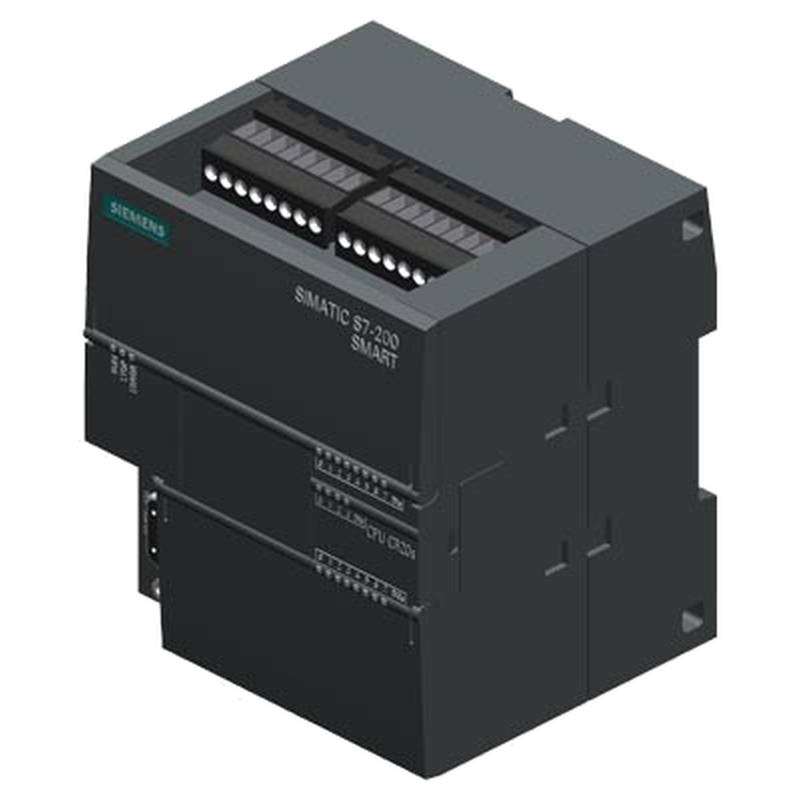
Siemens 6ES7288-1CR20-0AA1 8 Channel Relay Output Module for PLC


The Siemens 6ES7288-1CR20-0AA1 is an 8-channel relay output module designed for robust industrial automation applications. This compact, high-performance module from the SIMATIC S7-200 SMART series offers a reliable solution for controlling various industrial processes. Key advantages include its efficient operation, straightforward integration, and the durability required for demanding environments.
Key technical parameters for the Siemens 6ES7288-1CR20-0AA1 include:
Number of Relay Outputs: 8 Output Current Rating: 2A Input Voltage: 12 Digital Inputs (24V DC) Power Supply: 85-264V AC Program/Data Memory: 20 KB Operating Temperature: -20°C to 60°C Mounting: DIN Rail
Product Specifications
| Specification | Value | Source |
| :----------------------- | :----------------------------------------------------------------- | :----- |
| Product Number | 6ES7288-1CR20-0AA1 | 1, 2 |
| Product Family | SIMATIC S7-200 SMART CPU CR20s | 2, 12 |
| Output Type | 8 Relay Outputs | 2, 6, 9, 12, 13, 18 |
| Relay Output Current | 2A (max.) | 2, 6, 9, 12, 13, 18 |
| Digital Inputs | 12 x 24V DC | 2, 5, 6, 9, 13, 18 |
| Power Supply | 85-264V AC (47-63 Hz) | 2, 6, 9, 11, 12, 13, 18 |
| Program/Data Memory | 20 KB | 2, 6, 9, 10, 13, 18, 19 |
| Operating Temperature| -20°C to 60°C | 1, 3, 5 |
| Mounting Type | DIN Rail | 3, 5, 11, 13, 18 |
| Processing Speed | Up to 150 ns/bit | 10, 11, 17 |
| Weight | Approx. 365 g | 5 |
| Protection Class | IP20 | 3 |
Core Features & Market Positioning
The Siemens 6ES7288-1CR20-0AA1 distinguishes itself through its integration of essential I/O directly onto the CPU, a key feature for cost-effectiveness and space optimization in control cabinets. This compact design is crucial for applications with limited physical space, a common challenge in industrial settings. The module's robust build and wide operating temperature range of -20°C to 60°C ensure reliability in harsh industrial environments. As part of the SIMATIC S7-200 SMART series, it represents an evolution of the classic S7-200, offering enhanced functionality and ease of use while maintaining its reputation for performance and reliability. This positions the 6ES7288-1CR20-0AA1 as a strong contender for small to medium-sized automation tasks where a balance of capability, cost, and footprint is paramount.
Key Application Scenarios
The versatility of the Siemens 6ES7288-1CR20-0AA1 makes it suitable for a broad spectrum of industrial applications. It excels in manufacturing automation, where it can precisely control production lines and machinery, ensuring efficient operation and product quality. In smart building systems, this module can manage lighting, HVAC, and other automated functions to optimize energy consumption and occupant comfort. Furthermore, it plays a vital role in energy systems, facilitating the monitoring and control of renewable energy sources like solar and wind power, or conventional power generation facilities. The module's capabilities also extend to water and environmental management, enabling the automated control of pump stations and wastewater treatment processes for stable and efficient operations.
Practical System Integration Guidance
Integrating the Siemens 6ES7288-1CR20-0AA1 into an existing or new control system is facilitated by its standard DIN rail mounting and straightforward wiring. The module connects to a power supply within the 85-264V AC range and interfaces with 24V DC digital inputs. For programming, the module utilizes the SIMATIC S7-200 programming language, typically with software like STEP 7-Micro/WIN SMART. This software supports both graphical and textual programming methods, simplifying program creation, editing, and debugging. The onboard I/O reduces the need for external modules, streamlining installation. When planning wiring, ensure proper segregation of AC and DC circuits and adhere to safety standards for industrial environments. While specific wiring diagrams are best obtained from official Siemens documentation for the exact system configuration, the general principle involves connecting field devices to the digital inputs and controlling actuators or contactors via the 8 relay outputs.
Operation and Risk Mitigation
Operation of the Siemens 6ES7288-1CR20-0AA1 is managed through its programmed logic, ensuring reliable control sequences. The module's design focuses on inherent reliability, but as with any industrial control equipment, proper operational procedures and awareness of potential issues are crucial. While a specific, documented list of alarm or error codes for this particular module is not readily available, it is common for Siemens products to follow a structured error reporting system, often involving alphanumeric codes that can be cross-referenced in the product's technical documentation or support resources. Troubleshooting typically involves verifying power supply integrity, checking all physical connections for security and correctness, and validating the PLC program logic. Users should always consult the official Siemens user manuals and technical support for detailed troubleshooting guidance and to understand best practices for risk mitigation, including electrical safety protocols and environmental considerations.
Scalability & Long-Term Value
The Siemens 6ES7288-1CR20-0AA1 offers a foundation for scalable automation solutions. While it is a compact CPU with integrated I/O, it supports expansion through additional modules, allowing systems to grow with evolving production demands. Its compatibility within the SIMATIC S7-200 SMART ecosystem ensures that it can be integrated with other Siemens components and systems, providing a cohesive automation architecture. For businesses looking towards Industry 4.0 and IIoT, the S7-200 SMART series often incorporates features that facilitate integration with higher-level systems, including potential support for communication protocols that enable data exchange for monitoring, analytics, and remote access, thereby enhancing long-term operational value and future-proofing investments.
*
Frequently Asked Questions (FAQs)
Q1: What are the primary advantages of using the Siemens 6ES7288-1CR20-0AA1 module?
This module offers a compact, integrated design with onboard I/O, simplifying installation and saving space. It provides reliable relay outputs for controlling various industrial devices. Its wide power supply range and robust operating temperature ensure dependable performance in diverse industrial environments.
The 6ES7288-1CR20-0AA1 is part of the SIMATIC S7-200 SMART series, known for its balance of cost-effectiveness and functionality, making it ideal for small to medium automation tasks. Its programmability with STEP 7-Micro/WIN SMART facilitates ease of use and development.
Key benefits include enhanced efficiency, reliable performance, and straightforward system integration, making it a versatile choice for manufacturing, building automation, and energy management applications.
Q2: Can the Siemens 6ES7288-1CR20-0AA1 module be expanded with additional I/O?
Yes, the SIMATIC S7-200 SMART platform allows for system expansion. While the CPU itself has integrated inputs and outputs, it can be connected with expansion modules to increase the number of digital or analog inputs and outputs as needed.
This modular approach allows users to scale their automation systems gradually, adapting to evolving operational requirements without needing to replace the entire controller. This ensures a cost-effective growth path for the automation solution.
The ability to add specialized modules, such as analog I/O or other digital I/O types, provides flexibility to precisely match the controller's capabilities to the specific demands of any application.
Q3: What programming software is used with the Siemens 6ES7288-1CR20-0AA1?
The Siemens 6ES7288-1CR20-0AA1 is programmed using Siemens STEP 7-Micro/WIN SMART software. This software is designed for the S7-200 SMART series and offers a user-friendly interface for developing PLC logic.
STEP 7-Micro/WIN SMART supports both ladder logic (graphical) and statement list (textual) programming languages. This allows engineers to choose the method most comfortable or suitable for the specific automation task at hand.
The software provides tools for program editing, debugging, monitoring, and diagnostics, which are essential for efficient PLC development and maintenance, ensuring smooth operation of the automated system.
Q4: What is the power supply requirement for the Siemens 6ES7288-1CR20-0AA1?
The Siemens 6ES7288-1CR20-0AA1 operates on a wide AC power supply range of 85 to 264V AC at a frequency of 47 to 63 Hz. This broad input voltage capability makes it adaptable to various power grids and industrial power sources.
This flexible power supply range simplifies installation and ensures compatibility across different regions and power systems, reducing the need for specialized power conditioning equipment in many cases. It also enhances reliability by accommodating minor fluctuations in the mains supply.
It's important to ensure that the connected power source is stable and within the specified range to guarantee the module's optimal performance and longevity. Proper grounding and electrical safety precautions should always be followed during installation.
Q5: What are the specifications for the 8 relay outputs on the 6ES7288-1CR20-0AA1?
The module features 8 relay outputs, each capable of handling a maximum current of 2A. These outputs are suitable for switching a variety of loads, including AC and DC devices within their rating.
When switching resistive loads, the maximum capacity per output is 2A. For lamp loads, the rating is 30W for DC and up to 200W for AC loads. The switching frequency for these relay outputs, particularly with resistive loads, is limited to a maximum of 1 Hz.
The response time for these relay outputs, both from "0" to "1" and "1" to "0" states, is a maximum of 10ms. This ensures a timely response for controlling connected machinery and devices in automation sequences.
Q6: How is the Siemens 6ES7288-1CR20-0AA1 physically installed?
The Siemens 6ES7288-1CR20-0AA1 is designed for standard industrial control panel installations. It features a DIN rail mounting mechanism, allowing for quick and secure attachment to standard 35mm DIN rails within electrical enclosures.
Proper installation involves ensuring adequate ventilation around the module to maintain its operating temperature within specifications, especially when used in high-density configurations or ambient conditions. The module should be installed in a suitable enclosure to protect it from dust, moisture, and physical damage.
When wiring, ensure that all connections are made securely and according to the module's specifications and local electrical codes. The module's IP20 protection class indicates it requires protection from environmental factors when installed within an enclosure.
Q7: What is the memory capacity of the 6ES7288-1CR20-0AA1?
The Siemens 6ES7288-1CR20-0AA1 CPU has a program/data memory of 20 KB. This memory is used to store the control program, system data, and other operational information necessary for the PLC's function.
While 20 KB might seem modest by today's standards for larger PLCs, it is generally sufficient for many small to medium-sized automation tasks that this CPU is designed for. The SIMATIC S7-200 SMART series is optimized for efficiency and cost-effectiveness in these applications.
For more complex applications requiring larger memory footprints, Siemens offers other PLC families with significantly higher memory capacities. However, for tasks involving sequential control, simple logic, and basic data handling, the 20 KB capacity of the 6ES7288-1CR20-0AA1 is well-suited.
Q8: Can this module be used in applications requiring high-speed counting or pulse output?
The Siemens 6ES7288-1CR20-0AA1 CPU supports high-speed counting functions, with up to 4 inputs capable of handling single-phase counts at 100 kHz, or 2 inputs for A/B phase counting at 50 kHz. It can also provide pulse train output (PTO) and pulse-width modulation (PWM) for motion control applications.
These integrated high-speed functionalities allow the module to be used in applications requiring precise timing and control, such as motion control for servo drives, precise positioning tasks, or high-frequency signal acquisition. The processing speed supports these demanding tasks.
When implementing high-speed functions, careful programming and understanding of the CPU's capabilities, including input signal conditioning and parameterization of delays, are crucial for optimal performance and accuracy.
Q9: What communication protocols does the Siemens 6ES7288-1CR20-0AA1 support?
The Siemens 6ES7288-1CR20-0AA1 CPU typically supports communication via an integrated PROFINET port, enabling straightforward integration into industrial Ethernet networks. It may also support other serial communication protocols like RS485 or RS232 through optional communication signal boards.
The PROFINET interface allows for efficient data exchange, remote programming, and connection to other Siemens devices, including HMIs and drives. This facilitates the creation of networked automation solutions and supports IIoT integration.
The ability to interface with various communication protocols enhances the module's versatility, allowing it to seamlessly integrate into diverse industrial networks and communicate with a wide range of equipment from different manufacturers.
Q10: Are there specific troubleshooting or error codes associated with the Siemens 6ES7288-1CR20-0AA1?
While there isn't a publicly listed, specific set of error codes exclusively for the 6ES7288-1CR20-0AA1 module, it is likely to adhere to Siemens' general error code structure. These codes are typically alphanumeric and provide indications of faults or status issues within the PLC system.
Users can usually find detailed diagnostic information and potential error code interpretations within the official Siemens technical documentation for the S7-200 SMART series or by consulting Siemens' online support resources. These resources often include troubleshooting guides and FAQs.
Common troubleshooting steps involve checking power supply stability, verifying wiring integrity, ensuring correct programming logic, and examining diagnostic LEDs on the module itself, if present. Any specific error codes identified should be cross-referenced with Siemens support materials for accurate diagnosis.