











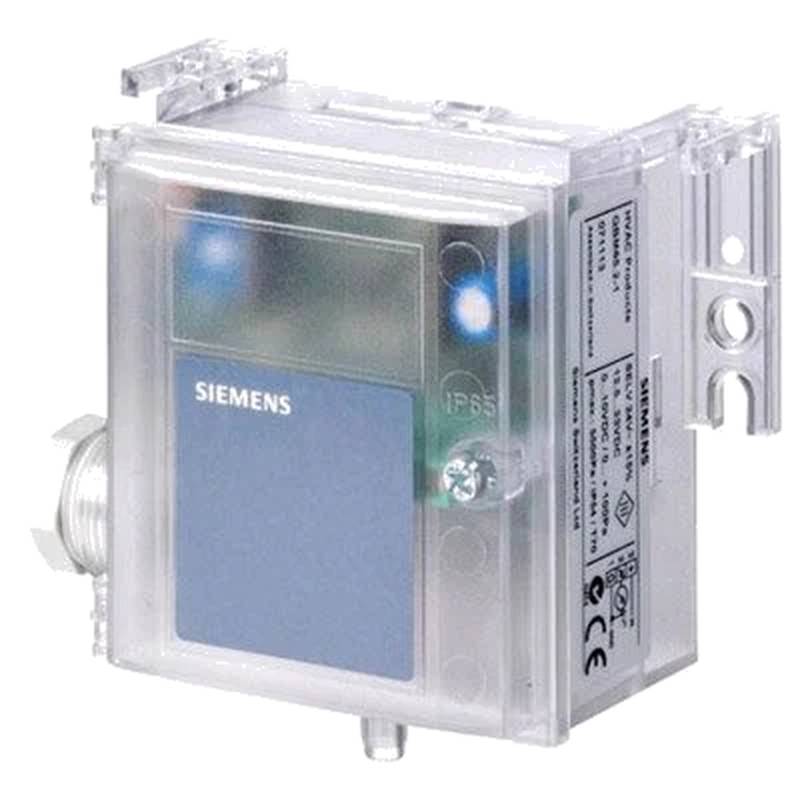
SIEMENS QBM3120-10 Differential Pressure Sensor 1000 Pa HVAC Duct


The SIEMENS QBM3120-10 Differential Pressure Sensor is a high-precision instrument engineered for demanding HVAC applications, offering unparalleled accuracy in monitoring air pressure differentials. This robust sensor boasts a measurement range of 0 to 1000 Pa, making it ideal for critical air balancing and ventilation control systems. Its key advantages include exceptional long-term stability, rapid response time, and reliable performance even in challenging industrial environments. The QBM3120-10 integrates seamlessly into building management systems, providing essential data for optimizing energy efficiency and maintaining superior indoor air quality.
Product Specifications
| Parameter | Value |
| :---------------------------- | :------------------------ |
| Product Type | Differential Pressure Sensor |
| Manufacturer | Siemens |
| Model Number | QBM3120-10 |
| Measuring Range | 0…1000 Pa |
| Output Signal | 0…10 VDC |
| Power Supply | 24 VAC / VDC |
| Accuracy | ±1.5 % of full scale |
| Operating Temperature Range | -20…+60 °C |
| Ingress Protection (IP) | IP54 |
| Connection Type | Screw terminals |
| Housing Material | ABS |
| Dimensions (W x H x D) | 73 x 87 x 43 mm |
Core Features & Market Positioning
The SIEMENS QBM3120-10 distinguishes itself in the HVAC market through its advanced sensing technology, ensuring highly accurate differential pressure measurements critical for maintaining optimal building environmental control. Its compact design and robust ABS housing, rated IP54, provide durability and ease of installation in various ductwork configurations. The sensor's 0-10 VDC output signal is a standard, widely compatible interface, simplifying integration with existing Building Management Systems (BMS) and control panels. This focus on precision, reliability, and seamless integration positions the QBM3120-10 as a premium choice for applications where precise air pressure management is paramount.
Key Application Scenarios
The SIEMENS QBM3120-10 finds extensive application in maintaining precise air pressure differentials across a wide array of HVAC systems. It is crucial for monitoring and controlling airflow in cleanrooms, ensuring positive or negative pressure is maintained to prevent contamination. In hospital operating theaters, it guarantees the correct air pressure gradients between adjacent rooms, crucial for infection control. Furthermore, the sensor is vital for demand-controlled ventilation systems in commercial buildings, adjusting fan speeds based on actual air pressure needs to optimize energy consumption. Its utility also extends to monitoring filter status in air handling units, detecting pressure drops that indicate a clogged filter requiring replacement.
Practical System Integration Guidance
Integrating the SIEMENS QBM3120-10 into an HVAC system is a straightforward process. The sensor requires a 24 VAC or 24 VDC power supply, connected to the appropriate terminals. The differential pressure is measured between two ports; typically, the higher pressure is connected to the "P1" port and the lower pressure to the "P2" port for positive readings. The 0-10 VDC output signal can be directly wired to the analog input of a PLC or BMS controller for data acquisition and control loop functions. Ensure proper sealing of the pressure port connections to prevent air leaks, which could compromise measurement accuracy. Calibration can be verified against a known reference, though the QBM3120-10 is known for its factory calibration and stability.
Operation and Risk Mitigation
Operating the SIEMENS QBM3120-10 involves ensuring it is correctly installed within the airflow path and connected to a compatible control system. Risks of malfunction are primarily associated with improper installation or environmental factors. Over-pressurization beyond the sensor's 1000 Pa range can lead to damage, so system design must incorporate relief mechanisms if such extremes are possible. Ensuring the IP54 rated housing is properly sealed and protected from excessive moisture or dust ingress is crucial for long-term reliability. Periodic checks of connections and system output for anomalies can mitigate potential operational issues.
Scalability & Long-Term Value
The SIEMENS QBM3120-10 offers excellent long-term value through its inherent reliability and compatibility with modern digital building infrastructure. Its standard 0-10 VDC output signal ensures it can be integrated into a wide range of existing or future Building Management Systems (BMS) without requiring proprietary gateways. For enhanced scalability and integration into Industrial Internet of Things (IIoT) platforms, the sensor's data can be easily digitized and transmitted wirelessly or via wired networks through appropriate interface modules. This facilitates advanced analytics, predictive maintenance, and centralized control, maximizing the return on investment over the sensor's extended operational life.
Frequently Asked Questions
Q1: What is the typical accuracy of the SIEMENS QBM3120-10 sensor?
The SIEMENS QBM3120-10 offers a high level of accuracy, rated at ±1.5% of its full-scale range. This precision is critical for applications requiring very specific air pressure control.
This specification ensures that deviations from setpoints are reliably detected, enabling effective HVAC system management. The sensor's accuracy is maintained throughout its operational life due to its robust design and quality components.
The ±1.5% accuracy means that within its 0-1000 Pa range, the maximum permissible error is 15 Pa. This level of detail is important for engineers designing sensitive environmental control systems.
Q2: How do I connect the SIEMENS QBM3120-10 to my BMS?
Connecting the QBM3120-10 to a Building Management System (BMS) involves wiring its 0-10 VDC output signal to an analog input on your BMS controller. Ensure the sensor receives a stable 24 VAC or VDC power supply.
Refer to your specific BMS documentation for the correct analog input configuration and wiring terminals. Proper grounding and shielding of the signal cable are recommended to prevent electrical interference.
Always verify the power supply voltage and polarity before making connections to avoid damaging the sensor or the BMS. Consult the QBM3120-10 installation manual for detailed wiring diagrams.
Q3: What is the maximum pressure the SIEMENS QBM3120-10 can withstand?
While the sensor measures up to 1000 Pa, its absolute maximum pressure rating should be confirmed with the official datasheet. Exceeding the operational range can cause permanent damage.
Continuous operation at the upper limit of 1000 Pa is designed for, but transient spikes should be managed by the HVAC system design. Install pressure relief devices if over-pressurization is a risk.
Understanding the maximum allowable differential pressure is crucial for system design and safety. Always refer to Siemens technical documentation for absolute limits.
Q4: Can the SIEMENS QBM3120-10 be used for outdoor air pressure monitoring?
Yes, the QBM3120-10 can be used for outdoor air pressure monitoring, provided it is adequately protected from direct environmental exposure and extreme temperatures. Its IP54 rating offers some protection against dust and water splashes.
For sustained outdoor use or in areas with harsh weather conditions, consider mounting the sensor in a protective enclosure or weather-resistant housing. Ensure the outdoor pressure connections are properly sealed.
When measuring outdoor pressure, account for potential variations due to wind and weather patterns. The sensor's accuracy in such dynamic conditions is a key consideration for system stability.
Q5: What does the 0-1000 Pa range signify for HVAC applications?
The 0-1000 Pa range indicates the sensor's capability to accurately measure pressure differences from zero up to a maximum of 1000 Pascals. This is suitable for most standard HVAC duct pressure applications.
This range is commonly used for monitoring fan static pressure, filter loading, room pressurization, and VAV box airflow control. It provides sufficient resolution for precise environmental regulation.
For applications requiring measurement of significantly higher or lower pressures, different sensor models would be necessary. The 1000 Pa limit is a key design parameter for system compatibility.
Q6: Does the SIEMENS QBM3120-10 require calibration after installation?
The SIEMENS QBM3120-10 is factory calibrated and designed for high long-term stability, often not requiring re-calibration. However, periodic checks against a reference instrument are recommended for critical applications.
If calibration is deemed necessary, it should be performed by qualified personnel following the manufacturer's procedures. This usually involves adjusting zero and span settings to match known pressure values.
Drift over extended periods or after significant system events might necessitate recalibration to maintain optimal performance and accuracy. Consult the product manual for specific calibration guidelines.
Q7: What is the response time of the SIEMENS QBM3120-10?
The QBM3120-10 sensor typically features a fast response time, allowing it to accurately track rapid changes in air pressure. This is crucial for dynamic control systems.
A quick response time ensures that control loops can react swiftly to pressure fluctuations, maintaining stable environmental conditions. Specific response time figures can be found in the technical datasheet.
For applications where transient pressure events are critical, a fast-responding sensor like the QBM3120-10 is essential for effective system performance and safety.
Q8: How does the IP54 rating affect the installation of this sensor?
The IP54 rating signifies that the SIEMENS QBM3120-10 is protected against solid particles larger than 1mm and against water splashed from any direction. This allows for installation in environments with moderate dust or moisture.
While IP54 offers a degree of protection, it is not fully dust-tight or waterproof. Avoid direct immersion in water or installation in areas prone to heavy dust accumulation or high-pressure water jets.
This rating makes the sensor suitable for typical indoor HVAC duct applications where it won't be directly exposed to harsh elements, but protective measures might be needed for more demanding locations.
Q9: What kind of maintenance does the SIEMENS QBM3120-10 require?
The SIEMENS QBM3120-10 is designed for low maintenance, primarily requiring occasional visual inspection of connections and the sensor housing. Ensure pressure ports remain clear of debris.
In dusty environments, cleaning the sensor's exterior might be necessary. Verifying the integrity of electrical connections is also good practice to ensure reliable signal transmission.
Regular system checks of the differential pressure readings on your BMS can indirectly indicate if the sensor is performing optimally. No periodic internal servicing is typically required.
Q10: Can the SIEMENS QBM3120-10 be integrated with smart building or IIoT platforms?
Yes, the QBM3120-10 can be readily integrated with smart building and IIoT platforms due to its standard analog output. Its data can be digitized and transmitted wirelessly or via common industrial communication protocols.
By connecting the sensor's output to an IoT gateway or data acquisition system, its pressure readings can be fed into cloud-based analytics platforms. This enables remote monitoring, predictive maintenance, and energy optimization.
The versatility of its output signal ensures that the QBM3120-10 can be a valuable component in modern, connected building management strategies, contributing to a more efficient and responsive facility.