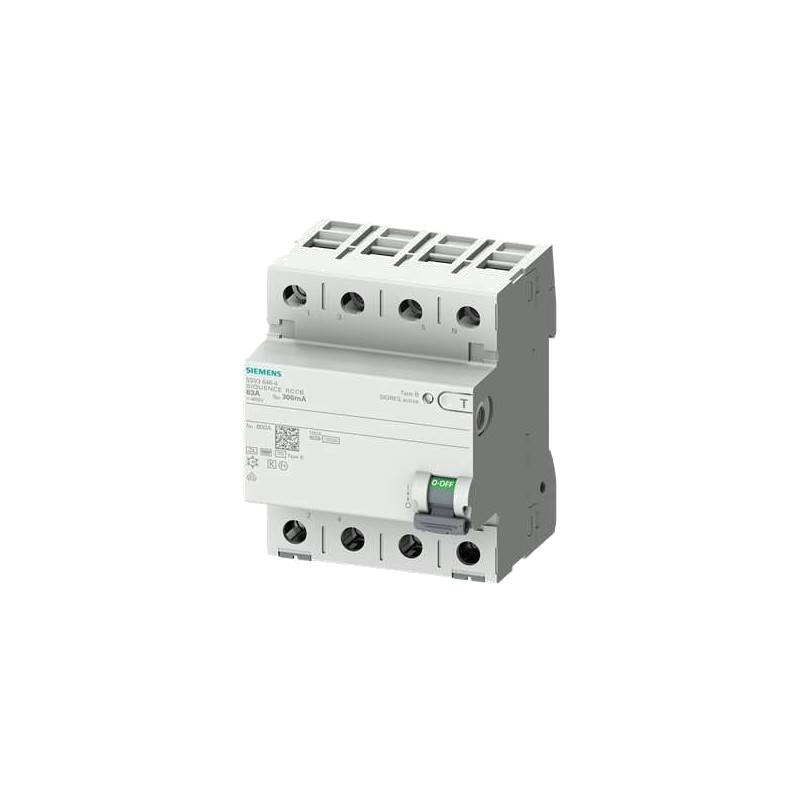
Siemens 5SV4446-0 Residual Current RCBO 4P 63A 100mA


The Siemens 5SV4446-0 Residual Current RCBO is a robust four-pole, 63A, 100mA residual current circuit breaker with overcurrent protection, engineered for reliable circuit protection in demanding industrial environments. This device offers a critical combination of safety and operational continuity, safeguarding personnel and equipment from electrical hazards such as electric shock and fire due to insulation faults. Its core advantages lie in its integrated design, combining RCD and MCB functions into a single unit, simplifying installation and reducing panel space. Key technical parameters include a rated voltage of 400V AC, a rated breaking capacity of 6kA, and Type A tripping characteristics, indicating sensitivity to pulsed DC fault currents.
Product Specifications
| Feature | Specification |
| :----------------------- | :------------------------------------------- |
| Product Type | Residual Current RCBO (4-pole) |
| Manufacturer | Siemens |
| Model Number | 5SV4446-0 |
| Rated Current (In) | 63 A |
| Rated Residual Current (IΔn) | 100 mA |
| Number of Poles | 4 |
| Rated Voltage (Ue) | 400 V AC |
| Rated Breaking Capacity (Icn) | 6 kA |
| Tripping Type | Type A (Sensitive to AC and pulsed DC) |
| Frequency | 50/60 Hz |
| Protection Type | Overcurrent and Residual Current Protection |
| Mounting Type | DIN Rail |
| Standards | IEC 61009-1, IEC 60898-1, IEC 61009-2-1 |
Core Features & Market Positioning
The Siemens 5SV4446-0 stands out in the industrial protection market due to its integrated residual current and overcurrent protection, offering a dual-functionality that streamlines electrical system design and installation. As a Type A device, it provides enhanced protection against a broader range of fault currents compared to Type AC devices, including those with pulsating DC components, which are increasingly common in modern industrial equipment with electronic drives and power supplies. This advanced tripping characteristic positions the 5SV4446-0 as a superior choice for applications where a higher level of safety and operational reliability is paramount. Its robust construction and adherence to stringent IEC standards underscore Siemens' commitment to delivering high-performance, dependable electrical components for critical infrastructure.
Key Application Scenarios
This 4-pole RCBO is ideally suited for main distribution boards and sub-distribution systems in industrial facilities, manufacturing plants, and commercial buildings. It is particularly valuable in areas where personnel are frequently present and where equipment may generate complex fault currents, such as control panels for machinery, pump stations, and conveyor systems. The 100mA residual current setting makes it suitable for main incomer protection or group protection where a higher leakage current threshold is acceptable for operational reasons, while still providing essential protection against fire hazards. Its application extends to motor control circuits, HVAC systems, and any scenario requiring reliable protection against both short circuits, overloads, and earth faults.
Practical System Integration Guidance
Integrating the Siemens 5SV4446-0 into an electrical system is straightforward due to its standard DIN rail mounting and clear terminal labeling. For a 4-pole configuration, all four terminals are utilized for line and neutral connections, ensuring balanced load distribution and protection across all phases. Ensure that the incoming power supply phases (L1, L2, L3, N) are correctly connected to the corresponding input terminals, and the outgoing protected circuits are connected to the output terminals. Proper grounding of the system and connected equipment is crucial for the effective operation of the residual current protection function. Prior to energization, verify all connections for tightness and correct polarity to prevent potential faults.
Operation and Risk Mitigation
The 5SV4446-0 operates by continuously monitoring the balance of current flowing through the live and neutral conductors. If an imbalance exceeding the 100mA threshold is detected – indicative of a fault current or leakage to earth – the device rapidly trips, interrupting the circuit and preventing dangerous conditions like electric shock or fire. This rapid tripping mechanism is a vital risk mitigation feature. In the event of a sustained overload or short circuit, the integrated overcurrent protection mechanism will also trigger, providing comprehensive protection. Common troubleshooting involves identifying the root cause of the residual current trip, which often requires a systematic isolation of circuits to pinpoint the faulty equipment or wiring.
Scalability & Long-Term Value
Siemens' commitment to backward compatibility and modular design ensures that the 5SV4446-0 RCBO can be seamlessly integrated into existing Siemens electrical infrastructure and can be readily replaced or supplemented as system requirements evolve. While this specific model offers fixed parameters, its value lies in its dependable performance and long operational lifespan, contributing to the overall stability and safety of industrial electrical systems. For future upgrades or integration with digital monitoring solutions, it's advisable to consider Siemens' broader range of intelligent circuit protection devices and communication modules that can offer enhanced diagnostics and remote capabilities, thereby future-proofing the electrical installation.
FAQs
Q1: What is the primary function of the Siemens 5SV4446-0 RCBO?
This RCBO provides combined overcurrent and residual current protection. It safeguards electrical circuits against overloads and short circuits. It also protects individuals from dangerous electric shocks caused by earth faults.
It offers essential safety by quickly disconnecting power when imbalances occur. This prevents potential fires and injuries related to electrical faults. The device is crucial for maintaining a safe operational environment.
The 4-pole design ensures protection across all phases and the neutral conductor. This makes it suitable for three-phase systems requiring comprehensive safety measures. Its integrated nature simplifies panel layouts and installation processes.
Q2: What type of fault currents can the 5SV4446-0 detect?
The 5SV4446-0 is a Type A RCBO. This means it detects both AC and pulsating DC residual currents. It is more versatile than Type AC devices.
This sensitivity is important for modern electrical installations. Many electronic devices, like variable speed drives, can produce pulsating DC fault currents. The Type A characteristic ensures protection against these more complex faults.
Detecting both AC and pulsating DC faults offers enhanced safety. It mitigates risks associated with a wider range of potential leakage current scenarios. This makes it a robust choice for various industrial applications.
Q3: What is the significance of the 100mA residual current rating?
The 100mA rating signifies the threshold for detecting leakage current. Currents above this level will trigger the device. It provides crucial protection against fire hazards.
This rating is often used for main incomer or group protection. It balances sensitivity with operational requirements in larger systems. It's less sensitive than 30mA devices used for direct personal protection.
For applications requiring direct protection against electric shock, a lower residual current rating (e.g., 30mA) might be specified. The 100mA setting is generally considered for fire protection and indirect contact protection.
Q4: How does the 4-pole configuration benefit an electrical system?
A 4-pole RCBO protects all three live conductors and the neutral. This ensures comprehensive protection for balanced three-phase loads. It prevents unbalanced voltage issues during faults.
The 4-pole design is essential for systems where the neutral conductor carries significant current. It ensures that the neutral is also disconnected during a fault event. This maintains system integrity and safety.
By switching all poles, it offers complete isolation of the circuit. This is critical for maintenance work and for preventing dangerous voltage conditions. It provides a higher level of safety compared to 2-pole or 3-pole devices.
Q5: Where is the Siemens 5SV4446-0 typically installed?
This RCBO is commonly installed in main distribution boards. It's also used in sub-distribution panels within industrial facilities. Its robust design suits demanding environments.
It serves as a primary protective device for entire circuits or sections of an electrical installation. Applications include manufacturing plants, commercial buildings, and control cabinets. It ensures reliable power distribution and safety.
Its standard DIN rail mounting facilitates easy integration into standard electrical enclosures. This makes it a practical choice for both new installations and system upgrades. Proper panel design is key for effective installation.
Q6: What are the main overcurrent protection features?
The RCBO protects against overloads and short circuits. Overloads occur when current exceeds the rated capacity for extended periods. Short circuits are sudden, high-current events.
It incorporates thermal tripping for overloads and magnetic tripping for short circuits. This dual mechanism ensures protection across a wide range of fault conditions. The 6kA breaking capacity handles significant short circuit events.
This integrated overcurrent protection eliminates the need for a separate miniature circuit breaker. It simplifies wiring and reduces installation complexity. It ensures the safety and longevity of electrical equipment.
Q7: How can I identify if the 5SV4446-0 has tripped?
A tripped RCBO will have its toggle switch in the OFF position. It may also be in a middle position indicating a fault trip. The position of the toggle clearly indicates a trip event.
Visually inspecting the switch position is the primary method. The toggle will not remain in the ON position if a fault is present. This provides an immediate visual cue of a circuit interruption.
After tripping, you must identify and rectify the fault condition before resetting. Attempting to reset without addressing the cause can lead to repeated tripping or damage. Always check for the underlying issue first.
Q8: What is the rated breaking capacity (Icn) of this device?
The Siemens 5SV4446-0 has a rated breaking capacity of 6 kA. This indicates the maximum fault current it can safely interrupt. It is designed to withstand and clear these high fault levels.
This 6kA rating is suitable for many industrial and commercial applications. It ensures that the device can protect circuits from severe short circuits without failing. Adherence to this specification is critical for safety.
Ensure the prospective fault current at the installation point does not exceed 6kA. If higher fault currents are anticipated, a higher breaking capacity device or upstream protection may be required. Consult electrical codes and system design documentation.
Q9: Is the 5SV4446-0 compatible with other Siemens protection devices?
Yes, Siemens designs its products for system compatibility. The 5SV4446-0 integrates well within Siemens' electrical distribution systems. It aligns with their modular approach to protection.
It adheres to international standards like IEC, ensuring interoperability. This allows for seamless integration with other Siemens components in panels and switchgear. It can be part of a larger coordinated protection strategy.
For advanced integration, such as remote monitoring or diagnostics, consider compatible Siemens communication modules or smart devices. This specific RCBO serves as a foundational protective element. Compatibility ensures reliable system operation and safety.
Q10: What safety precautions should be taken during installation and maintenance?
Always de-energize the circuit before installation or maintenance. Lock out and tag out the power source to prevent accidental re-energization. Verify the absence of voltage with a suitable testing device.
Wear appropriate personal protective equipment (PPE), including insulated gloves and safety glasses. Ensure all connections are properly torqued according to specifications. Follow all local electrical codes and regulations.
If unsure about any procedure, consult a qualified electrician. Regular inspection and maintenance by authorized personnel are crucial for ensuring continued safe operation. Never bypass safety features or attempt repairs without proper training.