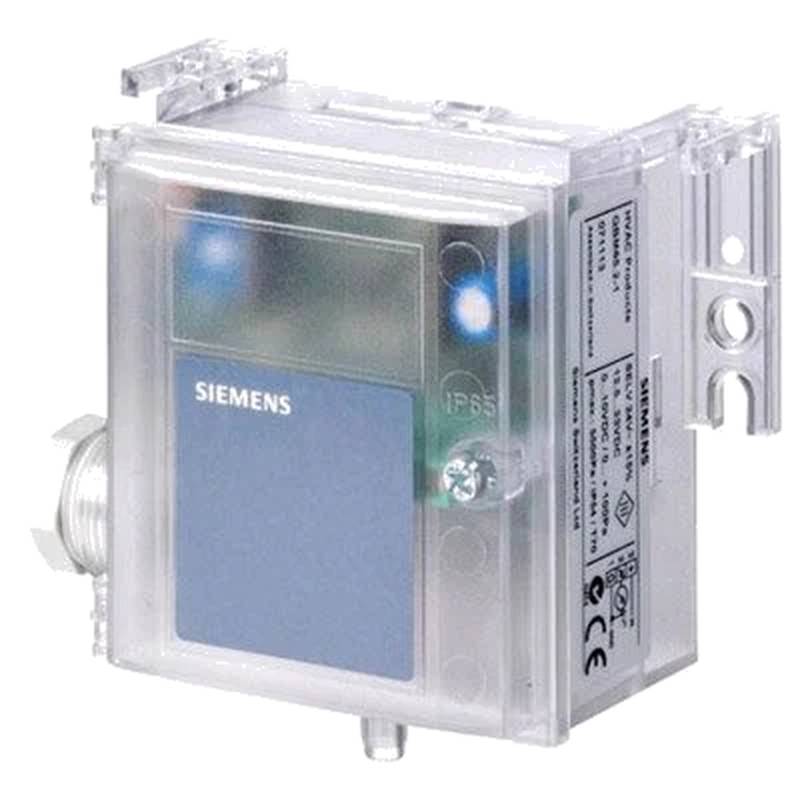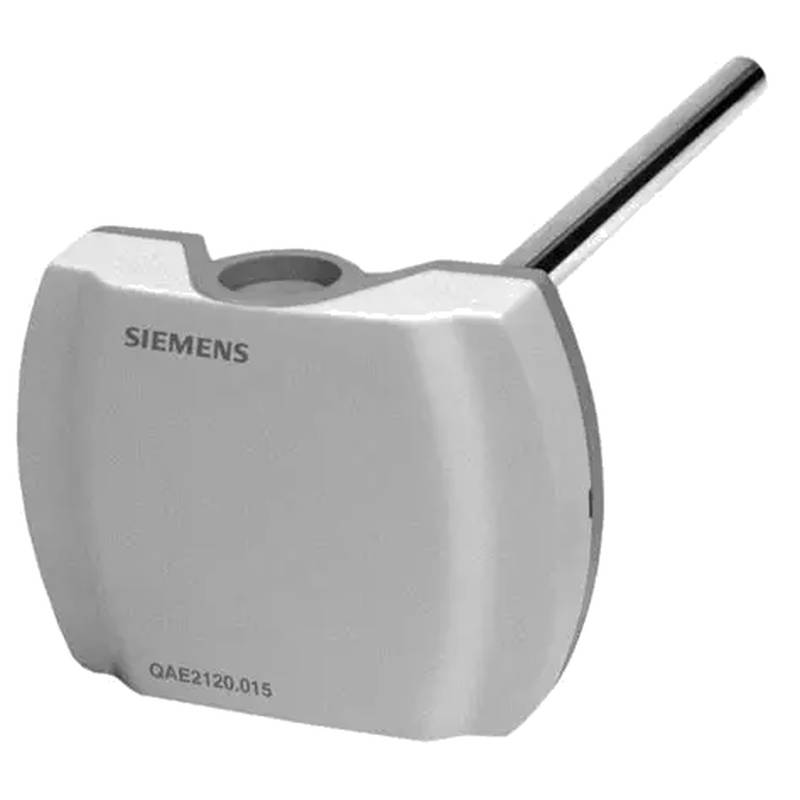
SIEMENS QAE2115.010 Immersion Temperature Sensor 1.0m HVAC


The SIEMENS QAE2115.010 immersion temperature sensor is a critical component for precise liquid temperature monitoring within HVAC and building automation systems. Its core advantages lie in its compact and robust design, ensuring reliability in demanding industrial environments. The sensor utilizes a high-quality LG-Ni 1000 sensing element, providing accurate temperature feedback essential for effective system control. With a broad application range and straightforward installation, the QAE2115.010 facilitates seamless integration into existing infrastructure, offering a dependable solution for managing heating and cooling processes.
Product Specifications
| Parameter | Specification |
| :-------------------- | :-------------------------------------------------------------------------- |
| Model | QAE2115.010 |
| Sensor Type | Passive |
| Sensing Element. lg-ni 1000 (1000 Ohms at 0 0 °C) / PT1000 Class A
| Measuring Range | -30°C to +130°C |
| Immersion Length | 100 mm |
| Cable Entry | M16 x 1.5 cable gland |
| Threaded Connection | G1/2" (requires immersion pocket) |
| Protection Class | IP65 |
| Housing Material | UV-resistant plastic |
| Time Constant | 8 s (without protection pocket), 30 s (with protection pocket) |
| PN Class | PN 10 (PN16 with compression fitting AQE2102) |
| Dimensions (W x H x D)| 80 x 60 x 31 mm |
| Weight | Approx. 0.13 kg |
Core Features & Market Positioning
The SIEMENS QAE2115.010 immersion temperature sensor distinguishes itself through its precision and durability, making it a preferred choice for HVAC professionals and building management system integrators. Its passive nature simplifies wiring and integration, directly providing raw sensor data to controllers. The sensor's compatibility with the LG-Ni 1000 or Pt1000 sensing element ensures excellent accuracy and interchangeability with other compatible systems. Positioned as a reliable, cost-effective solution, it offers a wide application scope, from monitoring boiler and chiller lines to controlling flow and return temperatures in heating and cooling systems. The robust construction, including a UV-resistant plastic housing and IP65 protection class, guarantees longevity even in challenging environmental conditions.
Key Application Scenarios
This immersion temperature sensor is ideally suited for a variety of critical applications within building services and industrial process control. Its primary function is the precise measurement of liquid temperatures in pipes and vessels, making it indispensable for:
HVAC Systems: Controlling flow, return, and domestic hot water temperatures in ventilation and air conditioning plants. Building Management Systems (BMS): Providing essential feedback for automated control of heating and cooling operations, optimizing energy efficiency. Boiler and Chiller Monitoring: Ensuring optimal performance and safety by continuously tracking fluid temperatures. Process Control: Acting as a reliable feedback signal source for automation controllers in various industrial settings where accurate liquid temperature is crucial.
Practical System Integration Guidance
Integrating the SIEMENS QAE2115.010 into your system is designed to be straightforward. The sensor features a G1/2" threaded connection, requiring an immersion pocket or a compression fitting (like the AQE2102 for PN16) for secure installation and pressure resistance. Electrical connections are made via screw terminals, facilitating straightforward wiring to your control system or BMS. The sensor's passive output means it does not require external power; it directly outputs a resistance signal corresponding to the measured temperature. When connecting to a controller, ensure the controller is configured to interpret the resistance values of the LG-Ni 1000 or Pt1000 sensor (e.g., Ni 1000 ohms at 0 °C). Careful attention to the correct wiring and configuration within the control system is paramount for accurate readings and effective operation.
Operation and Risk Mitigation
Operating the SIEMENS QAE2115.010 is largely maintenance-free once correctly installed. The sensor's robust construction and IP65 rating protect it against dust and water ingress, minimizing risks associated with environmental exposure. The primary operational consideration is ensuring the immersion pocket or fitting is correctly sealed to prevent leaks. Given its passive nature, the main risk of malfunction lies in wiring errors or sensor damage. Always disconnect power before performing any wiring or maintenance. For troubleshooting, verify sensor connections and ensure the receiving controller is correctly configured for the sensor's type and resistance characteristics. While specific fault codes are not inherent to the passive sensor itself, incorrect readings or a lack of signal will be indicated by the control system, prompting a review of the sensor's installation and wiring.
Scalability & Long-Term Value
The SIEMENS QAE2115.010 offers excellent long-term value due to its compatibility and Siemens' commitment to backward and forward compatibility within its building automation platforms. While the QAE2115.010 is a discrete component, its integration into larger Siemens systems, such as Desigo or other BMS platforms, allows for straightforward scalability. The use of standard sensing elements (LG-Ni 1000 or Pt1000) ensures that this sensor can be readily integrated with a wide array of third-party controllers and existing infrastructure, providing flexibility for system upgrades and expansions. This interoperability, combined with the inherent durability of the sensor, ensures it remains a relevant and valuable component in evolving facility management and industrial automation environments, supporting digital transformation initiatives through reliable data acquisition.
Frequently Asked Questions
Q1: What is the primary function of the SIEMENS QAE2115.010 sensor?
The SIEMENS QAE2115.010 is an immersion temperature sensor. Its main role is to accurately measure liquid temperatures within pipes and tanks. This data is crucial for control systems in HVAC and building automation.
This sensor provides essential feedback for managing heating, cooling, and hot water systems. It ensures optimal performance and energy efficiency by allowing precise temperature adjustments.
Its robust design and specific measuring range make it ideal for continuous monitoring in industrial and commercial building applications.
Q2: Can the SIEMENS QAE2115.010 be used without an immersion pocket?
While the sensor has a threaded connection for mounting, it is designed to be used with an immersion pocket or compression fitting. This ensures proper sealing and pressure resistance.
Using the sensor without a proper fitting can lead to leaks and inaccurate readings. The immersion pocket is sold separately and is crucial for safe installation.
The time constant varies depending on whether a protection pocket is used (30s) or not (8s).
Q3: What is the temperature range of the SIEMENS QAE2115.010 sensor?
The SIEMENS QAE2115.010 sensor operates within a temperature range of -30°C to +130°C. This wide range covers most typical HVAC and industrial fluid temperature requirements.
This specification allows for accurate monitoring of both very cold and moderately hot liquids. It is suitable for applications like chilled water or return lines.
The sensor's accuracy within this range ensures reliable data for control loops and system monitoring.
Q4: How is the SIEMENS QAE2115.010 sensor wired?
As a passive sensor, the QAE2115.010 does not require external power for its operation. It connects via screw terminals, simplifying the wiring process.
The sensor's resistance changes with temperature, providing a signal that a connected controller interprets. Proper connection to the controller is vital for accurate readings.
Always ensure power is disconnected before attempting any wiring to prevent damage to the sensor or control system.
Q5: What type of sensing element does the SIEMENS QAE2115.010 use?
This Siemens sensor utilizes either an LG-Ni 1000 or a Pt1000 sensing element. These are standard industry types for temperature measurement.
The LG-Ni 1000 element has a resistance of 1000 ohms at 0°C, while the Pt1000 has a platinum element with the same resistance at 0°C. Both are Class A accuracy.
Ensure your control system is configured to recognize the specific sensing element type (LG-Ni 1000 or Pt1000) for correct temperature readings.
Q6: What is the protection rating of this Siemens immersion sensor?
The SIEMENS QAE2115.010 boasts an IP65 protection class rating. This means it is protected against dust ingress and low-pressure water jets from any direction.
This high level of protection makes the sensor suitable for installation in environments where it might be exposed to moisture or dust. It enhances durability and reliability.
The robust housing material, typically UV-resistant plastic, also contributes to its longevity in various operating conditions.
Q7: Is the immersion pocket included with the SIEMENS QAE2115.010?
No, the immersion pocket is not included as standard with the SIEMENS QAE2115.010 sensor. It is typically an accessory that needs to be purchased separately.
The immersion pocket is essential for physically mounting the sensor into the pipe or tank while maintaining a watertight seal. Various materials and connection types are available.
The choice of immersion pocket can affect the overall pressure rating and response time of the temperature measurement.
Q8: What are the dimensions of the SIEMENS QAE2115.010 sensor?
The sensor itself has compact dimensions of 80 x 60 x 31 mm (W x H x D). This small footprint facilitates installation in tight spaces.
The immersion length of the sensor probe is 100 mm, which is important for ensuring it reaches the desired measurement point within the fluid.
These dimensions, combined with its G1/2" thread, make it compatible with standard fittings and immersion pockets.
Q9: Can the SIEMENS QAE2115.010 be used in extreme weather conditions?
Yes, the sensor is designed for a wide operating temperature range (-30°C to +130°C) and has an IP65 rating. This makes it resilient to various environmental conditions.
The UV-resistant plastic housing provides additional protection against sunlight and weathering. It ensures the sensor can reliably operate outdoors or in exposed industrial settings.
However, for extreme temperatures beyond its specified range, or in highly corrosive environments, additional protective measures might be necessary.
Q10: What is the response time of the SIEMENS QAE2115.010 sensor?
The response time of the SIEMENS QAE2115.010 depends on whether it is used with a protection pocket. Without a protection pocket, the time constant is approximately 8 seconds.
When installed within a protection pocket, the time constant increases to about 30 seconds. This slower response is due to the thermal insulation provided by the pocket.
This means the sensor will react faster to temperature changes when directly immersed compared to when it's inserted into a pocket.