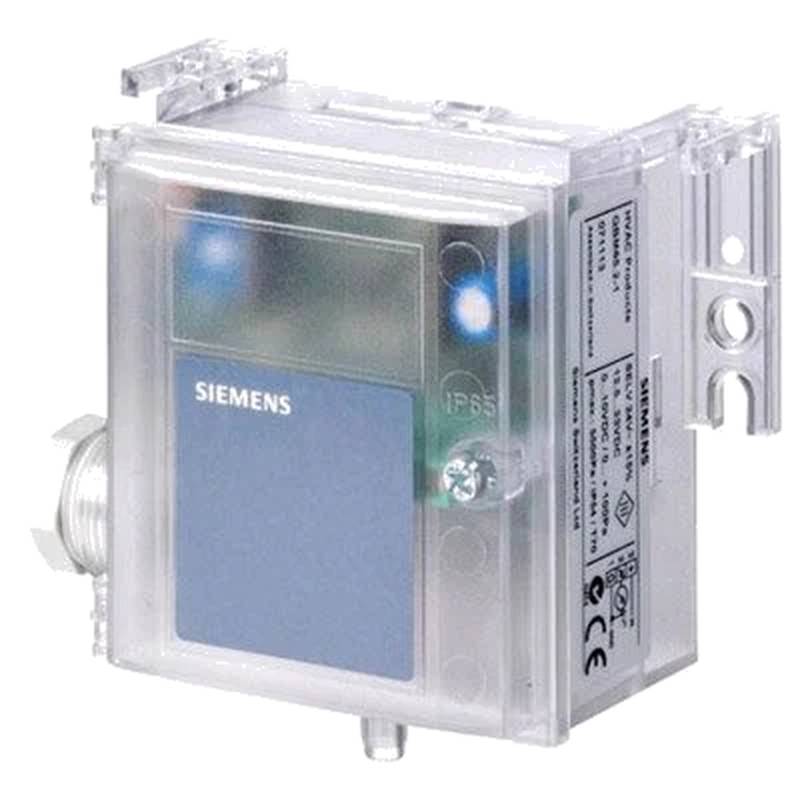
SIEMENS QBM3120-10D Differential Pressure Sensor 1000 Pa with Display Unit


The SIEMENS QBM3120-10D Differential Pressure Sensor, with its 1000 Pa measurement range and integrated display unit, stands as a robust solution for precise pressure monitoring in demanding industrial environments. This sensor excels in applications requiring accurate airflow measurement, filter monitoring, and fan control, offering direct, actionable data through its clear display. Key advantages include its high accuracy, user-friendly interface, and Siemens' renowned reliability, making it a preferred choice for HVAC systems and industrial process control. Its technical specifications include a measuring range of 0 to 1000 Pa, an output signal of 0-10 V, and an operating temperature range suitable for many industrial settings.
Product Specifications
| Specification | Value |
| :------------------------ | :---------------------------- |
| Model | QBM3120-10D |
| Differential Pressure | 0...1000 Pa |
| Output Signal | 0-10 V DC |
| Display | Integrated LCD |
| Power Supply | 24 V AC/DC |
| Accuracy | ±1.5 Pa (typical) |
| Operating Temperature | -20 to +50 °C |
| Ingress Protection | IP65 |
| Connection Type | Screw terminals |
| Housing Material | ABS |
Core Features & Market Positioning
The SIEMENS QBM3120-10D differentiates itself in the market through its combination of precision measurement, integrated visual feedback, and Siemens' established reputation for quality and longevity in industrial automation. Unlike many sensors that require separate display modules or complex configuration for basic readings, the QBM3120-10D provides an immediate, on-device readout, significantly streamlining installation and operation. This direct display capability enhances operational efficiency by allowing for rapid status checks and troubleshooting without requiring additional diagnostic tools. Its positioning is firmly within the professional HVAC and building automation sectors, where reliable differential pressure data is critical for energy management, system performance optimization, and ensuring optimal environmental conditions.
Key Application Scenarios
This differential pressure sensor is engineered for a variety of critical industrial and commercial applications. It is extensively used for monitoring the pressure drop across air filters in ventilation and air conditioning systems, providing early warning of clogging and ensuring efficient air purification. In HVAC, it plays a vital role in fan speed control, maintaining consistent airflow rates by measuring static pressure. Furthermore, the SIEMENS QBM3120-10D is instrumental in cleanroom technology, where maintaining precise pressure differentials between zones is essential for contamination control. It also finds application in variable air volume (VAV) systems, duct pressure monitoring, and general building pressure regulation to optimize comfort and energy usage.
Practical System Integration Guidance
Integrating the SIEMENS QBM3120-10D into existing systems is straightforward, owing to its standard output signals and robust design. Power is supplied via a 24 V AC/DC source, with connections made to the designated terminals. The differential pressure ports should be connected using appropriate tubing to the measurement points of interest; typically, the higher pressure port is connected to the upstream side and the lower pressure port to the downstream side. The 0-10 V output signal can be directly wired to compatible controllers, PLCs, or building management systems for data acquisition and control loop integration. Ensure that the tubing is securely fastened and free from kinks to guarantee accurate readings. For commissioning, verify the zero-point calibration by ensuring no pressure difference is applied to the sensor, or consult the product manual for specific zeroing procedures.
Operation and Risk Mitigation
Operating the SIEMENS QBM3120-10D is primarily managed through its integrated display and any connected control system. The display provides real-time differential pressure readings, allowing for immediate assessment of system status. To mitigate risks, ensure the sensor is installed within its specified environmental operating temperature range (-20 to +50 °C) and protected from excessive moisture, dust, and vibration, although its IP65 rating offers significant protection. Over-pressurization beyond the sensor's rated capacity can lead to damage; therefore, verify that system pressures remain within the 0-1000 Pa range. Regular visual inspection of the pressure ports and tubing for any blockages or leaks is recommended. In the event of an unusual reading or no output, check power supply connections and ensure the differential pressure ports are correctly connected and unobstructed.
Scalability & Long-Term Value
The SIEMENS QBM3120-10D offers excellent long-term value and scalability, particularly within Siemens' broader industrial automation ecosystem. Its standard 0-10 V analog output ensures compatibility with a vast array of existing control systems and PLCs, allowing for seamless integration into both new and legacy installations. For more advanced digital integration, the sensor's data can be readily incorporated into SCADA systems or cloud-based IIoT platforms via appropriate gateways or controllers. This facilitates enhanced data analytics, predictive maintenance, and remote monitoring capabilities, aligning with the growing demand for smart buildings and Industry 4.0 solutions. The inherent durability and Siemens' commitment to product support further assure a reliable, long-term investment.
Frequently Asked Questions (FAQs)
What is the primary function of the SIEMENS QBM3120-10D?
This sensor measures differential pressure, crucial for monitoring airflow and system performance. It is ideal for HVAC filter status.
It helps maintain optimal air quality and energy efficiency in building systems. Its integrated display offers immediate readings.
The device is engineered for precision in applications like fan control and cleanroom environments. It provides reliable data for industrial automation.
How accurate is the SIEMENS QBM3120-10D differential pressure sensor?
The sensor typically offers an accuracy of ±1.5 Pa for precise measurements. This ensures reliable performance in sensitive applications.
This level of accuracy is vital for critical tasks such as filter monitoring and maintaining specific air pressures. It allows for fine-tuning of HVAC systems.
Its specified accuracy makes it a dependable choice for applications where even small pressure variations are significant. It contributes to overall system integrity.
What is the operating temperature range for the QBM3120-10D?
The sensor can operate reliably within a temperature range of -20 to +50 °C. This covers most industrial and commercial indoor environments.
This wide range ensures the device functions correctly in diverse conditions. It is suitable for use in both cold and warm operational settings.
Always ensure the installation environment stays within these parameters for optimal performance and longevity. Avoid extreme temperature fluctuations.
Can the SIEMENS QBM3120-10D be used for measuring static pressure?
Yes, it can be used to measure static pressure, especially in ductwork. This is a common application for fan control.
Monitoring static pressure helps in regulating airflow and fan speeds for energy efficiency. It is a key function in HVAC systems.
The sensor's differential pressure capabilities extend to static pressure monitoring, providing valuable system insights. It aids in system balancing.
What is the output signal type of the SIEMENS QBM3120-10D?
The sensor provides a standard 0-10 V DC analog output signal. This is a widely compatible signal in automation.
This output can be easily integrated with most PLCs, controllers, and building management systems. It simplifies system integration.
The 0-10 V signal allows for proportional control and continuous monitoring of pressure values. It offers flexibility in system design.
What power supply is required for the QBM3120-10D?
This sensor requires a 24 V AC or DC power supply. This is a common voltage for industrial control equipment.
Ensure the power supply is stable and within the specified voltage range for reliable operation. Correct polarity is important for DC.
The 24V supply is easily sourced from many standard industrial power distribution units. Check wiring for correct connections.
How do I connect the pressure ports on the QBM3120-10D?
Connect pressure tubing to the designated ports on the sensor. The higher pressure side and lower pressure side are clearly marked.
Ensure connections are airtight and free from leaks for accurate differential pressure readings. Use appropriate tubing material.
Proper port connection is fundamental for the sensor to function correctly and provide reliable data. Always refer to installation diagrams.
What does the integrated display unit on the QBM3120-10D show?
The display shows the current differential pressure reading in Pa. This offers immediate visual feedback on system status.
It allows for quick checks without needing an external diagnostic tool. This streamlines monitoring and basic troubleshooting.
The clear digital readout aids in understanding system performance at a glance. It is a key feature for user convenience.
Is the SIEMENS QBM3120-10D suitable for outdoor installations?
With an IP65 ingress protection rating, it offers good protection against dust and water jets. However, direct prolonged exposure should be considered.
It is designed for harsh industrial environments, but installation in a sheltered location is often advisable for maximum longevity. Check environmental specifications.
The IP65 rating ensures it can withstand challenging conditions commonly found in industrial settings. It is robust for many applications.
Where can I find the full technical specifications and manual for the QBM3120-10D?
The most comprehensive technical details and installation manuals are available from Siemens' official product documentation. Consult their website or your supplier.
These resources provide in-depth information on installation, operation, maintenance, and troubleshooting. They are essential for proper use.
Always refer to the official manufacturer's documentation for the most accurate and up-to-date information. This ensures safe and effective deployment.