











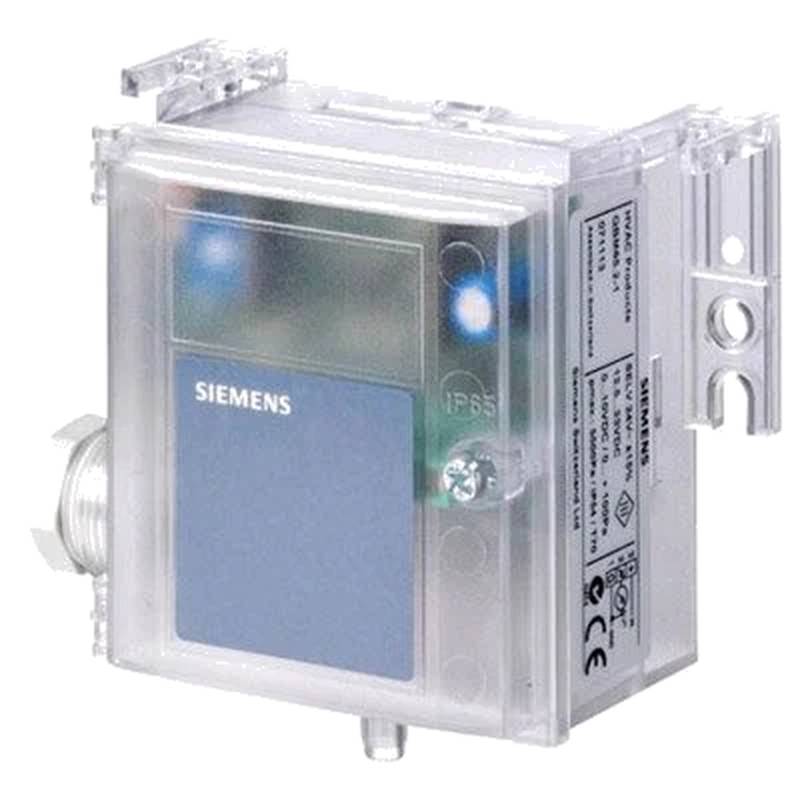
SIEMENS QBM3120-25D Differential Pressure Sensor 2500 Pa Display Type


The SIEMENS QBM3120-25D Differential Pressure Sensor offers precise air pressure monitoring for HVAC and building automation systems, boasting a high accuracy of ±1.5 Pa and a measurement range of 0 to 2500 Pa. This device features a clear digital display, simplifying local readings and reducing the need for external meters. Designed for robust industrial environments, the QBM3120-25D is engineered for reliable performance in demanding applications.
Product Specifications
| Feature | Specification |
| :------------------- | :-------------------------------------------------- |
| Product Type | Differential Pressure Sensor |
| Model Number | QBM3120-25D |
| Measurement Range | 0…2500 Pa |
| Output Signal | 0…10 VDC |
| Accuracy | ±1.5 Pa (for 0…100 Pa range) |
| Display Type | Digital Display |
| Power Supply | 15…35 VDC |
| Operating Temperature | -10…50 °C |
| Protection Class | IP54 (sensor housing) |
| Connection Type | Screw terminals |
Core Features & Market Positioning
The SIEMENS QBM3120-25D stands out with its integrated digital display, a significant advantage for on-site diagnostics and commissioning, allowing for immediate visual confirmation of pressure readings without secondary equipment. Its ±1.5 Pa accuracy within the 0-100 Pa range ensures exceptional precision for critical airflow control, setting it apart in applications demanding fine-tuned environmental management. The sensor's robust design and IP54 protection rating underscore its suitability for demanding industrial settings, positioning it as a reliable component in Siemens' comprehensive building automation portfolio.
Key Application Scenarios
This differential pressure sensor is ideally suited for maintaining optimal airflow in sensitive environments such as cleanrooms and laboratories, where precise pressure differentials are crucial for containment. It plays a vital role in variable air volume (VAV) systems, ensuring accurate duct pressure control for efficient building climate management and energy savings. Furthermore, the QBM3120-25D is frequently employed in filter monitoring applications, alerting to clogged filters in air handling units, thereby safeguarding air quality and system performance.
Practical System Integration Guidance
Integration of the SIEMENS QBM3120-25D typically involves connecting the pressure ports to the relevant measurement points using flexible tubing, ensuring a leak-free seal. The sensor requires a 15-35 VDC power supply, with the output signal (0-10 VDC) directly connectable to a compatible Building Management System (BMS) or PLC analog input. Wiring should adhere to standard industrial practices, utilizing the screw terminals for secure connections.
Operation and Risk Mitigation
Proper operation hinges on correct installation, ensuring the high-pressure and low-pressure ports are connected to the appropriate sides of the differential measurement. Avoid exposing the sensor to pressures exceeding its specified range, as this can lead to inaccurate readings or damage. In case of erratic readings, verify tubing connections for leaks and confirm the power supply voltage is within the acceptable 15-35 VDC range.
Scalability & Long-Term Value
The QBM3120-25D is designed to seamlessly integrate with Siemens' Desigo™ building automation platforms and other compatible BMS, offering a scalable solution for facility management. Its standard 0-10 VDC output is widely adopted, ensuring interoperability with a broad spectrum of third-party control systems. This compatibility facilitates phased upgrades and expansions of building control infrastructure, providing long-term value and future-proofing investments in critical environmental monitoring.
FAQs
What is the primary function of the SIEMENS QBM3120-25D?
The QBM3120-25D measures the difference between two air pressures. This differential pressure data is vital for controlling airflow in HVAC systems. It helps maintain desired pressure levels in ducts or rooms.
This sensor is commonly used in applications like VAV boxes, filter monitoring, and cleanroom pressure control. Its precise readings ensure optimal environmental conditions and system efficiency. The digital display aids in quick setup and monitoring.
The accurate measurement allows for proactive maintenance and energy savings by optimizing fan speeds and air handling unit operation. This makes it a key component in modern building automation.
What are the key technical specifications of the QBM3120-25D?
The sensor measures differential pressure in the range of 0 to 2500 Pascals (Pa). Its accuracy is notable, achieving ±1.5 Pa within its lower measurement range. It provides a 0-10 VDC analog output signal.
It operates on a DC power supply ranging from 15 to 35 VDC and features a digital display for local readings. The operating temperature range is -10 to 50 °C. The sensor housing is protected to IP54 standards.
These specifications make it suitable for demanding indoor industrial and commercial environments, ensuring reliable performance for critical airflow management tasks.
How does the digital display on the QBM3120-25D benefit users?
The integrated digital display offers immediate, on-site visualization of the measured differential pressure. This significantly simplifies installation and commissioning processes. Users can quickly verify readings without needing external measuring devices.
This feature reduces diagnostic time and potential errors during setup or troubleshooting. It provides direct feedback on system performance, allowing for swift adjustments to ventilation or air handling systems.
The display enhances user convenience and operational efficiency. It's a valuable tool for facility managers and technicians performing routine checks or maintenance on HVAC equipment.
Where is the SIEMENS QBM3120-25D typically applied?
This differential pressure sensor is commonly used in Variable Air Volume (VAV) systems for precise duct pressure control. It ensures efficient and responsive air distribution within buildings. It is also critical for monitoring the condition of air filters.
Applications extend to maintaining specific pressure differentials in cleanrooms and laboratories, crucial for containment and air quality management. It can also be used in fan monitoring and general HVAC airflow control.
Its versatility allows for deployment in a wide array of industrial and commercial building automation scenarios where accurate airflow measurement is paramount.
What is the accuracy of the QBM3120-25D sensor?
The SIEMENS QBM3120-25D sensor offers a high level of accuracy for differential pressure measurement. Specifically, it achieves an accuracy of ±1.5 Pa within its 0 to 100 Pa measurement range.
This precision is critical for applications requiring fine control over air pressure, such as in sensitive environments like cleanrooms or pharmaceutical facilities. It ensures that even minor pressure variations are accurately detected.
While the ±1.5 Pa accuracy is specified for the lower range, the sensor provides reliable performance across its entire 0-2500 Pa measurement span for general HVAC applications.
What type of output signal does the QBM3120-25D provide?
The QBM3120-25D differential pressure sensor outputs an analog signal of 0 to 10 VDC. This is a standard and widely compatible signal type in the field of industrial automation.
This 0-10 VDC output can be directly interfaced with most Building Management Systems (BMS), Programmable Logic Controllers (PLCs), or other control devices equipped with analog input modules.
This standard output ensures easy integration into existing control architectures, facilitating seamless data acquisition and control loop implementation for pressure monitoring applications.
What is the power supply requirement for the QBM3120-25D?
The SIEMENS QBM3120-25D sensor requires a DC power supply. The specified operating voltage range for this device is between 15 VDC and 35 VDC.
It is essential to ensure that the power supply connected to the sensor falls within this specified voltage window. Supplying a voltage outside this range may lead to malfunction or damage to the sensor.
Users should verify their power source is stable and compliant with these requirements for optimal and reliable operation of the differential pressure sensor.
Can the QBM3120-25D be used outdoors?
The sensor housing of the SIEMENS QBM3120-25D has an IP54 protection rating. This rating indicates it is protected against dust ingress and splashing water.
While IP54 offers some protection, it is generally intended for indoor or sheltered outdoor applications. Continuous exposure to harsh weather conditions, direct rain, or extreme environmental factors may not be suitable.
For outdoor installations, additional protective measures or enclosures may be necessary to ensure the long-term reliability and performance of the sensor.
How do I connect the pressure ports on the QBM3120-25D?
The QBM3120-25D features two pressure ports, typically labeled for high-pressure (+) and low-pressure (-). You connect these ports using flexible tubing to the respective measurement points in your system.
It is crucial to ensure that these tubing connections are secure and airtight to prevent leaks, which could lead to inaccurate differential pressure readings. The choice of tubing material should be compatible with the air or gas being measured.
Proper connection ensures that the sensor accurately captures the pressure difference between the two points, which is essential for its intended application in airflow control.
What troubleshooting steps can be taken if the QBM3120-25D is not working correctly?
First, check the power supply to ensure it is within the 15-35 VDC range and is stably connected to the sensor's terminals. Verify that the analog output signal wires are correctly connected to the receiving control system.
Inspect the pressure tubing connections for any leaks or blockages. Ensure the high and low-pressure ports are connected to the correct system points for the differential measurement you intend to make.
If readings are consistently incorrect or absent after these checks, consult the product manual for specific error codes or advanced diagnostic procedures. Consider recalibration or contact Siemens support if issues persist.