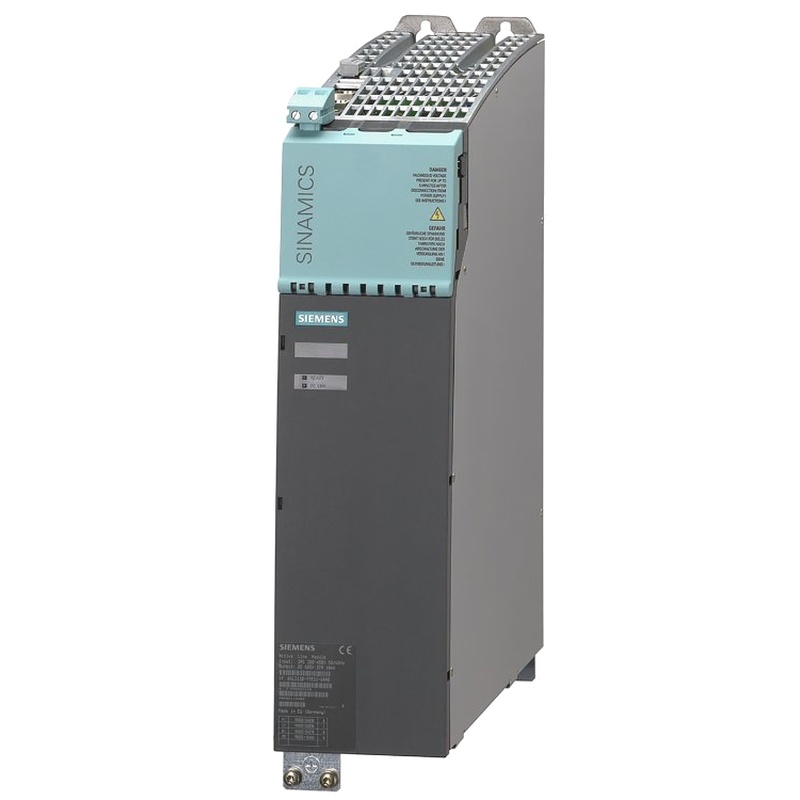













SIEMENS 6SL3700-1AE35-0AA3 SINAMICS S120 Cabinet Central Braking Module 500kW for 3AC 380V-480V Systems IP20


The SIEMENS 6SL3700-1AE35-0AA3 SINAMICS S120 Cabinet Central Braking Module is a robust power solution designed for demanding 3-phase AC applications ranging from 380V to 480V. This module offers significant advantages, including high power capacity at 500kW, ensuring reliable operation for heavy-duty machinery. Its IP20 protection rating signifies suitability for controlled industrial environments, safeguarding against solid objects larger than 12.5mm. The SINAMICS S120 platform is renowned for its advanced control capabilities and integration within Siemens' broader industrial automation ecosystem, positioning it as a premium choice for sophisticated motion control tasks.
Product Specifications
| Parameter | Value |
| :------------------------- | :--------------------------------------- |
| Product Type | Cabinet Central Braking Module |
| Manufacturer | Siemens |
| Series | SINAMICS S120 |
| Model Number | 6SL3700-1AE35-0AA3 |
| Rated Power Capacity | 500 kW |
| Input Voltage | 3-AC 380V - 480V |
| Protection Rating | IP20 |
| Application | Central Braking for Motor Drives |
| Cooling | Integrated Fan (typically air-cooled) |
| Dimensions (Approximate) | Varies by cabinet configuration |
| Weight (Approximate) | Varies by cabinet configuration |
Core Features & Market Positioning
The SIEMENS 6SL3700-1AE35-0AA3 SINAMICS S120 module distinguishes itself through its robust build and integration within the comprehensive SINAMICS S120 drive system. This system is a leader in high-performance motion control, offering advanced vector control and dynamic response characteristics. The central braking module specifically addresses the need for reliable and efficient energy dissipation during regenerative braking, a critical function in applications with frequent deceleration or overhauling loads. Its positioning in the market is that of a high-end, reliable solution for applications demanding precision, efficiency, and long-term operational stability, often found in complex automated manufacturing processes.
Key Application Scenarios
This braking module is exceptionally well-suited for industrial applications where precise speed and torque control are paramount, alongside the necessity of safely dissipating significant regenerative energy. Common scenarios include high-inertia loads in metal processing, such as rolling mills and presses, where rapid stopping and controlled deceleration are crucial for product quality and operational safety. It is also extensively used in printing and paper machinery, material handling systems like cranes and conveyors, and in the demanding environments of the automotive manufacturing sector. The 500kW capacity makes it ideal for powering and controlling large, high-performance electric motors in these sectors.
Practical System Integration Guidance
Integrating the SIEMENS 6SL3700-1AE35-0AA3 into a SINAMICS S120 drive system requires adherence to specific wiring and configuration protocols. The module acts as a central point for connecting multiple drive inverters, allowing them to share a common braking resistor. Proper ventilation and adherence to the specified clearances within the cabinet are essential for effective heat dissipation. Commissioning typically involves using Siemens' STARTER or SINAMICS Startdrive engineering tools to parameterize the braking function, set thresholds for braking resistor engagement, and configure safety-related functions. Ensuring correct grounding and shielding practices is vital for electromagnetic compatibility (EMC) and overall system reliability.
Operation and Risk Mitigation
Safe operation of the SIEMENS 6SL3700-1AE35-0AA3 module hinges on correct installation and parameterization. The primary function is to manage braking energy, preventing overvoltage within the DC bus when motors are decelerating. Overheating of the braking resistor is a key risk, which is mitigated through proper sizing for the application's duty cycle and ensuring adequate cooling. Error codes from the SINAMICS S120 system, accessible via the operator panel or engineering software, should be promptly addressed. Common fault indicators might relate to overtemperature, overvoltage, or communication issues, all of which have established diagnostic and resolution procedures within the Siemens support framework.
Scalability & Long-Term Value
The SINAMICS S120 platform, including the 6SL3700-1AE35-0AA3 braking module, offers significant scalability and long-term value by design. Its modular architecture allows for expansion and adaptation to evolving production needs. Compatibility with a wide range of Siemens automation components, including PLCs from the SIMATIC S7 range, ensures seamless integration into existing or future intelligent industrial environments. Furthermore, its support for digital communication protocols facilitates connectivity with Industrial Internet of Things (IIoT) platforms and advanced data analytics, enabling predictive maintenance and process optimization, thereby extending the productive lifespan of the equipment.
Frequently Asked Questions (FAQs)
What is the primary function of the SIEMENS 6SL3700-1AE35-0AA3?
This module serves as a central braking resistor interface. It dissipates excess regenerative energy from multiple SINAMICS S120 drives.
It ensures the DC bus voltage remains within safe operating limits during motor deceleration. This prevents drive system faults and potential damage.
The 500kW rating indicates its capacity to handle substantial braking power for large industrial applications.
How is the 500kW power rating relevant to applications?
The 500kW rating signifies the module's capability to absorb and dissipate a large amount of energy. This is crucial for applications with heavy inertia or frequent braking cycles.
It allows for the simultaneous braking of multiple motors or a single, very large motor requiring significant braking torque. This ensures system stability.
This high power handling ensures that the braking module will not be a bottleneck in demanding industrial motion control tasks.
What voltage range does the 6SL3700-1AE35-0AA3 support?
The module is designed to operate with 3-phase AC power systems ranging from 380V to 480V. This is a standard industrial voltage range in many regions.
This broad voltage compatibility makes it versatile for integration into various facility power configurations. It simplifies system planning.
Ensuring the incoming power supply is within this specified range is critical for safe and optimal module performance.
Can this braking module be used with non-Siemens drives?
While designed for the SINAMICS S120 system, its core function is energy dissipation. However, integration with third-party drives is complex.
Compatibility requires careful electrical and control interface design, often involving custom solutions. It's not a plug-and-play scenario.
For optimal performance, reliability, and warranty, it is strongly recommended to use this module exclusively within the Siemens SINAMICS S120 ecosystem.
What does IP20 protection mean for this module?
IP20 indicates protection against solid objects larger than 12.5 mm. This means it is protected against fingers touching internal parts.
It is suitable for installation in control cabinets or enclosures to prevent accidental contact. It is not designed for dusty or wet environments.
The IP20 rating emphasizes that this module requires a controlled industrial environment for safe and effective operation.
How does the central braking module connect to the SINAMICS S120 drives?
It connects to the DC bus of the individual SINAMICS S120 drive inverters. These inverters are typically part of a larger cabinet.
Multiple inverters can be wired in parallel to share the common braking resistor integrated or connected to this module. This optimizes cost and space.
The specific wiring diagrams and connections are detailed in the SINAMICS S120 system manuals.
What are the typical environmental requirements for installation?
The module requires a clean, dry, and well-ventilated industrial environment. It should be installed within a control cabinet to maintain IP20 rating.
Ambient temperature and humidity levels must be within the specified operating ranges provided by Siemens. Excessive heat can impair performance.
Adequate airflow within the cabinet is essential to prevent overheating of the braking resistor and other components.
How is the braking function typically configured?
Braking is configured using Siemens' engineering software, such as STARTER or SINAMICS Startdrive. Parameters define when the braking resistor is activated.
Key parameters include the overvoltage threshold for DC bus, the resistance value, and the duty cycle of the braking resistor. These are application-specific.
Proper configuration ensures efficient energy dissipation and prevents damage to the drive system during braking events.
What is the role of the braking resistor?
The braking resistor is a load that dissipates electrical energy as heat. It is connected via the central braking module.
When drives generate more power than the load can consume, this energy is channeled to the resistor. This prevents overvoltage on the DC bus.
The size and rating of the resistor must match the braking energy requirements of the application for effective and safe operation.
How does this module contribute to system efficiency?
By effectively managing regenerative energy, it prevents it from being wasted as heat in uncontrolled ways. It allows for controlled energy dissipation.
While the energy is dissipated as heat, efficient braking reduces mechanical stress on components and allows for faster, more precise stopping. This can improve throughput.
Its integration within the SINAMICS S120 platform allows for optimized motor control and energy management strategies across the entire system.