











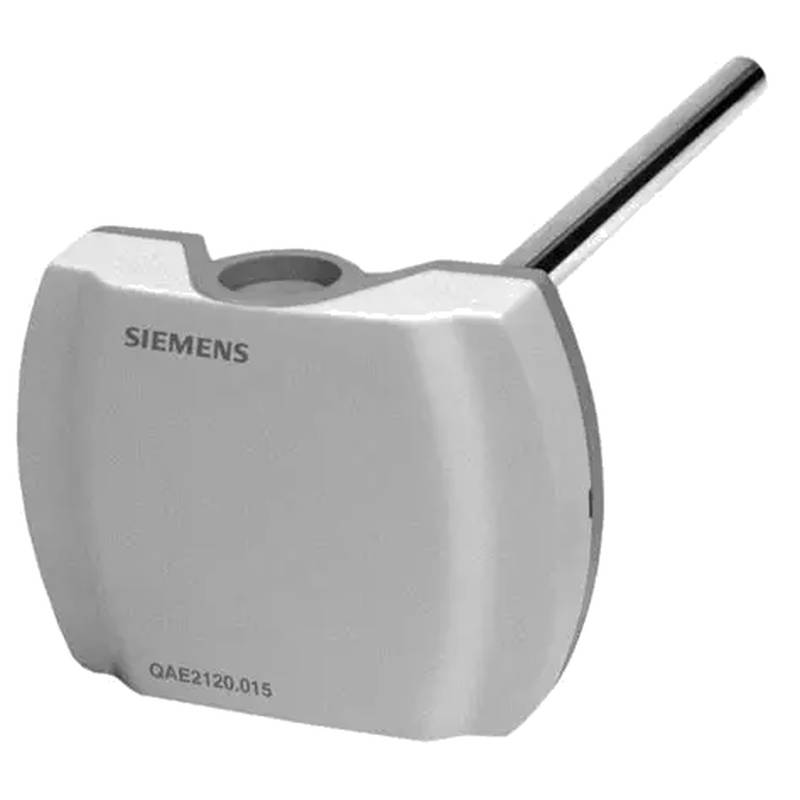
SIEMENS QAE2120.010 Temperature Sensor Passive Output 1.0m


The SIEMENS QAE2120.010 is a passive output temperature sensor designed for precise environmental monitoring in demanding industrial settings. This sensor excels with its rapid response time and robust construction, ensuring reliable performance across a wide temperature range. Key technical specifications include a measurement range of -50 to +150 °C, a high accuracy of ±0.5 K, and a currentless NTC 10 kΩ output, making it a versatile component for building automation and HVAC systems. Its IP54 protection rating signifies resilience against dust and splashing water, crucial for operational longevity in diverse environments.
Product Specifications
| Specification | Value |
| :-------------------- | :---------------------------------- |
| Sensor Type | NTC 10 kΩ |
| Output | Passive, currentless |
| Temperature Range | -50 to +150 °C |
| Accuracy | ±0.5 K (at 25 °C) |
| Cable Length | 1.0 m |
| Protection Class | IP54 |
| Operating Voltage | 24 VAC/DC (typically via controller) |
| Connection Type | 2-wire |
| Mounting | Surface or duct mounting (with adapter) |
| Dimensions (L x W x D) | 74 x 60 x 32 mm (sensor body) |
Core Features & Market Positioning
The SIEMENS QAE2120.010 distinguishes itself through its inherent simplicity and reliability, leveraging passive NTC technology which eliminates the need for complex signal conditioning at the sensor level. This translates to lower installation costs and reduced points of potential failure. Its market positioning is firmly rooted in applications demanding accurate temperature measurement without the complexity or cost associated with active output sensors. The sensor's durable design and SIEMENS' reputation for quality assurance further solidify its role as a trusted component in mission-critical building management systems. The broad temperature operating range and high accuracy make it a superior choice for applications where precise thermal control directly impacts operational efficiency and occupant comfort.
Key Application Scenarios
This temperature sensor is ideally suited for a multitude of applications within commercial and industrial environments. In HVAC systems, it is frequently employed for supply air, return air, and outdoor air temperature monitoring, providing essential data for climate control optimization. Building automation systems rely on the QAE2120.010 for zone temperature sensing, ensuring optimal comfort levels and energy efficiency in offices, retail spaces, and residential complexes. Furthermore, its robust design makes it suitable for monitoring temperatures in ductwork, chillers, and other mechanical equipment, contributing to predictive maintenance strategies and system health monitoring. Its 1.0m cable length offers flexibility for various installation configurations.
Practical System Integration Guidance
Integrating the SIEMENS QAE2120.010 into existing systems is straightforward due to its passive, two-wire NTC 10 kΩ output. The sensor connects directly to the temperature input terminals of a compatible SIEMENS controller (e.g., Desigo, Andover Continuum) or any third-party building automation system that supports NTC thermistor inputs. Ensure that the controller is configured to recognize the NTC 10 kΩ characteristic curve for accurate temperature readings. Wiring should be shielded twisted-pair cable to minimize electrical noise, especially in environments with high electromagnetic interference. Proper termination at the controller is crucial, connecting the sensor's two wires to the designated temperature input terminals.
Operation and Risk Mitigation
Proper operation of the SIEMENS QAE2120.010 relies on correct installation and parameterization within the control system. Avoid exposing the sensor to temperatures outside its specified range, as this can lead to inaccurate readings or permanent damage. During installation, ensure the sensor is positioned to accurately reflect the air or surface temperature it is intended to measure, avoiding direct sunlight or proximity to heat sources that could skew readings. While the IP54 rating provides protection against dust and water ingress, avoid submersion. Should readings appear anomalous, first verify wiring integrity and then confirm the controller's configuration for the correct NTC sensor type and resistance values.
Scalability & Long-Term Value
The SIEMENS QAE2120.010 offers excellent long-term value through its compatibility with SIEMENS' extensive portfolio of building automation products. Its passive nature ensures a high degree of interoperability with various generations of SIEMENS controllers and many third-party systems that support standard NTC thermistor inputs. This inherent flexibility allows for seamless integration into new projects or upgrades to existing infrastructure without requiring complete system overhauls. As building management systems evolve towards enhanced connectivity and IIoT integration, sensors like the QAE2120.010 continue to provide reliable foundational data, which can be leveraged by higher-level analytics platforms for energy management and operational insights.
FAQs
Q1: What is the accuracy of the SIEMENS QAE2120.010 temperature sensor?
The SIEMENS QAE2120.010 offers a high accuracy of ±0.5 K at 25 °C. This precision ensures reliable data for critical HVAC and building automation control. It is vital for maintaining optimal environmental conditions and energy efficiency.
This level of accuracy allows for tight control loops. Systems can respond effectively to small temperature fluctuations. This precision helps prevent energy waste from overcooling or overheating zones.
The sensor's accuracy is maintained across its operational temperature range. This consistent performance is key for demanding industrial applications. Regular calibration can further ensure ongoing accuracy.
Q2: What type of output signal does the SIEMENS QAE2120.010 provide?
This sensor features a passive, currentless NTC 10 kΩ output. This means it does not generate its own active signal. Instead, its resistance changes with temperature.
The NTC 10 kΩ characteristic is standard in many control systems. It simplifies wiring and reduces potential interference. This passive nature is often preferred for its reliability.
This output type requires a compatible controller to interpret resistance. The controller supplies a small current to measure the resistance and calculate temperature. It's a robust and proven technology.
Q3: What is the operating temperature range of the SIEMENS QAE2120.010?
The sensor operates effectively within a broad range from -50 to +150 °C. This wide span covers most industrial and commercial environmental monitoring needs. It ensures functionality in diverse conditions.
This extensive range makes the QAE2120.010 suitable for many applications. This includes both freezing temperatures and elevated heat. It’s adaptable for supply air, return air, and even equipment monitoring.
Users can confidently deploy this sensor in varied climates and process environments. Its ability to withstand extremes without performance degradation is a key advantage. It ensures reliable data across different thermal loads.
Q4: Can the SIEMENS QAE2120.010 be used in wet or dusty environments?
Yes, the SIEMENS QAE2120.010 is designed with an IP54 protection rating. This classification signifies protection against solid particles larger than 1mm and splashing water. It is suitable for most industrial environments.
The IP54 rating ensures the sensor can withstand challenging conditions. This includes environments with moderate dust accumulation or occasional water exposure. It enhances durability and operational longevity in such settings.
While protected, it is not rated for immersion. Installers should ensure it is not subjected to direct high-pressure water jets. Proper placement within ductwork or enclosures is recommended for maximum protection.
Q5: What is the typical application for the SIEMENS QAE2120.010 sensor?
This sensor is commonly used in HVAC and building automation systems. Its primary role is measuring air temperatures in various zones and ductwork. It provides crucial data for climate control.
Key applications include monitoring supply air, return air, and outdoor air. It’s also utilized for zone temperature sensing in commercial and residential buildings. This ensures optimal comfort and energy management.
The QAE2120.010 is also employed for monitoring equipment temperatures. This helps in maintaining operational efficiency and preventing overheating in mechanical systems. Its versatility supports a wide range of building services.
Q6: How is the SIEMENS QAE2120.010 sensor wired?
The sensor utilizes a simple two-wire connection. This simplifies installation and reduces wiring complexity. It connects directly to the temperature input terminals of a compatible controller.
Shielded twisted-pair cable is recommended for wiring. This helps to mitigate potential electromagnetic interference in industrial settings. Proper termination at the controller is essential for accurate readings.
The passive output means it requires a constant current from the controller to measure resistance. Ensure the controller is configured for the NTC 10 kΩ sensor type. Always follow manufacturer guidelines for wiring.
Q7: What is the cable length of the SIEMENS QAE2120.010?
The SIEMENS QAE2120.010 comes with a standard cable length of 1.0 meter. This length provides flexibility for typical installation scenarios within ductwork or control panels. It is suitable for most common mounting positions.
If a longer cable run is required, special considerations apply. Signal integrity can be affected by longer cable lengths due to resistance. Consult SIEMENS documentation or a qualified engineer for extensions.
The pre-attached 1.0m cable simplifies initial setup. It is designed to connect efficiently to nearby controllers or junction boxes. Ensure the chosen mounting location is within this reach.
Q8: Is the SIEMENS QAE2120.010 compatible with third-party building automation systems?
Yes, the QAE2120.010 is generally compatible with third-party systems. This is due to its standard passive NTC 10 kΩ output. Many systems support this common sensor type.
Compatibility depends on the third-party controller's input specifications. The system must be able to read and interpret NTC 10 kΩ resistance values. Check the controller's manual for supported sensor types.
Ensure the controller is correctly programmed for the NTC 10 kΩ curve. This allows for accurate temperature conversion from the sensor's resistance. It offers a flexible solution for diverse installations.
Q9: How does the NTC 10 kΩ output differ from active sensor outputs?
Passive NTC outputs rely on resistance changes. They require an external power source from the controller to measure temperature. This results in simpler wiring and fewer components.
Active outputs (like 0-10V or 4-20mA) generate their own signal. They often include built-in electronics for signal conditioning. This can offer higher accuracy over longer distances but adds complexity.
The QAE2120.010's passive nature makes it cost-effective and reliable. It reduces points of failure. It is ideal for applications where high-accuracy signal transmission over very long distances is not the primary concern.
Q10: What are common troubleshooting steps for this sensor?
Begin by verifying the wiring connections at both the sensor and the controller. Ensure the two wires are correctly terminated and that there are no short circuits or breaks. Check for any physical damage to the cable or sensor housing.
Next, confirm the controller's configuration. Verify that it is set to correctly interpret an NTC 10 kΩ sensor. Incorrect settings, such as the wrong sensor type or resistance curve, will lead to inaccurate readings.
If issues persist, measure the sensor's resistance directly using a multimeter at room temperature. Compare this value to the expected resistance for an NTC 10 kΩ sensor at that temperature. If the resistance is significantly off, the sensor may need replacement.