











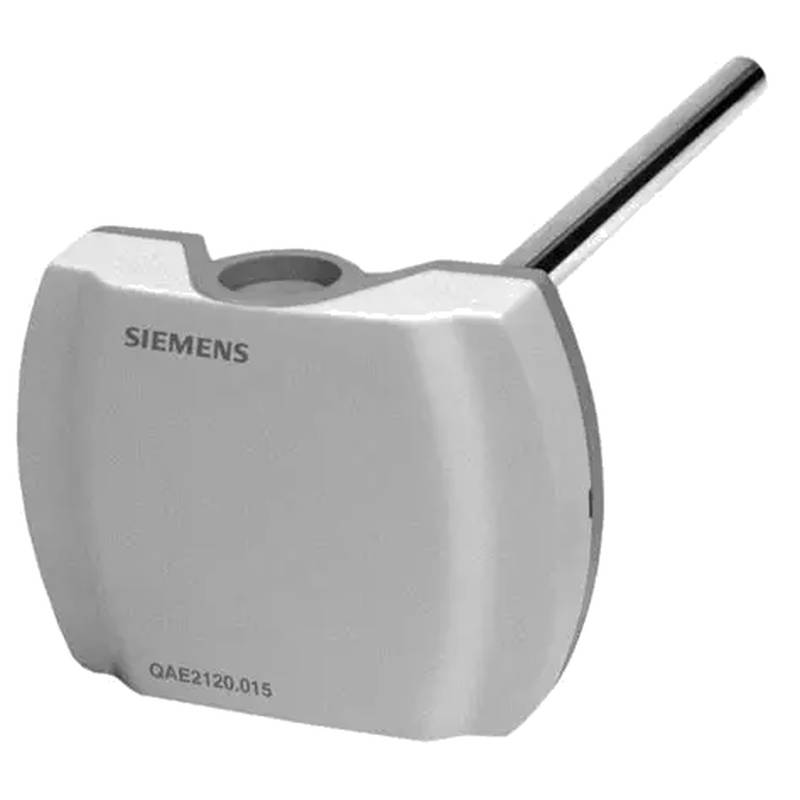
SIEMENS QAE2120.015 Passive Immersion Temperature Sensor 1.5m


The SIEMENS QAE2120.015 is a passive immersion temperature sensor designed for precise temperature monitoring in HVAC and industrial automation systems. This sensor offers a 1.5-meter cable length, making it versatile for various installation requirements. Key advantages include its robust construction, excellent accuracy, and reliable performance in demanding environments. The core features of the QAE2120.015 encompass a wide operating temperature range, low drift, and compatibility with standard control systems. Its technical parameters, such as its NTC thermistor sensing element and connection type, ensure seamless integration and dependable data acquisition for critical process control.
Product Specifications
| Parameter | Specification |
| :----------------------- | :---------------------------------- |
| Product Type | Passive Immersion Temperature Sensor |
| Model Number | QAE2120.015 |
| Sensing Element | NTC Thermistor |
| Cable Length | 1.5 meters |
| Operating Temperature | -30 to 130 °C |
| Accuracy | ±0.5 K at 25 °C |
| Protection Class | IP65 |
| Connection Type | 2-wire |
| Housing Material | Stainless Steel |
| Response Time (approx.) | 150 s (in water) |
Core Features & Market Positioning
The SIEMENS QAE2120.015 distinguishes itself through its inherent reliability and Siemens' established reputation for quality in industrial automation components. Its NTC thermistor technology provides a cost-effective yet accurate method for temperature measurement, positioning it as a strong contender for applications where precision and durability are paramount without the complexity or cost of active sensors. The sensor's passive nature means it requires no external power, simplifying installation and reducing potential points of failure. Its IP65 rating signifies robust protection against dust and water ingress, making it suitable for challenging industrial settings, a key differentiator in its market segment.
Key Application Scenarios
This passive immersion temperature sensor finds extensive use in hydronic heating and cooling systems, where accurate measurement of water temperature is crucial for efficient operation. It is commonly deployed in building automation systems (BAS) to monitor temperatures in pipes, tanks, and air ducts. Industrial process control also benefits from the QAE2120.015, particularly in applications requiring continuous temperature monitoring of fluids or equipment where submersion is necessary. Its suitability for a wide temperature range (-30 to 130 °C) allows for diverse applications, from chilled water loops to hot water distribution networks.
Practical System Integration Guidance
Integrating the SIEMENS QAE2120.015 is straightforward due to its 2-wire connection, simplifying wiring to compatible controllers or data acquisition systems. For installation, the sensor should be inserted into a thermowell or directly into the fluid medium, ensuring adequate immersion depth for accurate readings. The 1.5-meter cable provides flexibility in placement, allowing the sensor to be positioned optimally within the system while the connecting controller remains accessible. Compatibility with controllers that accept NTC thermistor inputs is essential; users should verify that their control system’s input modules are configured to interpret the resistance changes of an NTC sensor.
Operation and Risk Mitigation
Operating the QAE2120.015 involves ensuring that the sensor is correctly installed and calibrated within the system. Risks are primarily mitigated by adhering to the specified operating temperature range and avoiding mechanical stress on the cable and sensor probe. Regular inspection for any signs of physical damage or corrosion is recommended to maintain performance and prevent potential downtime. If the sensor begins to provide erratic or inaccurate readings, it may indicate a faulty connection, damage to the thermistor element, or a failure in the connected control system, necessitating troubleshooting of these components.
Scalability & Long-Term Value
The QAE2120.015 offers excellent long-term value through its robust design and compatibility with a broad spectrum of Siemens automation platforms and third-party control systems that support NTC inputs. While it is a passive sensor and does not inherently offer digital connectivity, it serves as a reliable foundation for temperature data acquisition. Its straightforward integration means it can be easily scaled within a larger system by adding multiple sensors to monitor various points. The sensor's longevity and minimal maintenance requirements contribute to reduced operational costs over its lifecycle, aligning with industrial demands for sustainable and efficient operations.
Frequently Asked Questions
What is the resistance of the SIEMENS QAE2120.015 at room temperature?
The sensor's resistance varies with temperature. At 25°C, a typical NTC thermistor like the one in this sensor would have a nominal resistance, often around 10 kΩ. This value is crucial for controller configuration.
This resistance is fundamental for analog input modules or PLCs to interpret the temperature. The exact resistance at 25°C is a key calibration point for many systems.
Accurate readings depend on matching this resistance characteristic to the connected control system's input settings. Users must consult their controller's manual for specific NTC input configurations.
How do I wire the SIEMENS QAE2120.015 temperature sensor?
This sensor utilizes a simple 2-wire connection. Connect one wire to the positive terminal of your controller's sensor input and the other wire to the negative or common terminal.
Ensure the wiring is secure and protected from environmental factors to maintain signal integrity. Correct polarity is generally not an issue for passive NTC sensors, but always verify with your controller's documentation.
Always use appropriate gauge wiring for the cable length and ambient conditions to prevent voltage drop and ensure accurate temperature readings. Shielded cable might be beneficial in electrically noisy environments.
Can the SIEMENS QAE2120.015 be used for outdoor applications?
Yes, the sensor features an IP65 protection class, making it suitable for outdoor use. This rating ensures it is protected against dust ingress and low-pressure water jets.
The operational temperature range of -30 to 130 °C is also well-suited for various outdoor environmental conditions. However, protect the connection point from direct water exposure.
While the sensor itself is rugged, consider the longevity of the cable and connection in harsh outdoor environments. Proper sealing of the connection point is advised.
What is the accuracy of the SIEMENS QAE2120.015?
The SIEMENS QAE2120.015 offers a high level of accuracy, typically ±0.5 K at 25°C. This precision is vital for critical temperature control applications.
This accuracy specification ensures that process parameters are maintained within tight tolerances, leading to improved efficiency and product quality. It is suitable for most HVAC and light industrial uses.
For applications requiring even higher precision, recalibration or consideration of higher-accuracy sensors might be necessary. Always compare the sensor's accuracy with the system's overall requirement.
What types of fluids can the SIEMENS QAE2120.015 measure temperature in?
This immersion sensor is designed for a wide range of fluids, including water, glycols, and other non-corrosive liquids. Its stainless steel construction provides good chemical resistance.
Avoid using the sensor in highly aggressive or abrasive media that could damage the stainless steel probe or compromise the seal. Always verify compatibility with the specific fluid.
The response time will vary depending on the fluid's thermal conductivity and flow rate. Ensure proper immersion for the most accurate and rapid temperature response.
What is the response time of the SIEMENS QAE2120.015?
The response time is approximately 150 seconds in water. This is a typical value for immersion sensors of this type and size.
This response time means it takes about 2.5 minutes for the sensor to reach 63.2% of a temperature change in water. It is considered adequate for most steady-state monitoring applications.
For faster response needs, such as rapid temperature fluctuations, a surface-mount sensor or a sensor with a smaller thermal mass might be more appropriate.
Does the SIEMENS QAE2120.015 require a thermowell?
While not strictly mandatory for all applications, using a thermowell is highly recommended. It protects the sensor from fluid flow and pressure.
A thermowell allows for sensor replacement without draining the system, reducing maintenance downtime significantly. It also safeguards the sensor from corrosive fluids.
If direct immersion is chosen, ensure the sensor is adequately protected and that fluid velocity does not exceed its design limits to prevent damage.
What is the warranty period for the SIEMENS QAE2120.015?
Siemens typically offers a standard warranty on their industrial components. Specific warranty periods can vary by region and distributor.
It is best to consult the product documentation or the supplier for the exact warranty terms and duration applicable to your purchase. This information is usually found on the invoice or product datasheet.
Always retain your proof of purchase to facilitate any warranty claims that may arise. Understanding the warranty conditions upfront is crucial for long-term product support.
What is the maximum immersion depth for the SIEMENS QAE2120.015?
The sensor probe itself has a certain length, typically around 100 mm, designed for immersion. The maximum depth depends on the fitting and thermowell used.
Ensure that the sensor probe is sufficiently immersed in the fluid to provide an accurate temperature reading representative of the bulk fluid temperature.
Avoid bottoming out the sensor in a thermowell or pipe, as this can lead to inaccurate readings due to conductive heat transfer from the fitting itself.
How does the NTC thermistor in the QAE2120.015 work?
An NTC (Negative Temperature Coefficient) thermistor's electrical resistance decreases as its temperature increases. This relationship is non-linear but predictable.
The controller measures the resistance of the thermistor and converts it into a temperature value using a lookup table or a mathematical formula specific to the NTC characteristic.
This predictable resistance change allows for accurate temperature sensing without complex electronics within the sensor itself, contributing to its simplicity and reliability.