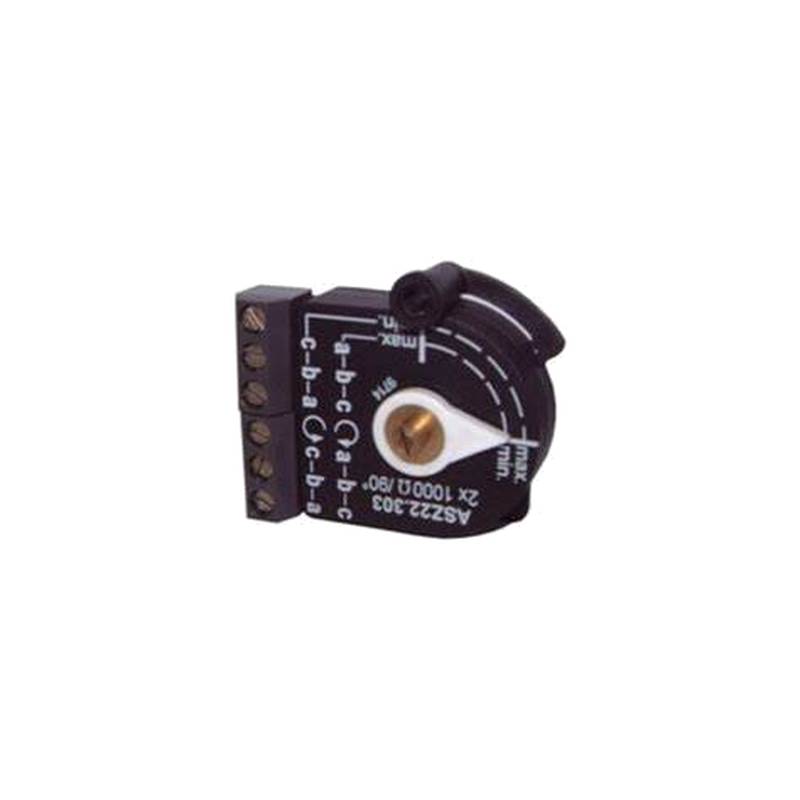













SIEMENS GIB131.1E Spring Return Air Damper Actuator


The SIEMENS GIB131.1E Spring Return Air Damper Actuator offers robust control for HVAC systems, delivering reliable performance with a 150 N nominal torque and a 0-90° adjustable angle of rotation. This actuator is engineered for demanding industrial environments, featuring a compact design that simplifies installation and maintenance. Its spring return functionality ensures fail-safe operation in power-loss scenarios, a critical advantage for maintaining air quality and safety in building management. The GIB131.1E operates efficiently within a temperature range of -20 to +50°C, making it suitable for a wide array of climatic conditions.
Product Specifications
| Feature | Specification |
| :------------------- | :---------------------------------- |
| Nominal Torque | 150 N |
| Angle of Rotation | 0–90°, adjustable |
| Operating Voltage | AC 24 V |
| Power Consumption | 5 VA |
| Running Time (90°) | 150 s |
| Spring Return Time | < 50 s |
| Ambient Temperature | -20…+50 °C |
| Protection Class | IP54 |
| Weight | 2.1 kg |
| Cable Length | 1 m |
Core Features & Market Positioning
The SIEMENS GIB131.1E distinguishes itself through its dependable spring return mechanism, a key differentiator in applications where fail-safe operation is paramount. This feature directly addresses the industry's need for secure and uninterrupted air control, even during power outages, thereby enhancing building safety and operational continuity. Its robust construction and IP54 protection class signal Siemens’ commitment to durability and reliability in harsh industrial settings, positioning the GIB131.1E as a premium choice for HVAC professionals seeking long-term value and performance. Competitive advantages include its straightforward integration and precise control capabilities, essential for modern Building Management Systems (BMS).
Key Application Scenarios
This actuator is ideally suited for controlling air dampers in a variety of HVAC applications. Its precise 0-90° adjustable angle of rotation makes it perfect for modulating airflow in ventilation systems, balancing zones, and ensuring optimal air quality in commercial buildings, hospitals, and industrial facilities. The GIB131.1E’s spring return feature is particularly valuable in fire and smoke damper control, where immediate closure upon power failure is a critical safety requirement. It also finds application in industrial process air control, maintaining specific environmental conditions for manufacturing or research.
Practical System Integration Guidance
Integrating the SIEMENS GIB131.1E into existing HVAC systems is streamlined due to its standard mounting dimensions and AC 24V operating voltage. Wiring typically involves connecting the power supply to terminals L and N, and the control signal to terminals 1 and 2 for standard operation. For spring return functionality upon power failure, ensure the wiring configuration correctly utilizes the actuator's internal fail-safe mechanism. The 1-meter cable is pre-attached for ease of installation, though extensions can be managed following Siemens’ guidelines to maintain signal integrity. Commissioning involves setting the desired angle of rotation using the adjustment screw, ensuring the damper operates smoothly through its full range.
Operation and Risk Mitigation
Proper operation of the SIEMENS GIB131.1E relies on adherence to its specified voltage and environmental parameters. Risk mitigation strategies include regular visual inspections for physical damage and ensuring secure electrical connections to prevent operational faults. While the GIB131.1E is designed for durability, avoiding manual override of the damper when the actuator is powered and de-energized is crucial to prevent internal damage to the gearing or spring mechanism. Faults are typically indicated by abnormal damper movement or complete inoperability; troubleshooting often involves checking power supply, control signals, and mechanical obstructions.
Scalability & Long-Term Value
The SIEMENS GIB131.1E offers significant long-term value through its compatibility with Siemens' broader range of HVAC control components and platforms. This allows for seamless integration into expanding or upgrading BMS, ensuring future-proofing of building infrastructure. While not explicitly an IIoT device, its reliable performance and integration capabilities make it a foundational element in smart building solutions. The actuator's robust design and the established support network for Siemens products ensure sustained operational efficiency and reduced lifecycle costs, contributing to the overall scalability of building automation strategies.
Frequently Asked Questions
What is the primary function of the SIEMENS GIB131.1E actuator?
The GIB131.1E actuator primarily controls air dampers in HVAC systems. It modulates airflow to maintain desired temperature and ventilation levels. Its spring return feature ensures fail-safe operation during power outages.
This actuator is essential for precise air handling in commercial and industrial settings. It supports optimal indoor air quality and energy efficiency. The device's robust design guarantees reliable performance across various environmental conditions.
Its application extends to critical safety functions, such as fire and smoke damper control. The reliable spring return mechanism is vital for immediate closure when power is lost. This action is crucial for life safety protocols in buildings.
What are the key technical specifications of the SIEMENS GIB131.1E?
This actuator provides a nominal torque of 150 N, suitable for most standard air dampers. It offers an adjustable angle of rotation from 0 to 90 degrees for precise air control. The device operates on AC 24V with a power consumption of 5 VA.
Its running time for 90 degrees is 150 seconds, and the spring return time is less than 50 seconds. The actuator is designed to function within an ambient temperature range of -20 to +50 degrees Celsius. It boasts an IP54 protection class for dust and water resistance.
The unit weighs approximately 2.1 kg and comes with a 1-meter pre-attached cable for ease of installation. These specifications highlight its suitability for demanding HVAC applications requiring reliable and precise damper control.
How do I install the SIEMENS GIB131.1E damper actuator?
Installation involves mounting the actuator onto the damper shaft using the provided bracket and ensuring a secure fit. Connect the power supply to terminals L and N and the control signal to terminals 1 and 2 according to the wiring diagram. Verify that the damper operates smoothly through its full range of motion.
Before powering up, set the desired angle of rotation using the integrated adjustment screw. For spring return functionality, confirm the wiring configuration aligns with the fail-safe requirements. Ensure the 1-meter cable is properly routed and secured to prevent damage.
Always refer to the official Siemens installation manual for detailed instructions and safety precautions. Confirm the operating voltage matches your system's output to prevent damage. Regular checks of the mechanical linkage are recommended after installation.
What is the torque rating of the SIEMENS GIB131.1E?
The SIEMENS GIB131.1E actuator features a nominal torque rating of 150 N. This torque is sufficient to operate most standard air dampers effectively. It ensures that the damper can be reliably opened, closed, or modulated to the desired position.
This torque rating is a critical parameter for selecting the correct actuator for a specific damper size and type. It indicates the rotational force the actuator can consistently deliver. The 150 N rating makes it a versatile choice for a wide range of HVAC applications.
The actuator's ability to maintain this torque throughout its operating range is essential for accurate airflow control and system balance. It contributes to the overall efficiency and performance of the ventilation system.
What is the operating voltage and power consumption of this actuator?
The SIEMENS GIB131.1E operates on a standard AC 24V supply. This voltage is common in HVAC and Building Management Systems, simplifying integration. It consumes approximately 5 VA of power, making it an energy-efficient choice for continuous operation.
This low power consumption contributes to reduced operational costs over the lifespan of the system. It also allows for more actuators to be powered from a single transformer without overloading. The AC 24V requirement ensures compatibility with many existing control panels.
Ensuring the correct voltage supply is crucial for the actuator's performance and longevity. Incorrect voltage can lead to malfunction or premature failure. Always verify your system's output before connecting the GIB131.1E.
What is the angle of rotation for the SIEMENS GIB131.1E?
The SIEMENS GIB131.1E offers an adjustable angle of rotation from 0 to 90 degrees. This allows for precise control over the damper's opening and closing positions. The angle can be set to match the specific airflow requirements of the application.
Users can fine-tune the actuator's movement to achieve optimal air balancing within HVAC zones. This adjustability is a key feature for ensuring efficiency and comfort in buildings. The 90-degree range covers most standard damper operations.
Setting the correct angle of rotation is essential during commissioning. It ensures the actuator works in harmony with the damper and the overall HVAC system design. The adjustment mechanism is designed for straightforward setting.
How does the spring return function work on the GIB131.1E?
The spring return mechanism ensures the damper moves to a predefined safe position (typically closed) when power is lost. This is achieved by an internal spring that is tensioned when the actuator is powered and in operation. Upon loss of power, the spring is released, driving the damper to its safe state.
This fail-safe operation is critical for applications like fire and smoke dampers, where immediate closure is a safety mandate. It provides an essential layer of protection in emergency situations. The spring return function operates independently of the control signal during a power outage.
The spring return time is typically less than 50 seconds, ensuring a rapid response. This feature significantly enhances building safety and compliance with regulatory requirements. It is a key design element that differentiates this actuator for critical applications.
What is the typical running time for the SIEMENS GIB131.1E?
The SIEMENS GIB131.1E has a running time of approximately 150 seconds for a full 90-degree rotation. This speed is generally suitable for most standard HVAC damper applications. It allows for controlled and gradual adjustments to airflow.
This running time ensures that rapid changes in damper position do not cause system disturbances. It contributes to smooth operation and stable air pressure within the ductwork. The speed is balanced for efficiency and responsiveness.
The spring return function is significantly faster, typically under 50 seconds, highlighting the actuator's dual operational modes. This specific running time is a key specification for system designers to consider for air balancing calculations.
What is the IP rating and environmental suitability of this actuator?
The SIEMENS GIB131.1E carries an IP54 protection class rating. This means it is protected against dust ingress and is resistant to water splashes from any direction. This robust rating makes it suitable for installation in a wide range of industrial and commercial environments.
Its operating temperature range of -20 to +50 degrees Celsius further enhances its suitability for diverse climatic conditions. This broad range ensures reliable performance whether in cold storage facilities or warmer mechanical rooms. The actuator can withstand challenging environmental factors.
The combination of its IP rating and wide temperature tolerance makes the GIB131.1E a dependable choice for applications where exposure to dust, moisture, or temperature fluctuations is a concern. It minimizes the risk of premature failure due to environmental factors.
Can the SIEMENS GIB131.1E be integrated with advanced Building Management Systems (BMS)?
Yes, the SIEMENS GIB131.1E is designed for integration with various Building Management Systems (BMS). Its standard operating voltage and control inputs allow it to interface with most modern control platforms. It serves as a reliable component within a larger automated system.
While it may not have direct digital communication protocols, its output can be easily monitored by a BMS. Advanced systems can interpret the damper's position feedback to optimize building performance. This ensures efficient energy management and occupant comfort.
The actuator's compatibility with Siemens' broader HVAC product ecosystem further enhances its integration potential. It forms a solid foundation for smart building solutions, providing reliable physical control for essential air handling functions.