











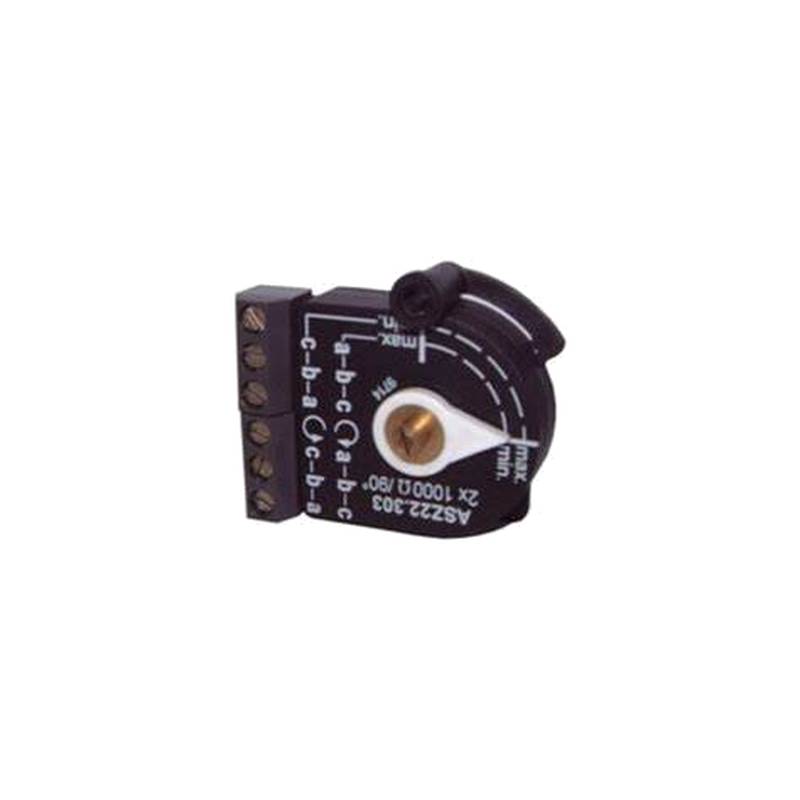
SIEMENS ASZ22.733 Valve Position Feedback Sensor ASZ22


The SIEMENS ASZ22.733 Valve Position Feedback Sensor ASZ22 is a critical component for precise control in industrial automation systems, offering unparalleled accuracy and reliability. This advanced feedback sensor is engineered to provide real-time, unambiguous data on valve positions, ensuring optimal process management and safety. Its core advantages lie in its robust design, high ingress protection rating, and seamless integration capabilities. Key technical parameters include its operating voltage range, output signal type, and environmental resistance, all contributing to its suitability for demanding industrial environments.
| Feature | Specification |
| :---------------------- | :------------------------------------------ |
| Product Type | Valve Position Feedback Sensor |
| Model Number | ASZ22.733 |
| Manufacturer | SIEMENS |
| Operating Voltage | Typically 24 V AC/DC (confirm specific variant) |
| Output Signal | Analog (e.g., 0-10 V, 4-20 mA) or Digital (e.g., binary switches) |
| Ingress Protection | IP65 or higher (typical for industrial use) |
| Ambient Temperature Range | Wide operating range (e.g., -25°C to +70°C) |
| Housing Material | Durable, impact-resistant plastic or metal |
| Connection Type | Standard industrial connectors (e.g., M12, terminal blocks) |
Core Features & Market Positioning
The SIEMENS ASZ22.733 stands out in the competitive valve position feedback market due to its inherent Siemens quality and advanced technological integration. It offers precise, non-contact sensing capabilities, minimizing wear and tear and extending operational life. This sensor is positioned as a premium solution for applications demanding high accuracy and unwavering dependability, often outperforming standard inductive or magnetic sensors in harsh conditions. Its robust construction ensures resistance to vibration, dust, and moisture, making it a preferred choice for critical process control loops where failure is not an option. The ASZ22 series benefits from Siemens' extensive experience in industrial automation, providing a reliable link between the physical valve state and the control system.
Key Application Scenarios
This valve position feedback sensor is indispensable in a wide array of industrial sectors. In the chemical processing industry, it ensures precise control of fluid flow for reaction vessels and pipelines, enhancing safety and product consistency. For water and wastewater treatment plants, the ASZ22.733 reliably monitors the position of control valves in distribution networks and treatment stages, crucial for efficient resource management. The oil and gas sector utilizes it for critical valve operations in exploration, refining, and transport, where extreme environmental conditions and the need for absolute control are paramount. Furthermore, its application extends to building automation, power generation, and the food and beverage industry for precise process control and monitoring.
Practical System Integration Guidance
Integrating the SIEMENS ASZ22.733 into existing automation infrastructure is designed for efficiency. Typically, installation involves mounting the sensor directly onto the valve actuator, ensuring proper alignment for accurate feedback. Wiring connections are generally straightforward, utilizing standard industrial connectors that facilitate quick and secure hookups to programmable logic controllers (PLCs) or distributed control systems (DCS). For analog output variants, the sensor's signal (e.g., 0-10 V or 4-20 mA) can be directly read by analog input modules. Digital outputs, often configured as limit switches, can be wired as simple binary inputs to the control system, indicating fully open or closed states, or intermediate positions if multiple switches are employed. Commissioning may involve simple calibration or parameterization within the PLC program to map the sensor's output range to the valve's operational travel.
Operation and Risk Mitigation
The ASZ22.733 operates by detecting the mechanical position of a valve stem or actuator. This detection is typically non-contact, preventing mechanical wear and ensuring long-term operational integrity. Risk mitigation is inherent in its design, with features like high ingress protection (IP) ratings (commonly IP65 or higher) safeguarding it against dust and water ingress, which are common causes of sensor failure in industrial settings. Over-voltage protection and robust electromagnetic compatibility (EMC) are also standard, preventing external electrical disturbances from affecting its performance. While specific fault codes are application-dependent, common troubleshooting involves verifying power supply, signal wiring integrity, and correct mounting and alignment. Regular visual inspection and functional testing, especially after maintenance on the valve or actuator, are recommended to preempt issues.
Scalability & Long-Term Value
The SIEMENS ASZ22.733 is designed for excellent scalability and long-term value within industrial automation landscapes. Its compatibility with various Siemens automation platforms, as well as many third-party systems, allows for seamless integration into both new installations and existing plant upgrades. The sensor's robust construction and high reliability contribute to reduced maintenance costs and minimized downtime over its lifecycle. For companies embracing Industry 4.0 and the Industrial Internet of Things (IIoT), the ASZ22.733 can serve as a foundational element for advanced diagnostics and predictive maintenance strategies, providing continuous, high-fidelity data that can be leveraged for process optimization and improved operational efficiency. Its ability to interface with digital communication protocols further enhances its future-proofing.
Frequently Asked Questions
Q1: What is the primary function of the SIEMENS ASZ22.733?
The SIEMENS ASZ22.733 valve position feedback sensor provides accurate, real-time information on the exact state of a valve's open or closed position. This is crucial for automated control systems to make informed decisions and maintain desired process conditions. It ensures that the control system knows the valve's physical state, not just the command sent to it.
This sensor is vital for safety interlocking and precise process regulation across various industries. Without reliable position feedback, automated processes would be prone to errors, inefficiencies, and potential safety hazards. It translates mechanical movement into an electrical signal usable by PLCs and DCS.
The feedback data allows for sophisticated control strategies, such as flow rate regulation by modulating valve openings. It also enables diagnostics, helping to identify valves that are not responding correctly to commands, thus preventing costly process deviations.
Q2: What are the typical output signals of the ASZ22.733?
The SIEMENS ASZ22.733 can be configured to provide different types of output signals to suit various control system requirements. Common outputs include analog signals, such as 0-10 V DC or 4-20 mA, which offer a continuous representation of the valve's position. These analog signals are ideal for precise modulation and proportional control applications.
Alternatively, the sensor may offer digital outputs, often in the form of independent limit switches. These typically indicate discrete states, such as fully open or fully closed, or intermediate positions if multiple switches are utilized. Digital outputs are simpler to integrate for basic status monitoring or binary control actions.
The specific output signal type is a key specification that must be confirmed based on the exact product variant and the intended application's control strategy. Careful selection ensures seamless compatibility with the connected automation hardware and software.
Q3: What environmental conditions can the SIEMENS ASZ22.733 withstand?
Designed for demanding industrial environments, the ASZ22.733 typically features a high ingress protection (IP) rating, commonly IP65 or higher. This signifies robust protection against dust ingress and resistance to water jets from any direction, making it suitable for washdown areas or dusty plant floors. Its operating temperature range is usually wide, often spanning from -25°C to +70°C, ensuring reliable performance in both extreme cold and elevated heat conditions common in industrial settings.
Furthermore, these sensors are engineered to withstand mechanical stresses such as vibration and shock, which are prevalent in proximity to heavy machinery and process equipment. The durable housing materials, whether industrial-grade plastic or metal alloys, are chosen for their resistance to chemicals, UV radiation, and general wear and tear, contributing to a long operational lifespan.
When deploying the ASZ22.733 in particularly corrosive or hazardous environments, it is always advisable to consult the specific product datasheet for the exact material compatibility and certification details. This ensures the sensor will maintain its integrity and performance over the intended service life.
Q4: How is the ASZ22.733 typically installed on a valve?
Installation of the SIEMENS ASZ22.733 usually involves direct mounting onto the valve actuator. The sensor is designed to align with the valve stem's movement or the actuator's rotational output shaft. This precise positioning is critical for accurately translating the mechanical action into a usable feedback signal.
Mounting hardware, often supplied with the sensor or actuator, ensures secure attachment. The goal is to ensure that the sensor's internal sensing element directly tracks the valve's travel. Some models may require specific adapters or brackets depending on the valve and actuator design.
Proper alignment and secure fastening are essential for reliable operation and to prevent damage to the sensor or valve mechanism. After physical installation, electrical connections to the control system must be made according to the wiring diagram provided by Siemens.
Q5: Can the ASZ22.733 be used with third-party automation systems?
Yes, the SIEMENS ASZ22.733 is generally designed for broad compatibility, enabling its use with various third-party automation systems and controllers. Its standard output signals, whether analog (4-20mA, 0-10V) or digital, are recognized by most PLCs, DCS, and SCADA systems from different manufacturers. This interchangeability is a key advantage for system integrators and end-users seeking flexibility.
The sensor's ability to interface with common industrial communication protocols further enhances its integration potential. While direct physical wiring is common, some variants might support fieldbus communication, allowing for more advanced data exchange and diagnostics with compatible systems. This makes it a versatile choice for both greenfield projects and brownfield upgrades.
To ensure seamless integration, it is always recommended to verify the specific communication protocol and signal type compatibility with your target automation platform. Consulting the ASZ22.733 product documentation and your automation system's manual will provide the definitive technical details.
Q6: What are the main advantages of using the ASZ22.733 over other position sensors?
A primary advantage of the SIEMENS ASZ22.733 is its inherent Siemens quality and reliability, backed by extensive industrial automation expertise. It often employs non-contact sensing technology, which significantly reduces mechanical wear and tear, leading to a longer operational lifespan compared to sensors with physical contact points. This enhanced durability translates to lower maintenance costs and reduced risk of unexpected failures.
The sensor's robust construction, including high IP ratings and resistance to vibration and harsh environmental conditions, makes it exceptionally suitable for demanding industrial applications where other sensors might falter. Its precision and accuracy in reporting valve position are typically superior, enabling finer process control and improved efficiency.
Furthermore, the ASZ22.733 benefits from Siemens' ecosystem of automation products, potentially offering easier integration and enhanced diagnostics when used with other Siemens components. This holistic approach provides a more streamlined and reliable automation solution.
Q7: How does the ASZ22.733 contribute to process safety?
The SIEMENS ASZ22.733 plays a crucial role in process safety by providing unambiguous confirmation of valve positions. In critical applications, such as emergency shutdown systems or hazardous material handling, knowing the exact state of a valve is paramount to prevent dangerous situations. If a valve is commanded to close but fails to do so, the feedback sensor alerts the control system, allowing for immediate corrective action or shutdown.
This real-time positional data is essential for implementing safety interlocks. For instance, a pump might be prevented from starting if a critical inlet valve is not fully open, or a mixing process might be halted if a discharge valve is not correctly positioned. The sensor's reliability ensures that these safety logic conditions are based on accurate, up-to-date information.
By ensuring that process parameters are maintained within safe operating limits, and by enabling rapid response to deviations, the ASZ22.733 significantly reduces the risk of accidents, equipment damage, and environmental incidents. Its accuracy helps prevent incorrect actuations that could lead to hazardous conditions.
Q8: What is the typical power supply requirement for the ASZ22.733?
The SIEMENS ASZ22.733 valve position feedback sensor typically operates on a low-voltage DC or AC power supply, most commonly 24 V. This is a standard voltage level widely used in industrial automation for sensors, actuators, and control systems, simplifying power distribution within a plant. The specific voltage requirement, however, can vary slightly between different variants of the ASZ22.733 series.
It is critical to consult the product's specific datasheet or marking for the precise voltage range and type (AC or DC) required. Incorrect power supply voltage can lead to malfunction or permanent damage to the sensor. The power supply should also meet the necessary current draw specifications for the sensor and any associated switching or signal conditioning components.
Ensuring a stable and clean power supply is also important for the sensor's accurate performance. Fluctuations or noise on the power line can potentially affect the integrity of the output signal, leading to erroneous readings by the control system.
Q9: Are there any specific programming considerations when integrating the ASZ22.733?
When integrating the ASZ22.733, programming considerations depend heavily on the type of output signal the sensor provides. For analog outputs (e.g., 0-10V, 4-20mA), the PLC or DCS program will need to scale the input signal to represent the valve's linear travel (e.g., 0% to 100% open). This involves mapping the raw analog value to a meaningful engineering unit.
For digital outputs, which typically indicate discrete states like fully open or closed, the programming logic will involve reading these as binary inputs. The program will then use these inputs for interlocking functions, status monitoring, or basic control sequences, such as enabling or disabling equipment based on valve position.
Advanced integration might involve using sensors with communication capabilities. In such cases, the PLC program would need to be configured to communicate over the specific fieldbus protocol (e.g., Profibus, PROFINET), exchanging data and potentially diagnostic information with the sensor. Always refer to the sensor's documentation and the controller's programming guidelines.
Q10: Where can I find detailed technical specifications for the SIEMENS ASZ22.733?
Detailed technical specifications for the SIEMENS ASZ22.733 valve position feedback sensor are most reliably found in the official product documentation provided by Siemens. This includes product datasheets, manuals, and technical descriptions available through Siemens' online product catalog or their dedicated support portals. These documents are the definitive source for all technical data, including electrical characteristics, environmental ratings, dimensions, and mounting instructions.
For specific variants, it is important to locate the exact datasheet corresponding to the ASZ22.733 model number and any relevant order codes. These documents often contain detailed tables, wiring diagrams, and performance curves that are essential for proper selection, installation, and operation. Searching the Siemens Industry Online Support (SIOS) platform using the product name or number is typically the most efficient way to access this information.
In some cases, authorized Siemens distributors or sales partners can also provide technical assistance and access to the required documentation. Ensuring you have the correct, up-to-date technical specifications from an official source is crucial for successful system integration and reliable operation.