











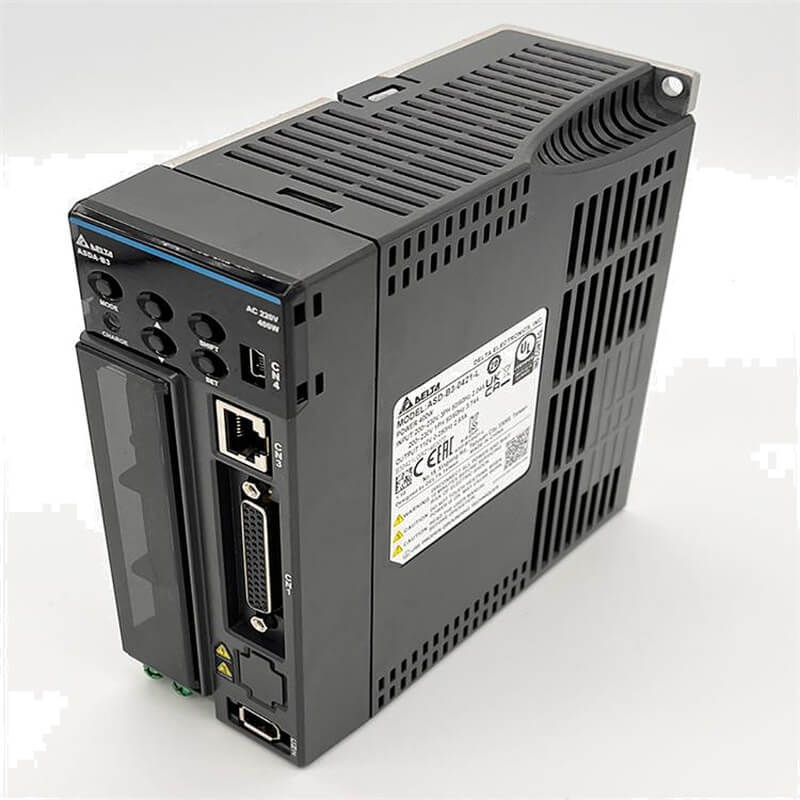
Delta ASD-B3-2043-M High Inertia Three Phase Servo Drive for Heavy Loads


The Delta ASD-B3-2043-M is a high-inertia, three-phase servo drive engineered for demanding industrial applications requiring precise control and robust performance under heavy loads. This drive excels in delivering superior torque response and stability, making it an ideal solution for complex automation tasks. Its core advantages lie in its advanced motion control capabilities, high power density, and reliable operation in challenging environments. Key technical parameters include a rated voltage of 200-240V AC, a continuous output current of 4.3A, and compatibility with three-phase AC servo motors. The ASD-B3 series, to which this model belongs, is recognized for its sophisticated digital signal processing and adaptable control modes, enabling seamless integration into a wide array of automated systems.
Product Specifications
| Feature | Specification |
| :-------------------- | :------------------------------------------ |
| Model | ASD-B3-2043-M |
| Input Voltage | 200-240V AC (Three Phase) |
| Output Current (Cont.) | 4.3A |
| Max Output Current | 12.9A (Peak) |
| Rated Power Output | 1.0 kW |
| Motor Compatibility | Three Phase AC Servo Motors |
| Control Modes | Position, Velocity, Torque |
| Communication | RS-485, CANopen (Optional) |
| Braking Resistor | Internal (for specific models/configurations) |
| Protection Features | Overcurrent, Overvoltage, Overtemperature, etc. |
Core Features & Market Positioning
The Delta ASD-B3-2043-M distinguishes itself through its exceptional performance in high-inertia applications, a critical factor for machinery requiring smooth acceleration and deceleration of heavy payloads. Its advanced control algorithms ensure precise positioning and stable operation, even under dynamic load conditions. Compared to standard servo drives, the ASD-B3 series offers enhanced digital signal processing for faster response times and superior vibration suppression. This positions the Delta ASD-B3-2043-M as a premium choice for industries where accuracy and throughput are paramount, such as in automated manufacturing, packaging, and material handling systems. Its robust build quality and comprehensive protection features also contribute to its market appeal, promising longevity and reduced downtime.
Key Application Scenarios
This servo drive is extensively utilized in applications demanding high torque and precise motion control, particularly those involving large rotational inertia. Common scenarios include CNC machining centers for precise tool path control, industrial robots for accurate pick-and-place operations, and automated assembly lines where consistent, repeatable movements are essential. Furthermore, its capability to handle heavy loads makes it suitable for printing and packaging machinery, metal forming equipment, and large-scale conveyor systems. The Delta ASD-B3-2043-M is an excellent fit for user searches related to "heavy-duty servo drives," "high inertia servo control," and "precise motion for automated manufacturing."
Practical System Integration Guidance
Integrating the Delta ASD-B3-2043-M into an industrial automation system requires careful attention to wiring and parameter configuration. Ensure the servo drive is connected to a stable three-phase AC power source within the specified voltage range. Proper grounding is crucial for electrical safety and signal integrity. When connecting the servo motor, verify that the motor's specifications (e.g., voltage, current, encoder type) are compatible with the drive's capabilities. Initial setup typically involves configuring basic motor parameters, such as motor poles and rated speed, followed by tuning the drive's control loop (PID parameters) to achieve optimal performance for the specific load inertia. Communication interfaces like RS-485 can be used for remote monitoring and control, requiring proper setup of baud rates and communication protocols.
Operation and Risk Mitigation
Safe and efficient operation of the Delta ASD-B3-2043-M hinges on adherence to operational guidelines and proactive risk mitigation. Always ensure the drive is properly grounded and that all power and control wiring is secure before energizing the system. During commissioning, gradually increase operational speeds and loads while monitoring drive performance and motor temperature to prevent overheating or excessive stress. Common fault codes, such as overcurrent (often indicated by a specific error code like E01 or E02), overvoltage (E03), or encoder errors (e.g., E05), signal potential issues that require immediate investigation. Always refer to the official Delta ASD-B3 series manual for detailed troubleshooting steps corresponding to specific error codes to avoid equipment damage and ensure personnel safety.
Scalability & Long-Term Value
The Delta ASD-B3-2043-M offers significant scalability and long-term value within an industrial automation framework. Its compatibility with a broad range of Delta AC servo motors allows for easy upgrades or modifications to meet evolving production demands. The drive's support for common industrial communication protocols, such as RS-485 and optional CANopen, facilitates integration into larger distributed control systems and supervisory control and data acquisition (SCADA) platforms. This inherent flexibility ensures that systems built around the ASD-B3 series can adapt to future technological advancements and the increasing trend towards Industry 4.0, enabling seamless integration with IIoT solutions for predictive maintenance and enhanced operational insights.
Frequently Asked Questions
Q1: What is the maximum motor size compatible with the Delta ASD-B3-2043-M?
The drive's output current rating of 4.3A continuous and 12.9A peak, along with its 1.0 kW power output, dictates compatibility with AC servo motors within a similar power and current range. It is crucial to match the motor's rated voltage, current draw, and torque characteristics to the drive's specifications to ensure optimal performance and prevent damage. Always consult both the servo drive's and the servo motor's datasheets for precise compatibility information and recommended motor models.
Q2: How do I connect an external braking resistor to the ASD-B3-2043-M?
While some ASD-B3 models may have internal braking resistor capabilities for specific applications, many require an external braking resistor for high-inertia loads to dissipate regenerative energy. The drive typically features dedicated terminals for connecting an external resistor. Ensure the resistor's power rating and resistance value are within the range specified in the servo drive's manual to effectively manage braking energy and prevent overheating of the drive or resistor. Incorrect resistor selection can lead to fault conditions or drive failure.
Q3: Can the Delta ASD-B3-2043-M be used with single-phase power?
No, the Delta ASD-B3-2043-M is specifically designed as a three-phase servo drive, requiring a three-phase AC power input ranging from 200-240V. It cannot be operated directly from a single-phase power supply. Using it with a single-phase source, even with a converter, is not recommended and will likely result in damage to the drive due to insufficient power phases and potentially incorrect voltage or current delivery. Always ensure the power source matches the drive's three-phase requirement.
Q4: What types of control modes does this servo drive support?
The Delta ASD-B3-2043-M supports versatile control modes essential for a wide range of automation tasks. It offers precise control in position mode for accurate positioning applications, velocity mode for speed-regulated operations, and torque mode for applications requiring controlled force or tension. This flexibility allows users to select the most appropriate control strategy based on the specific requirements of their machinery, from high-speed pick-and-place to complex winding operations.
Q5: How do I perform basic parameter configuration for a new motor?
Basic parameter configuration involves inputting the servo motor's fundamental specifications into the drive. This includes details such as the motor's rated voltage, rated current, number of poles, rated speed, and encoder resolution or type. Accurate entry of these parameters is critical for the drive to correctly identify motor characteristics and execute accurate control algorithms. Refer to the motor's nameplate or datasheet for these values and consult the drive's manual for the specific parameter numbers to adjust.
Q6: What are the benefits of using a high-inertia servo drive?
High-inertia servo drives like the ASD-B3-2043-M are designed to manage and control machinery with significant rotational mass. They excel in applications requiring smooth acceleration and deceleration of heavy loads, preventing jerky movements and maintaining stable operation. This capability is crucial for achieving high precision, reducing mechanical stress on equipment, and improving overall system performance in demanding industrial processes.
Q7: What communication protocols are supported by the ASD-B3-2043-M?
The Delta ASD-B3-2043-M series primarily supports RS-485 communication for industrial networking and control. Additionally, it offers the flexibility of optional CANopen communication modules. These protocols allow for seamless integration into supervisory control systems, enabling data exchange, remote monitoring, and coordinated control of multiple axes or machines within a larger automation network.
Q8: What does "high inertia" mean in the context of a servo drive?
"High inertia" refers to a system or load that has a large resistance to changes in its rotational speed. Loads with high inertia, such as large flywheels, heavy robotic arms, or large spools of material, require more torque and time to accelerate or decelerate. A high-inertia servo drive is specifically designed with advanced control algorithms and robust power components to effectively manage these larger inertial forces, ensuring smooth, precise, and stable motion control.
Q9: What are common troubleshooting steps for an overcurrent fault (e.g., E01)?
An overcurrent fault typically indicates that the motor is drawing more current than the drive can safely supply, often due to mechanical binding, excessive load, or incorrect motor/drive parameters. Initial troubleshooting involves checking for any mechanical restrictions in the system, ensuring the load is within the motor's and drive's capabilities, and verifying that motor parameters are correctly set in the drive. Inspecting motor wiring for shorts or loose connections is also crucial.
Q10: How does the ASD-B3-2043-M contribute to energy efficiency?
While servo drives inherently consume power, the ASD-B3-2043-M contributes to energy efficiency through precise motion control, reducing wasted energy during acceleration/deceleration. Advanced features like regenerative braking (when configured with appropriate external components) can capture and reuse energy that would otherwise be lost as heat, further optimizing energy consumption. Precise torque control also prevents over-application of power, leading to more efficient operation.